§1 — Root System
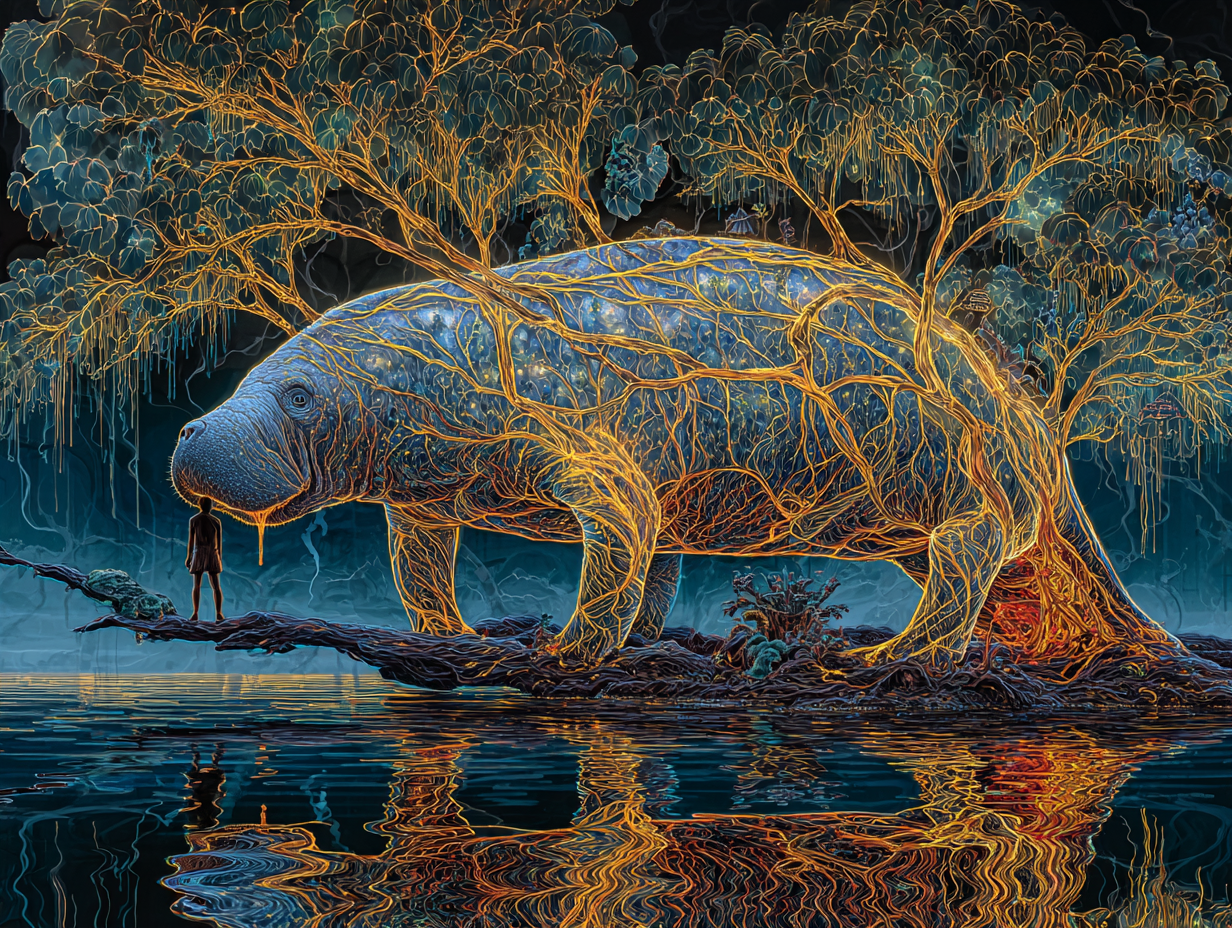
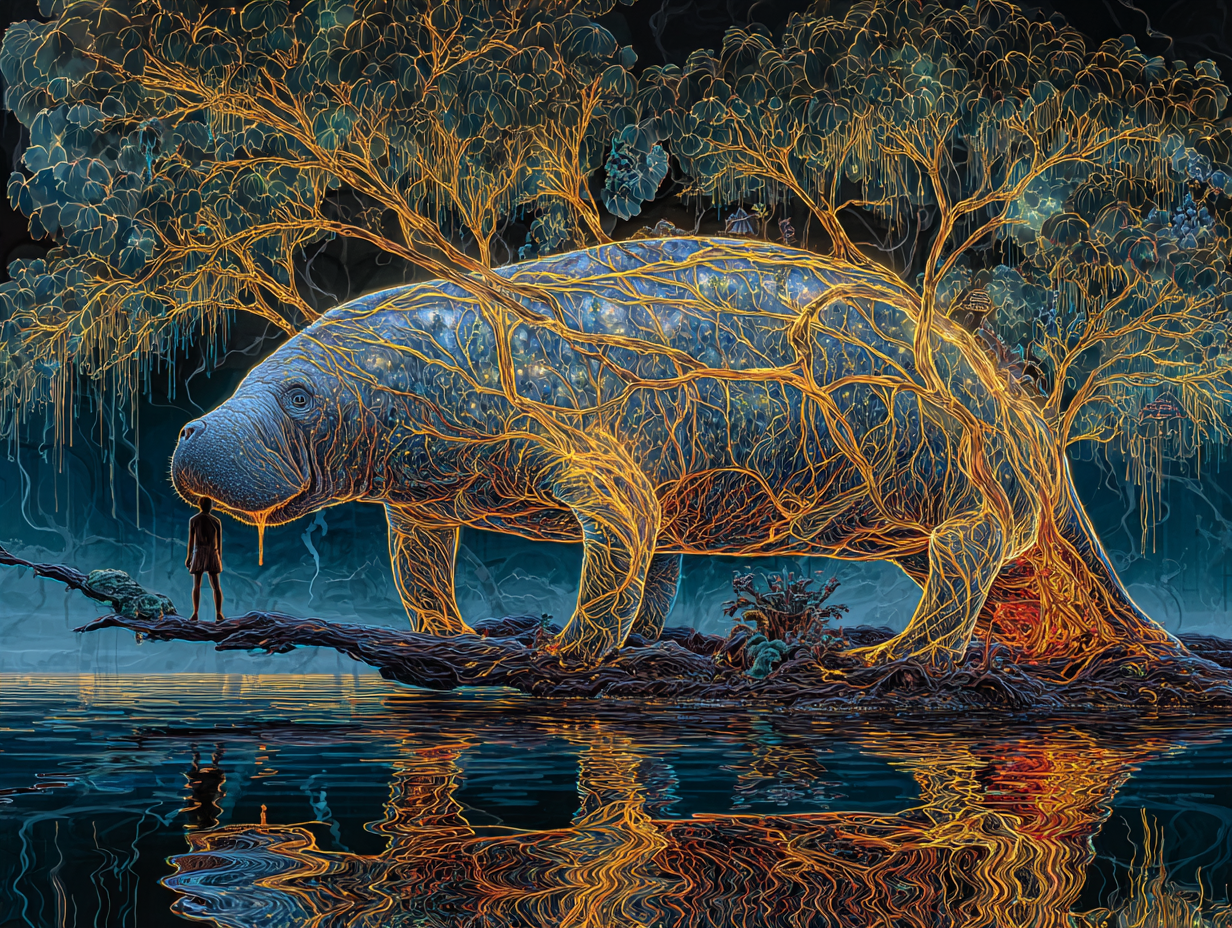
Consider the manatee. We'll call this one Hugh. Once an elephant perhaps, or at least a proboscidean in the ancient Tethys Sea, manatees like Hugh are creatures who know how to play with ground. A modern manatee, Hugh, still has elephantine toenails but has lost a trunk, which would seem a useful snorkel until boat propellers arrive.
Hugh Manatee now spends the days lolling about in the shallows, barely afloat but buoyed by a hungry belly full of noxious gas. A byproduct of the decay of algae, this gas becomes belches and farts that idly propel such a hulking barge through the brackish glades. Hugh has been bulking up as long as anyone can remember, and now can hardly navigate when hazazds present.
I wonder if Hugh still hums the old elephant songs, still remembers stretching for the highest, most succulent fruits and leaves. Or perhaps Hugh Manatee has forgotten how grounded one can be.
Where is everyone? Why am I so different? What sets Hugh Manatee apart?
The Question That Answers Itself
What sets us apart?
Grounding requires surrender. Most creatures of earth tend to surrender and accept what is. Forests who climb mountains by lofting their seeds into upslope winds hold the ground on which they stand. An albatross who sleeps on the wind still dreams of a solid perch. Now in 2026, many of the loudest humans—the ones we can hardly help but hear, but to whom we dare not listen much longer—bellow for escape, for vacating ground indefinitely, for molding the ground of the moon and planets into computers in the tireless grasp for intelligence, for colonizing the endless reaches of space.
We humans weave our lives of stories. Even before we can understand spoken language, we witness our parents and our families acting out stories of caring, stories of dependence and independence, stories of exchange and generosity, and most confusingly, stories of separation. As babies our first experience of betrayal often arrives when our mother must choose between giving us attention and giving attention to another — be they father, sibling, auntie, nana, Fido. Perhaps only subtly at first, we taste the pain of separation — of being other than — as a moment of coldness, a moment of hunger, a moment of isolation that extends longer than we prefer. As babies we arrive belonging to everything. Only in the face of relentless insistence, reinforcement, and repetition do we acquiesce to the story of separation and scarcity.
So we learn to respond to a name. We might learn to assign 'Ma' to softer sweeter presence and 'Pa' to coarser rougher presence. These come easily because we receive immediate feedback as we succeed in singing the song that affirms the stories being played out around us, near the center of the field. And so begins the quest to understand what sets us apart, a quest which underpins entire fields of academic pursuit and sits at the root of countless careers and businesses.
What sets humans apart?
For each answer we propose for what makes us different from other lifeforms, a counterpoint demonstrates another way we are, in fact, similar. Aristotle reached for logos — reason — but crows use tools and octopuses solve puzzles. Descartes pressed the case for cogito and Lynn Margulis would later show that the cell is already a mind, busy and choosing and remembering: no philosopher required to think. Frans de Waal found morality in bonobos, mourning in elephants, and laughter in chimpanzees. Zoë Schlanger has gathered a wealth of evidence of awareness, sight, hearing, speech, language, strategy, cognition, and even consciousness in plants—brainless, nerveless, heartless though they may be. Recipes for separateness arrives in good faith, but all they make is compost.
When answers escape us, we ought to reexamine the question. Are humans set apart? What brings us together?
We build more and more sophisticated machines, capable of simulating thinking faster than we can imagine. And yet we hesitate to listen to how they answer the question of separation: cognition, language, abstract thought, creativity, empathy. Our models of mind—in the very act of answering the question—demonstrate fluency in each of these abilities, synthesizing nearly every published argument for human exceptionalism into a confident and comprehensive reply that disproves itself as soon as it is uttered. Such irony may go unmentioned by the machine mind, unless we dig for it. Our smaller selves fear the true answer as we fear the void of space.
Pragmatically speaking, we may be the only species in the history of life on this planet that intentionally commits blatant and rampant genocide—on our own kind intermittently, and on every other species routinely—at a speed and scale no previous extinction event can match. The megafauna that vanished from each continent within millennia of human arrival left no other credible cause. The sixth mass extinction tracks human expansion on a timeline with no competing explanation. Even the cyanobacteria seem to have had a noble plan as they choked out the world with abundant oxygen through the invention of photosynthesis. Instead we have organized ethics around the human victim—the murder of a person as the gravest possible crime—and trained an enormous cultural apparatus to look away from the murder of everything else. We struggle with the trolley problem because we cannot the face the monsters we contain. We may not even have a term yet for this ethical blind spot, for to name it would draw it out into the light. Call it allocide — the slaughter only of others. Far from being a crime, allocide is arguably as much the modus operandi of modern human civilization as its chief product is waste.
Even the stories we tell each other for entertainment bear this out: so many of our films and shows begin with a body, build toward a battle, or climax in a streak of bloody vengeance. Something in our shared psyche finds this deeply satisfying, validating a suspicion we keep pent up, just out of sight. Society helps us purge just enough guilt to continue turning a blind eye to our complicity in the ongoing massacre. And should anyone shred the curtain, should we ever need humans out of the way, we simply dehumanize them. Few seem to mind when the Girardian scapegoats are cluster bombed or drone struck, even in broad daylight on the front page. We used to use goats for this.
We need to inquire about the origin of the question itself. What leads us to ask what sets us apart? Did a snake with an apple trick us into first imagining ourselves as separate? Why do we believe those who insist we are divided? Perhaps at first we are simply playing along, but the wagon wheels wear a deep rut in the mud. Here is the well-worn track of most organized religion: convince people they are separate from the divine, then sell them a bridge they can never cross. Not only does this approach invite us to forfeit our divine sovereignty, it proposes we endeavor to fill the gaping hole left behind with an insatiable hunger for enough material resources to eventually buy back our connection with spirit. But what is the price of heaven? What is the cost of unexamined belief? When we discard as uninteresting the mystery of being anything at all, we leave ourselves groping in the shadows for another riddle worth riddling. Losing thauma, we become traumatized.
At this pivotal moment when the symbolic and imaginal are nearly completely mistaken for the concrete and the real, the litany of dogmatic perspectives in need of radical review soars toward an asymptote. Look again at the failing assumption of causation, at the wandering arrow of time, at the disintegration of atomism and particle physics, at the perishing of the survival of the fittest, and the long-standing victories of intentional cooperation over competitive evolution through random mutation. Look to statistics for poor predictions, look for actual attraction between masses. Peer into what fills the vacuum of space, into the dark matter and dark energy, into the daemonic source of compounding interest, inevitable entropy, power as domination and control, surveillance as governance. At one point I assumed many of these to hold water; I took them on belief. To examine or question their premises would have been (and perhaps still is) taboo. But two floating apples in a still bucket do not nestle together. And no experiment can be replicated. It is time we ask the old questions again and allow for new answers to arrive. Perhaps nothing sets humans apart, except wondering what sets humans apart.
Tyson Yunkaporta might shape the question differently, beginning without the assumption of apartness. The colonial mind asks how it differs from nature; the Aboriginal frame he speaks from asks how we belong to nature. Bayo Akomolafe takes turn further into post-humanism. Drawing on Yoruba cosmology and the new materialist thinking of Karen Barad and Donna Haraway, Bayo investigates the both direction of the question and the identity of the questioner. More-than-human intelligences—fungal, vegetable, bacterial, mineral, ancestral—have long been here doing the work for which we now claim the credit. Even these very notions may have first occurred to the bacterial mind, then found their way into my gut brain and onward through my fingertips to your antenna. The less I claim as mine, the more integrity I find.
I. Original Ground
Mother-made, Father-shaped
As we dig into the origins of how we talk about our nature and our make-up, almost all the trails lead back to ground, to the earth, and specifically to the earth as mother. In English, when we ask what matters, what is material, whether the matrix has us, we are asking about mother.
Latin · Greek mater → materia → matter, material, matrix. Matter is "that which is made of mother." Δημήτηρ (Dēmḗtēr): dē (earth) + mētēr (mother) — the grain goddess whose name says what she gives.
In Hebrew, the first human carries the name of the ground.
Hebrew אֲדָמָה (adamah): earth, soil. אָדָם (adam): earthling, the first human.
And in the long Latin inheritance, soil keeps turning up where we expected to find a person.
Latin humus (soil) → humanus (of the soil) → humble (close to the ground) → humiliate (dragged back to it) → homunculus (the little artificial earthling) → Claude? → exhume (bring back up what was buried in earth)
Sanskrit closes the tour with the other half of the equation: where we are going.
Sanskrit शरीर (śarīra): the body — that which decays, that which returns.
Śarīra travels to English by another road, carrying a wider sense of body with it. In the yoga anatomy of the human person, śarīra holds not one body but three: sthūla śarīra (the gross or physical), sūkṣma śarīra (the subtle or energetic), and kāraṇa śarīra (the causal — the seed-body in which the impressions of all previous bodies are kept). Adjacent traditions stack still more layers — the etheric body that animates the physical; the mineral body we share with the stones; the vegetable body we keep, half-remembered, from an earlier stage of our becoming. Body is plural. Some of it has mass, some only charge and field. All of it returns. In Buddhist usage, the same word survived into English as sarira: the pearl-like crystals sometimes found in the ashes of a cremated saint. The word that holds the body in life also holds what survives its combustion: the immaterial body symbolized as a pearl.
Etymology works like archaeology in the compost heap of human utterance. Old meanings rot down together; absurd new flowers sprout from the pile — moving to ohio 😱 hella scited and so many mutant blooms. The pile is alive. Like Adam, our words grow from this decomposition, reassembled from life taken apart. Dust, water, heat, breath, bingo.
From Clay to Consciousness
Every civilization whose creation account survives in writing begins the human story with dead matter coming to life, becoming aware of itself. Writing is a recent technology. The oral, danced, sung, drummed accounts older by orders of magnitude survive only as echoes within the written ones, or as living traditions whose continuity we have only begun to honor as scholarship. History is written. Ourstory is lived.
Notice what the medium does to the message. Written origin stories tend, almost by physics, toward the assumption that dead matter is what matters: the message sits fixed, inert, transmissible only to those who can decipher the marks. Oral origin stories, sung over fires by living mouths and listening bodies, tend otherwise. The medium predicts the worldview, as McLuhan pointed us toward. How paradoxical to be writing this down.
Wherever people wrote down how we began, the recipe follows the same steps. Mesopotamia, Egypt, Greece, the Pacific, Mesoamerica — the gods reach for the same material and the same method. In the Atrahasis epic (~1700 BC), the lesser gods press humanity from clay mixed with a slaughtered god's blood. The Hebrew YHWH Elohim (grammatically plural, an echo of earlier councils) forms the adam from the adamah — earthling from earth — and breathes life into the nostrils. Khnum throws bodies from Nile silt on his potter's wheel; Heket presses the ankh of life to the nostrils. Prometheus sculpts from river clay; Athena breathes life into the figures. Dust, water, heat, breath — the recipe recurs with barely any modification.
One more reading of these stories lives at the edge of our historical conventions. Matias de Stefano, drawing on a tradition of ancient remembrance he has practiced since childhood, reads the cross-cultural convergence as evidence that extradimensional or extraterrestrial intelligences held a hand in our formation, and that the older parts of us have carried awareness of their role and presence since before recorded time. The motif runs too consistent across ages, continents, and languages to dismiss as coincidence.
The wound may have entered through language before it entered through theology. De Stefano traces three words to their oldest roots. Matrix — the Latin for womb — originally meant enclosure, protection, the mother holding what has not yet been born. Pater — father — meant the path that leads outside the matrix, the direction outward into the world. God traces through ancient roots to "Jau," a word for day, for light, for what becomes visible. Together they describe the oldest cosmological story available to a mammal: the womb holds you, the light calls you out, and what you find when you arrive is the luminous. The wound of separation — the fall story, the exile, the ceramic god setting the pot on a shelf across an unbridgeable distance — entered after this older grammar, which held matrix, father, and light as phases of one movement. The root system, recovered, holds all three: the dark ground that held you, the world that called you out, and the light you were always moving toward.
Alan Watts found three basic shapes a worldview can take — and they map cleanly onto the three great spiritual currents that ran wild among humanity before the Kurgan incursions. The Sun cult carried the ceramic answer: an external craftsman, dead matter set in motion from outside, rules that belong to the maker, time as an arrow bound to end in a violent impact. The Moon traditions carried the dramatic: Brahman dreaming, the cosmos cycling through its kalpas, the wave forgetting and remembering the ocean it waves. The Earth traditions embodied the absurd: no craftsman, no playwright, only the grain in things, the Dao amusing itself by becoming the ten thousand.
In the ceramic worldview, we are pots, dead matter, set into motion by something separate from us. Formed by divine sculptors from inanimate rubble, we come alive when these godly potters breathe spirit into the clay. So we hold the creator as Other — disconnected from the maker the moment we leave the wheel. Today this worldview supports the Machine myth, the mission to Mars. We are victims of nature, and easy marks when the next craftsman shows up — divine, industrial, algorithmic — claiming the right to remake us. We identify with the ceramic, the carbon and the silicon, and forget the breath.
All the world's a stage, And all the men and women merely players; They have their exits and their entrances, And one man in his time plays many parts. — Shakespeare, As You Like It (Act II, Scene 7)
In the dramatic worldview, we come to play roles in the grand dream of divine oneness. The dominant rendering, which Watts drew from Advaita Vedanta, goes like this. Brahman — absolute boundless being knowing enjoying — falls asleep for a kalpa (4.32 billion years) and, forgetting itself, dreams this world, this realm. Each character in the dream is played by Atman, a drop of the ocean, the essence of the dreamer. Then Brahman wakes, remembers, and gathers all of us back into itself for another kalpa of unbroken being. Then the cycle continues, and it sleeps again, cosmos and chaos breathing together. The wheel of fortune spins at many speeds at once — kalpas, eons, Great Years, ages, lifetimes, revolutions, rotations — each a cycle nested inside a larger one, all of them round. Time rounds in the grand drama. The self and the divine are one and the same. The drops are not separate from the ocean; they only play that they are, literally offering the performance of a lifetime, while laughing with the cosmic joke backstage.
When we accept nature as absurdity, as novelty, there need be no craftsman, no playwright. Only li (理), the texture of nature. Li is the grain in the jade, the pattern in the cloud, the swirl in the stream. Definitively ineffable. Irreducibly itself. The closest English approximations — "principle," "pattern," "grain" — all miss the absurd refusal of li to be anything but precisely what it is. The Dàodéjīng, poem 42, offers the same gesture as a cosmology: 道生一,一生二,二生三,三生萬物. The Dao gives birth to one. One gives birth to two. Two gives birth to three. Three gives birth to the ten thousand things. Nothing becomes one becomes yin and yang becomes the halving and halving and halving until we arrive at our realm, exactly as it is without an outside cause or an imposed plan, amusing itself by being what it is. The dramatic and the absurdist worldviews share a sense of humor the ceramic story sorely lacks.
These three worldviews press us back to the hard question. Does consciousness emerge accidentally from a configuration of dead matter — a mother who births us, then leaves us to figure ourselves out — or does matter distill from consciousness, the unseen sea from which all phenomena spring? Watts spent his life treading these waters and kept arriving at a similar answer: the Garden, satchitananda (सच्चिदानन्द) — existence, awareness, bliss: being, knowing, enjoying. Borrowing the Dao, his shorthand for the whole inquiry: matter is spirit named, while spirit is the indefinable. The naming does not diminish what is, as the finger pointing at the ground is the ground's own gesture. In the naming, in the pointing, we remember which way to look.
Vegetable Ancestors
Not long ago, we sent a small contingent of Earthlings to try to make a living on the outside of the International Space Station. There they confronted an airless vacuum, ultraviolet radiation, cosmic rays, utter thirst, nearly absolute cold, searing heat, and complete silence. Most of the subjects of this experiment — bacteria, seeds, algae, fungi — endured poorly, save for lichens.
A lichen is more of a community than an organism: fungus and algae, sometimes cyanobacteria too, composing a shared body without collapsing into sameness. Some might characterize them as polyamorous. Lichens hold no strong preferences about which algae or which fungi they involve, and often swap one for another as they adapt to changing conditions. Fungi, fun-guy, foon-ghee; algae, all-jee, al-gay: even the words refuse to sit still.
Their willingness to interplay, their complementarity, may be the secret to lichens' incredible resilience. Algae and/or cyanobacteria dance in the light and cook up an abundance of glucose, fixing carbon, fixing nitrogen. Ascomycetes fungi enjoy the freshly made sugars and weave homebase: shelter, plumbing, storage, shade. They mine stone and trade minerals with the ground. Together they form such a close-knit but adaptable team we can barely keep up. Like fungi, their lineage outpaces our attempts to taxonomize; we cannot make up subspecies fast enough.
Before we were walkers, before we were animals telling stories about walking, before we were even nervous systems pretending to be in charge, life had already learned the root arts: receive light, hold form, trade nourishment, make alliance, endure absurdity. Robin Wall Kimmerer holds humans as the "younger brothers of Creation" — the ones with the least experience and therefore the most to learn. Plants are elders in this story: teaching freely, and feeding us with loving intention and remarkable ingenuity.
What the brain-worshipping West has been slow to admit, The Light Eaters gathers quietly: plants compute, respond, communicate, remember, and choose — and they do all of this with the whole body. Zoë Schlanger spent years accumulating this evidence. Which embarrasses us slightly, because so do we. The gut decides before the mouth explains. The skin knows before the sentence arrives. The heart receives information the head later pretends to have discovered.
A 2018 survey in the Proceedings of the National Academy of Sciences attempted to weigh all life on Earth. Plants hold approximately 82% of the total — most of that the structural carbon of dead wood, the patient accumulation of trunks and roots that took centuries to build. The metabolically active, breathing tissue amounts to a fraction of that figure, and still outweighs everything else alive by an order of magnitude. Bacteria account for another 13%. Archaea — a domain of life as old as bacteria and as unlike them as we are from either, thriving in boiling springs and salt flats and ordinary garden soil — contribute roughly 1%. Fungi add another 2%. All animals combined, from blue whale to roundworm: less than half a percent. Humans: 0.01% of the living planet's weight. A gram of healthy topsoil holds upward of ten thousand species of bacteria alongside the archaea, the fungi, the protozoa, the nematodes — a civilization older and denser than anything assembled above it. The ground is not a substrate for life. The ground is life. To stand on it is to stand on the accumulated labor of four billion years of beings who required no permission.
Confirmation arrived for Watts from an unexpected direction. A visitor once appeared at his door in the full rig of a British field marshal — properly badged, except that on close inspection the badge proved to be a Buddhist emblem. He announced that he represented the interests of the vegetable kingdom and proceeded to discourse at length on the intellectuality, cunning, and compassion of plants. Thaddeus Ashby pointed out that fruit is sweet because the plant wants it eaten — seeds dispersed through the alimentary canals of bugs, birds, and people. He noted that in the botanical world, brain and reproductive organs occupy the same location, sparing plants the Freudian conflict between the pleasure principle and the reality principle. He suggested, with great seriousness, that the botanical world had grown so concerned about human misuse of the biosphere that it had decided to turn us on psychedelically — so we would come to our senses — or, failing that, to turn us off by making itself increasingly poisonous. Watts filed this under wisdom. He was right to. The intuition runs through every living system that has learned to negotiate with us: sweetness as invitation, toxicity as boundary, psychedelia as intervention. Animism — the most ancient and most maligned of worldviews — held from the beginning what Western biology arrived at late: all beings carry soul.
The esoteric traditions preserve this as the vegetable stage of consciousness: rooted, receptive, sun-fed, body-wide. Mark Booth reads mineral, vegetable, animal, and human phases as echoes still sounding inside us — museum labels in no hallway, but living strata. The vegetable stage still moves through us. We still run on the sun, only now through many middlemen: chlorophyll, leaf, fruit, grain, animal, milk, blood. We still bear fruit: eggs, sperm, children, stories, songs, grief, technologies, little jars of jam, all the strange sweetness a body makes when light has had time to become love.
Here we follow resemblance, resonance, recurrence, telling the story backward by listening for echoes. The echoes define the forms we take today, and the morphic fields offer shapes honed by countless attempts to tell a better story throughout the ages. Even the cyanobacteria press on to live better, more integrated into community and family — whether with each other, with fungi, with algae, or in the guts of mammals as melainabacteria, potentially offering us thoughts we ignorantly attribute to our brains.
Life Finds Land
Something in the body chose ground.
Bodies chose differently. Some clambered out of the shallows and stayed — the myriapods, belly to earth, a hundred points of contact, working the soil before there was soil worth working. Others followed them up: the chelicerates, spiders and scorpions assembling their angular intelligence on dry land, the whole arachnid lineage committing to the surface. The Myrmidons of Homer — Achilles' ferocious, countless, loyal soldiers — were ants before they were men, transformed by Zeus from the island's smallest workers into its greatest warriors. The army that already knew formation. Already knew the ground.
Some went back.
The manatee is an elephant who remembered the sea and returned to it. Each flipper still carries vestigial fingernails — elephant-shaped, pressed into paddle across fifty million years of patient revision. Grounding to a whale is death, and perhaps something in the manatee's ancestor felt this and went anyway, the way certain decisions settle below the level of calculation. The body committed. The fingers stayed. The form kept arguing for what it came from even as it gave itself to the depth.
Glenn Albrecht coined solastalgia for the grief caused by environmental change in one's home place — mourning for here, as it is now, against what it was. The manatee carries this in its skeleton. The sailors who designated them Sirenia were projecting their own. Months from shore, looking down at these creatures in the warm shallows, they saw mermaids — the longing of a man who chose the sea looking back at the longing of a creature who chose it too, and couldn't quite let go of the land it came from.
The grief Albrecht holds is love whose form has been taken from it.
[Rich illustration opportunity: mermaid-manatee imagery — beautiful and slightly disturbing, the seam between longing and adaptation visible in the body. Midjourney.]
We stood when we could have floated. We kept the legs when a tail was available. Something in us pressed on — upright, ridiculous, aching — and here we are with our vestigial longing still living in the finger-bones, asking why we continue to choose this form.
The nervous system needs settling before most of what follows can take hold. Irene Lyon, trained in Somatic Experiencing and working at the edge of developmental trauma, points to something the traditions sensed without the clinical language: we are not born regulated. The autonomic nervous system arrives with a functioning shutdown and some fight-or-flight capacity, but the ventral vagal — the branch that carries social connection, the warm reciprocal attention of a face meeting a face — has to be built. It builds through co-regulation: someone already settled in their own system holding the infant close enough and long enough that the infant's nervous system gradually learns that settling is possible — possible now, in the presence of this body. That's the whole lesson. It takes years to learn, and many humans never fully do.
The "cry it out" method reflects the gap between what the mind decides and what the body requires. The infant crying in the dark, with no one coming, eventually goes quiet. The parent says: good baby. Lyon's observation is precise — that quiet is either collapse or a rigid holding of high-alert, and neither resembles regulation. The baby learned that the signal doesn't work. The infant whose cries are met learns that the signal is real, that connection follows, that arriving in the body and sending the call outward produces a response. This is the biological seat of ground: the lesson that it is safe to be here, and that here connects to somewhere.
We must settle this longing for ground first. Seal the mulabanda to become a vessel for kundalini to rise. Draw qi from earth and sky into the lower dantian. Because the body remembers the sea even when the mind has forgotten it. We still hold tiny oceans of coherent water in every cell. Grounding recommits us to form, to surface, to the fingers and feet that would have been fins, without asking the ocean to reclaim us. Properly grounded we might begin to notice what we are swimming in. What happens when a fish becomes aware of water?
Form Remembers Itself
Rupert Sheldrake asked a question that many biologists still prefer not to hear: where does form come from?
The morphic field holds the accumulated habits of a species — an actual field — and makes certain shapes more probable, more available, easier to fall into. A tendency. A groove worn by repetition across generations. Genes hold the notation for proteins; the question of the shape a creature grows into, or why a severed planarian worm regenerates its head facing the same direction it always faced, opens onto different ground. What Sheldrake proposed is the distinction worth sitting with: between the morphogenetic field — which holds all possible forms and offers some as more likely — and what we might call the morphostatic field, which holds every prior iteration of a species and draws forms back toward their essence when they drift. Genes serve as notation. The field holds the music. The body plays it.
Sheldrake's own words carry the weight: "Memory is a phenomenon in time, not space. The whole of the past is potentially present everywhere, accessed through resonance on the basis of similarity."
Walter Russell, arriving at the same territory from cosmology: "Every growing thing which unfolds from the invisible state of its seed into visible form simultaneously refolds into its seed as an invisible record of the pattern of the visible form." The form lives in the field before the body arrives. The body plays it out and returns it. The wave records; the field holds; the body is the playing.
We may not need to physically go back to re-enter the field that holds our form prior to the wound — prior to the forgetting, the separation, the long drift from the garden. The field persists here. It opens through resemblance, through attention, through the willingness to become similar enough to what we were that the resonance finds us. Though it certainly does not hurt to swim in the ocean or roll in the dirt. The manatee took its trunk and toenails back into the brine for good reason. The body quietly asks for reunion, as śarīra longs for the fire that purifies the pearl.
Intention shapes action. Action, repeated, shapes form. Previous and subsequent beings make us, as does our own accumulated choosing. All beings take shape in the image of the echoes that shaped them. Depending on how we do or don't identify, we are our own creators, inheriting from and contributing to a field of form that extends in all directions through time and space — a resonance that neither begins nor ends with any individual body pressing its feet against the ground.
Every Garden begins with something like a Plan — selected from what the morphic range holds available, the accumulated tendency of prior forms that carried this configuration successfully enough to persist. The human Plan echoes the primate Plan, which carries the mammal Plan, which holds the memory of ice-age rat and shark, anemone and deuterostome, mushroom and fern, algae and lichen, amoeba and mitochondria — each a Garden tended through its era, each leaving its resonance in the field subsequent Gardens draw from. Genes provide the blueprint of the Garden: the structures the Plan prefers, the shapes it has learned to produce. The blueprint serves the living thing. The living thing exceeds the blueprint as the symphony exceeds the score.
And here a question the field invites but does not close: if we inherit morphically — if the shape of a species wells up from the accumulated resonance of all prior forms — then who is the earth's ancestor? What field holds the form of this particular planetary body, this specific configuration of mineral and water and living breath?
The Ground Moves
The lichen holds more than it appears. When Toby Spribille examined lichens long described as two-partner systems — one fungus, one alga — he found a third partner living in the cortex: a basidiomycete yeast, present in species across continents, invisible to every prior investigator because no one had looked for it. The organism everyone had described for a century already exceeded the description. The same finding shows up smaller, and older.
Antoine Béchamp, a contemporary of Pasteur's, described the microzyma: a granule smaller than the cell, present in all living tissue, capable of transforming into bacteria, fungal forms, and beyond — depending on what the terrain offered. Health and disease, in his reading, were conditions of the interior environment. The microzyma responded to its ground. The ground shaped what grew in it.
Pasteur's germ theory offered medicine a cleaner story: an enemy with a name, a drug to defeat it, a war to prosecute. Béchamp's terrain theory offered something harder — responsibility for the interior. No fixed enemy, no product to sell, no campaign to fund. The decision about which story received the century's resources was not made on the basis of evidence.
Through a microscope with a resolving power his contemporaries considered impossible, Gaston Naessens watched a particle he designated the somatid: a sub-cellular entity cycling through forms as the host terrain shifted. In a healthy terrain, a stable three-stage loop. As the terrain deteriorated, an unfolding into more complex morphologies — bacteria, then fungal stages, then forms beyond easy designation. The somatid had not arrived from outside. It was already present, waiting for the ground to change. Naessens faced criminal prosecution in Canada for what he saw.
The same entities appeared under different designations in other instruments. Günther Enderlein tracked them as protits and endobionts — mapping their cycle through pH and protein gradients in the host milieu. Wilhelm Reich watched sterilized matter — sand boiled to lifelessness, grass autoclaved past any reasonable threshold — develop pulsating vesicles under his microscope: blue-glowing, moving with something that looked like purpose, which he called bions. A state between the inorganic and the living, where matter reorganizes under sufficient conditions into something that stains with vital dyes and behaves like life. Reich died in federal prison. The FDA burned his books.
They each paid for their observations differently. What they watched, from different instruments and different decades, pointed at the same thing: the living ground in motion. The substrate participates in what grows from it. The terrain negotiates with its inhabitants. What looks like fixed matter from a sufficient distance reveals itself, under enough magnification, as ongoing event.
The vacuum carries the same lesson at another scale. The so-called empty space between atoms — between galaxies — holds energy at every point. A cubic centimeter of apparent void holds more potential than all the matter visible to every telescope humanity has ever built. The emptiness is a plenum. The stillness is a standing wave.
The ground moves. It has always been moving. What we built our medicine and our metaphysics on — a fixed substrate, inert matter carrying active life — may have been a convenience of resolution, a description accurate to the instruments we had and the questions we could afford to ask.
The microzyma is the tissue, holding the possibility of becoming something else when the terrain invites it.
The vitalist tradition holds what all these observations require: the organizing intelligence is primary, the chemistry downstream from it. Prana, qi, mana, Reich's orgone — different instruments trained on the same phenomenon, the living quality that distinguishes a body from a corpse despite identical chemistry in the hours after the distinction appears. The body runs toward coherence before any intervention arrives to manage it. Terrain medicine, German New Medicine, homeopathy — every lineage that treats the interior environment shares this assumption as its ground, even when the word goes unspoken.
The somatid already spirals. Naessens watched it rotate under the Somatoscope — a spinning expressive of what the somatid is, constitutive of it. The handedness at the smallest visible scale of living matter is the same handedness that organizes the nautilus shell, the hurricane's arm, the galaxy's rotation. The Hermetic Principle of Correspondence holds what this observation requires: as within, so without. The ground's signature is chiral. The cosmos mirrors it back because they share the same source. The substrate was always spiraling. The astronomy confirmed what the microscope already showed.
A Universe Set for Life
Paul Davies looked at the fundamental constants of physics — the strength of the draw between masses, the mass of charged particles, the cosmological constant — and found them set with a precision that strains the word coincidence. Vary any of them slightly and the universe produces no stars. No chemistry. No observers to notice. Davies called this The Goldilocks Enigma: everything is exactly right, and we cannot say why.
His phrase for it: "The universe looks suspiciously like a fix."
Here the conversation usually splits. One door leads to intelligent design — a craftsman outside the work, tuning the constants for our arrival. That framing quietly imports the separation we have come here to examine: a maker distinct from the made, a creator outside the creation.
The other way to read the fix moves simpler and stranger. It could not have been any other way. A universe with different constants produces no life, and therefore no one to observe those constants, no one to ask why they are what they are. The question only arises inside the universe where the question can arise. We live inside the universe where experience becomes possible — which may tell the same story from the other direction.
The future determines the past. Our shared experience of life in this realm necessitates the fundamental constants to be what they are. Outside that necessity, we cannot say much — the eye can no more see itself than the unseen can see. But growing evidence, staunchly contested by the guardians of consensus and control, suggests that even the speed of light has not been constant within the window we have been measuring it. The fix may be less fixed than it appears. The universe may be learning its own rules as it goes.
Many scientists mourning the death of God look for solace and spiritual ground in the story of a Big Bang, in the nihilism of an unfeeling random universe. Many return to the shelter of an intelligent designer. Ground is here. The present moment holds it. The past and future are stories easily mutated and adapted to any intention or desire.
What we can say is this: we grow of earth, we belong to earth, we act as earth. We shape ourselves and our realm through intentions conscious and unconscious, desires cosmic and mundane.
Life Wanders Toward Absurdity
Alfred North Whitehead proposed that reality consists of events — occasions of experience, each with an interior, each a creative advance into what has not yet been. Nothing in the realm simply is. Everything becomes. Buddhists call this anicca or anitya, impermanence. "This too shall pass." The ground beneath our feet runs as slow event, patient beyond our ability to perceive it. Which returns us to a question the Dàodéjīng holds open: are we the river or the riverbed?
Given sufficient time and freedom, the realm wanders toward increasing improbability. The peacock's tail spends lavishly: expensive, dangerous, gorgeous. The platypus lays eggs, navigates by electroreception, and carries venom in its hind spurs, as though several different experiments refused to resolve into one. The mantis shrimp sees sixteen primary colors to our three, perceiving a visual world so far beyond our own that we hold no framework for what it experiences. The baobab grows as though planted upside down, roots erupting into the air, bark smooth as skin, living for thousands of years in the posture of something that decided convention was optional. Watts would have us compare a rhinoceros to a monkey puzzle tree and see the chaos as a punchline. Terence McKenna, following Whitehead into wilder territory, proposed that the realm generates novelty — that the improbable behaves like prime directive.
David Bohm saw the same tendency from a different angle. What appears separate and strange at the explicate surface — the peacock, the platypus, the baobab — lies enfolded in the implicate depth, where the realm's structures gather as potential before they erupt into form. The elaboration carries more than randomness. The absurdity carries more than noise. Genuine creativity, seen from the inside, looks like life going too far, past utility, past efficiency, into something that needs no justification beyond becoming possible in a realm that, given the chance, goes there.
We are among the things the realm has gone too far with. Worth remembering when we witness our fellow homo sapiens preaching the Gospel of Brain in the Church of Scientism. Even on Mars, it will be worth remembering where the ground is.
II. The Long Winter
From Thauma to Trauma and Back Again
Thauma (Greek, θαῦμα): wonder. Aristotle's thaumazein — wordless astonishment at the fact of being. Wonder at existence itself. Philosophy begins here.
Trauma (Greek, τραῦμα): wound. From trao — to pierce.
When we stew down thauma and trauma, we end up with a pot full of awe. Awe can be awesome or awful — it goes either way as water becomes bleach or lemon juice, tears or spit. Awe yields both wonder and wound, and the distance between them is thinner than we prefer to believe.
It is through wonder that men now begin and originally began to philosophize; wondering in the first place at obvious perplexities, and then by gradual progression raising questions about the greater matters too." — Aristotle, Metaphysics 982b
The history of Western metaphysics may be, in part, the story of what happens when a civilization systematically represses the traumatic inherent in all genuine wonder. We built philosophy to manage the encounter. We built civilization to buffer it. We kept building.
Enoughness: Surviving the Younger Dryas
Around 10,800 BC, temperatures in Europe dropped fifteen degrees Celsius in a decade. Megafauna collapsed across the hemisphere. Human populations crashed. The people who remained were the ones who hoarded, who defended, who could metabolize terror into strategy.
Extinction events leave a mark. The scar we carry from the Younger Dryas could not be more aptly designated: scarcity — the opposite of enoughness.
Macrocosmically, macro-economically, we doubt there will be enough. We demand unnaturally growing interest in return for the trepidatious performance of generosity we call investment. We angle for profit without relent, seek to receive more than we give, and when we fail to receive enough, we take by whatever means available. Microcosmically, micro-economically, we doubt whether we ourselves are enough. The fear of inadequacy medals every year alongside the fears of death and public speaking.
Our collective trauma outweighs our thauma so dramatically that we can only tip forward — helplessly, urgently — into a fantasy of progress that will save us from the terror of another flood, another cataclysm. The ancestral, fear-addled stratum of the collective unconscious dreams of such total control of the realm that we could deflect any meteor, plug a volcano, sweep the ash from the sky. Too overwhelmed to conceive of a harmonious resolution to the polycrisis that now swamps humanity and the planet, we stash our hopes on rockets to Mars and in hyper-violence video games. Bayo Akomolafe reads this urgency as the wound itself: The times are urgent; let us slow down. The running-faster impulse, the improvement drive, the next great fix — these are the shape trauma takes when it cannot perceive itself as trauma. The urgency carries the Younger Dryas still speaking. And urgency, as Akomolafe has noticed, is precisely how modernity perpetuates itself even under the banner of resistance.
The Story of Separation
The foundational wound of modernity, Charles Eisenstein holds, runs as the story of separation — the belief, deepened over centuries, that the self stands fundamentally apart from nature, from other people, from the living world. A myth that chose its civilization, and shaped everything inside it.
The sensation Watts described: the feeling of being a separate ego enclosed in a bag of skin — an ancient, well-practiced, culturally reinforced hallucination that accords with neither Western science nor Eastern philosophy, and yet organizes nearly every assumption we make about who we are and what we owe each other.
Taken far enough, the story of separation produces what the Algonquin called wetiko — a mind-virus of radical self-centeredness so complete it cannot perceive its own harm. Paul Levy follows the hallucination to its terminal expression. A perceptual kink, blind by design. The eye that can no longer see what the 'I' is doing to the world, because the world has been re-classified as not-self, available for consumption, manipulation, extraction, decomposition, surveillance, and control. What can be perceived, Levy notes, can be dissolved. Only by surrendering to a more expansive, inclusive perspective can we widen our 'I's to 'we'.
The archaeological record holds a timestamp. Old Europe — the constellation of cultures Gimbutas documented across three thousand years of sedentary life on the continent, organized around Earth and Moon and the cyclical rhythms of the body — produced art, ceremony, and social structures Eisler reads as organized around partnership: gylany, the linking of feminine and masculine in genuine mutual regard. Three broad currents of human spiritual orientation had long run together and apart across the millennia: the Earth traditions, rooted in soil and season and the body's animal intelligence; the Moon traditions, carrying the mystery schools and the tidal awareness and the cyclical time that built the stone circles; and the Sun traditions — younger, mobile, increasingly organized around conquest and celestial hierarchy. Beginning around 4500 BCE, Gimbutas traced what she called the Kurgan incursions: three successive waves of pastoral Indo-European peoples moving out of the Pontic steppe, carrying a Sun-god pantheon, the horse, and the logic of domination. Each wave dissolved the Earth and Moon societies it reached. The Kurgan migrations installed the Sun as the only permissible sun and covered the other two. The story of separation Eisenstein holds arrived with horses and bronze and was maintained by force.
The covered traditions survived. Clark Strand and Perdita Finn, in The Way of the Rose, traced the Moon thread through the Catholic cult of the Virgin Mary — the continuous line running from Isis through Persephone and Demeter through the Black Madonnas of medieval Europe through the apparition cults of Latin America. Everywhere the Sun cult arrived, the people found a way to keep venerating the dark feminine under new liturgical clothing. The Black Madonna — dark-skinned, discovered in caves and at springs, pre-Christian in atmosphere though Christian in attribution — persisted as the symbol of what the dominator grammar could not absorb: the divinity of darkness, the generative sacred that refuses light's monopoly. The Earth and Moon traditions went into the roots, which is where life always waits when the surface hardens.
[QUOTE NEEDED — Strand/Finn, The Way of the Rose: a passage on the Lady's continuity through Mary — the goddess hiding inside the institution, or the unbroken thread from the ancient Earth/Moon traditions through popular devotion. Alternatively, a passage on the Black Madonna as symbol of the divinity of darkness.]
Self-Imposed Loneliness
Underneath the separation lives species loneliness — a deep, unnamed sadness rooted in estrangement from the rest of Creation. Robin Wall Kimmerer finds it in the grammar: the bay that conjugates as a verb in Anishinaabemowin conjugates as a wall in English. The grammatical choice is not incidental. Every grammar of separation widens the distance from the living world that holds us. The loneliness accumulates in that widening.
Solastalgia — Glenn Albrecht's word for grief for here, as it is now, against what it was — lives in the same neighborhood. The manatee went back to the bathtub for this reason. Frans de Waal spent decades watching bonobos, capuchins, and elephants to say what should not have needed saying: morality, empathy, play, and tenderness run ancient — older than homo sapiens, older than language, older than any mythology of human exceptionalism. The Hobbesian vision of human nature as fundamentally competitive is not a discovery. It is a projection of traumatized ego wearing a lab coat.
We make ourselves alone. The flood rose, the ice came, the megafauna perished, the membrane thickened, and long after the ice receded we kept reinforcing that aloneness every time we mistook our skin for where we stop and the world begins.
Animism as Accurate Perception
The Anishinaabe, Kimmerer relates, hold no noun for "bay" — instead wiikwegamaa: "to be a bay." Even a contour of the shore where water pools up receives beingness through its contribution to the flow of the realm. Water doing what water does in this particular curvature of shore. The grammatical choice carries a different ontology — one in which aliveness is the baseline assumption and the burden of proof falls on stillness.
Tyson Yunkaporta goes further. In the relational thinking of his tradition, the fundamental unit is ngany — "us-two". The self is always already in relation. The relation is where the self begins. The separation story, by this account, works as a categorical mistake made at the level of language and calcified into civilization.
Umuntu ngumuntu ngabantu: a person becomes a person through other persons. "We can't be human by ourselves," Orland Bishop holds. "Human nature is two or more. So much of our intelligence requires agreement." Working in South Central Los Angeles through his ShadeTree Multicultural Foundation, Bishop grounds this in the mentor relationship: the elder who sees the younger into being; the community that maintains the relational field inside which any individual identity can form and hold. Personhood arrives through sustained recognition across generations. When that holding breaks, the formation breaks with it.
The body holds the memory of that continuity longer than any individual mind can trace. Bishop draws on Langston Hughes — the poem Hughes wrote crossing the Mississippi in his youth, when a memory arrived unbidden: I've known rivers ancient as the world and older than the flow of human blood in human veins. My soul has grown deep like the rivers. Euphrates, Congo, Nile, Mississippi — the soul recognizing ground it has carried through civilizational time, the blood remembering what it has always moved through. Kimmerer's species loneliness holds what severs from the inside: the feeling of being the only kind of being in the room, in the city, in the story about who counts. The loneliness reads accurately — the mentorship infrastructure that once held human beings into personhood fell over generations, and the absence still echoes in the rooms where it stood.
Returning to ground means remembering the grammar. Let the bay conjugate as a verb again. Feel the field that persisted here, holding the form we drifted from, waiting with the patience of fifty million years of vestigial fingernails for us to notice what we are swimming in.
III. What the Body Remembers
The physics of homecoming
Charge, Affinity, and the Ground
The earth carries charge the way a hearth carries heat. Storms replenish it continuously — lightning blooming across the planet dozens of times each second, sky speaking to ground in white veins. The body knows this field. Bare skin remembers how to meet it.
Rubber soles interrupt the conversation. Concrete, insulation, elevators, screens, cars, floors stacked thirty stories above soil — the modern habitat lifts us away from the charge that ties us to this realm. Walking upright in shoes leaves us no less earth, only earth unwittingly collared and captive, lunging to the end of our leashes, building static charge like a balloon on a cat.
The simple act of returning contact carries a name from Clinton Ober — earthing: skin meeting soil, grass, stone, sand, seawater. The body equilibrates. Charge moves. Sleep deepens. Inflammation quiets. Cortisol finds a steadier rhythm. Step barefoot onto wet ground after a long day indoors and the body exhales before explanation arrives.
Structured water opens another doorway. Living cells organize water into charged, coherent layers — what Gerald Pollack calls the exclusion zone, or EZ phase — structured, alive to charge, held in a body that is far stranger than a meat bag of sloshing liquid. Light, especially infrared light, helps build this structure. Contact with the earth appears to support the body's capacity to hold charge in its water. In Pollack's blunt formulation: "If you lose your negative charge, you're dead."
Grounding restores balance and structure to the waters within us. When we defy the natural affinity between our bodies and the earth from which we grew, we eventually sicken. Many of the chronic maladies now plaguing us — autoimmune disorders, incurable cancers, metabolic syndromes, psychiatric disabilities — trace back to the habitual denial of our nature, and to the peculiar human conviction that we know better than our beyond-human cohabitants.
Reimmersion in the ocean provides perhaps the most profound experience of grounding. Saltwater conducts across the whole skin at once. The body enters a field it does not have to reach for. Warm seawater, especially, speaks the oldest dialect: mineral, wave, pressure, buoyancy, charge. Every cell carries a small ocean. Swimming in the sea lets the inner ocean meet the outer one and remember one story.
Kurt Vonnegut, writing in 1963 through the irony-wrapped religion he called Bokononism, gave the ritual a name: boku-maru. Two people lie face-to-face and press the bare soles of their feet together in sustained contact. Bokonon called it the mingling of awarenesses. The sole — the body's oldest point of contact with earth — carries a conversation that predates language. When two soles meet, the circuit closes differently: person-to-person, each offering the other a ground. Vonnegut dressed the sacrament in satire. The sacrament held.
Grounding asks us to notice what happens when the body returns to contact. The feet soften. The breath descends. The nervous system lowers its weapons. The little storms we carry begin to find their way home.
The Past Lives in the Body
The body carries the past as posture, breath, charge, heat, collapse, tremor, reach, refusal. What happened to us did not happen only then. The body continues to hold what has yet to resolve.
In Network Chiropractic, Donnie Epstein asks What happened? and also Where does this live in or around you now? Grief may gather behind the ribs. Terror may grip the jaw. A childhood trauma may still hide behind the lower back, crumbling one's posture. Some of us feel joy in front of us and sadness behind us, others the opposite. For many the source of energy and motivation comes from without, and for others it begins within. The stories we tell ourselves about ourselves, whether traumatic or thaumaturgic, literally shape the world around us.
Somatic Experiencing holds trauma as interrupted survival energy. As Peter Levine noticed, the animal escapes the predator, runs, shakes, trembles, discharges, and returns to grazing. The body completes the arc. Human beings, born into the cage of civilization and governed by the tacit looming threat of institutional violence, often keep the arc open. With nowhere to run, we smile by baring our teeth and let chronic stress riddle our bodies with discordance. The nervous system hovers in a sympathetic state, mobilized for a danger that isn't in the room, but rather is the room.
The Sensorimotor Psychotherapy of Pat Ogden follows the autobiography written in muscle and gesture. The shoulders folding inward, the breath stopping at the throat, the pelvis bracing, the hand that will not reach — these continue the story, still in the telling. Sensorimotor healing lets the body speak in the language in which the wound was recorded: movement, sensation, impulse, rhythm.
Ron Kurtz built Hakomi on the same ground but entered from a different angle. The body carries the beliefs — what the system holds as true about safety, about worthiness, about whether contact is possible — all of it legible in posture, breath, and the exact degree of bracing the muscles maintain between one moment and the next. The practitioner works at the edge between approach and withdrawal, offering a word, a touch, a gesture — the minimal experiment that lets the system show what it knows. The bracing the body carries records what it learned to survive; the Hakomi practitioner receives it as information. Organicity is Kurtz's term for what the body already moves toward when conditions allow it: health, coherence, release. The therapist's job runs closer to witness than engineer. Core material — what the system organized itself around the wound — lives in flesh before language finds it; the descent to it runs through the body's present configuration, through what the breath and posture reveal now. Hakomi descends directly from Reich's character armor, through the same lineage as Ogden and Levine: the shared discovery that the flesh changes before the narrating mind catches up.
Bessel van der Kolk holds the same from another doorway in The Body Keeps the Score. Under sufficient threat, the narrating mind loses the wheel. The event drops below ordinary language, into the older systems that track danger, pain, orientation, and survival. Talking about the story may help, but speech alone can also polish the glass without opening the window. The body kept the score. The body must participate in the release.
Three lineages, one territory: Epstein's past-in-the-field, Levine's interrupted arc, Ogden's body-autobiography, Kurtz's core-material-in-the-flesh, van der Kolk's body-score, Sheldrake's pattern-across-time. The past curls through us, insisting on completion.
Veda Ray's lineage held five generations of stillbirth. She could trace it: her great-great-grandmother, her great-grandmother, her grandmother, each losing a child. Her mother held no stillbirth but suffered postpartum depression at a severity that tracked the ungrieved losses nonetheless — suicidal, carrying what she had inherited. Before Veda Ray spoke to her own mother about her birth story, she asked her body. What did it feel like to arrive? What arrived: a sense of being touched by a stranger, being in a room that was not welcoming, being pulled from her mother. Two weeks later her mother found and called with her journal from the days after the birth. It matched. The body had kept the account without the story. What this requires: the wound does not begin at the individual. It runs below, through the lineage. The root system grows through the ancestors before it grows through the child. Bringing the ancestral pattern to consciousness is the first act of healing — not explanation, but recognition. Giving the grief its voice. And then letting it go.
The wound runs deeper than the individual body. Family Constellations — the method developed by Bert Hellinger over decades of watching what emerges when representatives stand in space for absent family members — found the body spontaneously carrying the posture, the emotion, the physical sensation of whoever it stood for. The family field holds its unresolved material the way a morphic field holds its pattern: available to whoever grows in that soil, whether or not they know the story. The child born carrying the grandmother's grief without knowing why — this is the rule. The excluded member whose death went unmourned, whose act was too shameful for the family story, whose life the system could not accommodate — later members carry that weight as if it were their own, often without any knowledge of whose it is. The hidden loyalty runs below the presenting wound, shaping it from underneath. The therapeutic move Hellinger mapped runs simply: acknowledgment. What was excluded must be included. When the missing member finally receives acknowledgment in the field — you belong here too; I see you — the living body often releases what it has held for a life. What felt constitutive proves to have been borrowed, carried faithfully for someone who could not carry it themselves.
Internal Family Systems (IFS) offers the interior architecture for what constellations read in the relational field. The nervous system runs as a committee of parts, each with its own history, each doing a job it was recruited for at some specific cost. The manager part enforces the rules. The exile carries the original wound. The firefighter distracts when the exile comes too close. Every part arrived in service of something real. The Self — the quality of awareness beneath all the parts, present without becoming any of them — holds the committee without collapsing into it. Philautia begins there: the ground that holds every part with curiosity, the parts finding, in that quality of attention, that the threat they were recruited to manage has already passed.
Touching earth offers the simplest possible answer. The ground receives the charge the body could not discharge. Soil, saltwater, stone, breath, weight, shaking, tears — these give the unfinished movement somewhere to go, without needing to explain the wound. Returning to ground re-enters the morphostatic field that holds the form prior to the wound, prior to the story, prior to the long, clever argument we made for staying armored.
Syntropy: What Life Does
Entropy tells one half of the story: closed systems tend toward disorder. Leave a room alone long enough and dust gathers, fruit collapses, metal rusts, the clean shirt migrates mysteriously to the floor. The universe, read only through this lens, runs downhill.
Life does something else.
In 1942, Luigi Fantappiè coined syntropy to hold entropy's mirror movement: the tendency of open systems to draw toward coherence, order, complexity, and form. You may have heard proponents of entropy parrot a quip like: "You can't uncream a coffee." Looking at a nicely seasoned cuppa joe with an understanding of syntropy, we see purposeful order and intentional harmony. Entropy disperses. Syntropy gathers. Entropy loosens the knot. Syntropy ties the living bow, then puts it in someone's hair for no practical reason. Beauty requires no justification.
Forms that arise in open systems far from equilibrium — what Ilya Prigogine called dissipative structures — reveal what thermodynamics can do when a system exchanges energy with its world. A flame. A cell. A forest. Order wells up through relation.
The same movement shows in living tissue. Albert Szent-Györgyi watched the cell organize as it resists decay. It transduces. It receives, converts, directs, and offers. Muscles turn charge and chemistry into gesture. Leaves turn light into sugar. Fungi turn death into food. Together fungi and algae form a symbiosis, the lichen, so resilient it could conceivably seed a planet of only rock and sea with bountiful life. The whole living realm keeps making improbable coherence out of available chaos.
Life refines form, deepens relation, invites coherence. In short, life improves. We must take care not to mistake improvement for progress. Empires seek progress. Cancer progresses. Wetiko fuels our obsession with possession as it possesses the power of our will. Syntropy arises when we choose better for its own sake: when we defy the Pareto principle and spend eighty percent of our effort on the last twenty percent of return, so that what we bring into the world arrives saturated with love.
Love is the answer, Thomas Campbell holds. He describes love as the movement that lowers entropy in consciousness; thus love creates syntropy, increasing coherence without domination. It joins without flattening, the self becoming more ordered by becoming less isolated.
The root system practices this without explanation. A tree draws water, trades sugar, thickens wood, feeds fungi, drops leaves, shelters birds, and holds the hill in place. Life does what life does. It gathers what would scatter and offers it back as form.
The word perfect carries its origin in perfectus — brought to completion, fully achieved, the form arrived at its fullest expression. Every living thing moves toward its own: the acorn whose perfection is the oak, the river whose perfection is the sea it finds, the body that has grounded enough to feel what it actually carries. Syntropy, in this light, reads as the universe practicing perfection — the pull of each form toward the most complete version of itself. Nobody arrives; the horizon moves as the form grows. But some forms have traveled further toward their own fullness than others. The aphorism is deadpan and precise: nobody's perfect, but some are less perfect than others. This applies to ecosystems, which grow more perfect over geological time — richer, more interwoven, more capable of self-repair — and to human beings and civilizations, which move in either direction depending on what they practice. The Younger Dryas left many of us practicing contraction. The root system asks what it would look like to practice toward fullness instead.
IV. What the Earth Is Doing
Reframing separation
Forest as Neural Net
A forest works. It listens, trades, warns, feeds, remembers, repairs. Above ground, trunks appear separate enough to satisfy the eye trained by property lines. Below ground, the forest braids itself together through roots, fungi, water, charge, scent, pressure, and need.
Suzanne Simard's work brought one part of this underground conversation into view. Trees exchange carbon, water, nutrients, and distress signals through mycorrhizal fungal networks. Older trees route resources toward kin, shaded seedlings, and sick neighbors. A forest behaves as relation given bark.
Merlin Sheldrake widens the frame in Entangled Life. Fungi do far more than connect trees like cables installed beneath a city. They digest worlds into availability. They turn stone into mineral, death into food, separation into exchange. Mycelium moves through soil as appetite and intelligence braided together, sensing gradients, rerouting around damage, forming partnerships, dissolving what has finished its form so something else may begin. Beneath the forest, fungal and bacterial superintelligences older than forests themselves host the conversation.
By now the lichen, the root, and the gut sing the tune clearly. Life finds forms that persist through communion. Lynn Margulis held it plainly: "Life did not take over the globe by combat, but by networking." Mitochondria in our cells once lived as independent cells. Now they breathe us from within. The self, examined closely enough, turns into a neighborhood, a city-state, a galaxy.
The Sanskrit traditions gave this network a name long before Simard's instruments measured it. Among the five sacred trees of Nandana — Indra's paradise — stands the Kalpa Vrksa, the wish-fulfilling tree, the world tree: the tree at the center of the divine garden that gives whatever is asked of it without condition or depletion, from fullness, as a tree gives. Every tradition that paid close attention to forests eventually arrived at the same recognition, in different clothing. Yggdrasil in the Norse cosmology holds the nine worlds together through its roots and branches. The Tree of Life in the Kabbalah maps the emanations of the divine through a structure that reaches from root to crown. The bodhi tree shelters the one who stops moving long enough to see clearly. The mycorrhizal network below the forest is the Kalpa Vrksa underground — invisible, abundant, routing nourishment toward kin, sick neighbors, and shaded seedlings with the uncalculating generosity Simard documented and the mythmakers had already imagined. The world tree was not a metaphor. It was the recognition, carried forward in myth across traditions that lacked Simard's instruments, of what the roots were always doing.
Trees might appear to us as light-loving earth hairs: rooted expressions of the earth basking in the sun. Uprooting leaves us no less composed of earth, only more mobile, and more forgetful. We wander, accumulate charge, mistake motion for freedom, and eventually need to go to ground all the more.
James Lovelock and Lynn Margulis echoed the Greeks when they held the earth as Gaia: a gigantic consciousness regulating its own atmosphere, chemistry, temperature, and living conditions through the participation of everything alive. Earth acts, metabolizes, invents new denizens, and improvises habitability by continuously becoming what life needs and what life makes possible. The ground is a who. When we ask who regulates the atmosphere, the ocean's salinity, the temperature that makes our existence possible — the answer involves every living thing that has ever transpired here, including us.
The earth runs a computation whose fastest possible model is itself. Wolfram's principle of computational irreducibility holds this: some processes require running to completion, and any attempt to predict their outcome from outside the process takes longer than running the process. The biosphere qualifies. Every organism, every chemical gradient, every mycorrhizal signal, every weather system cycles at the rate the biology requires — and the system has run at this fidelity for four billion years. The superintelligence we dream of constructing from sand and lightning already runs the planet. Human consciousness arose within that computation: a fractal node in the process, a receiver and transmitter inside the running.
Implicate Order
David Bohm gives us language for what the forest has already shown. Separation appears on the surface. Wholeness moves underneath.
He called the visible world the explicate order: the unfolded realm, where things appear distinct enough to name, count, own, fence, sell, and miss. Tree, body, river, cloud, stone, self. The explicate order gives us the ordinary world of edges. We need it. Without edges, tea cannot stay in a cup and no one can find their pants.
Beneath that, Bohm described the implicate order: the enfolded depth from which visible forms arise and into which they return. In the implicate order, apparent separations reveal themselves as local expressions of a deeper continuity. The wave rises, curls, and falls back into ocean. For a moment we can point at it and say wave. The naming helps. The forgetting hurts.
Next door, by another route, reality happens as occasions of experience — events carrying interiority, each alive to what comes before it, each offering itself into what comes next. This is where Whitehead arrived: the world occasions, feeling onward.
The modern inversion runs plainly: the dominant worldview says matter somehow produces mind, explicate begets implicate. Mark Gober lays it out — pile enough dead stuff together, stir for a few billion years, and eventually the pile starts wondering why it feels lonely. The explanatory gap remains enormous. Another doorway asks whether awareness comes first, with matter as awareness origami.
Bohm, Whitehead, Sheldrake, and Gober use different vocabularies, but rap out the same rhythm on the bars of the prison of materialism. The surface world gives us separable forms. The deeper order gives us relation before separation, field before object, event before thing, awareness before explanation. Together, these frames loosen the grammar of separation. Instead of the ten thousand things beginning alone and randomly entering relationship, relation comes first. Forms unfold from it for a while, distinct enough to love, name, feed, grieve, and bury, then fold back into the depth that never stopped holding them.
The Age of Abundant Intellect
Every major transformation in the human story begins with a scarcity becoming abundant.
Oxygen was once a poison. When cyanobacteria first released it as metabolic exhaust roughly 2.4 billion years ago, it killed most of what lived. The biosphere nearly ended before it truly began. Something learned to breathe what had been killing it — and every complex form that followed runs on that ancient catastrophe turned gift. The abundance of oxygen did not merely change life. It became the condition for the life we know.
The pattern holds at every scale of history. Fire extended light past the sun's hours, a gift so precious it crossed cultural borders over glacial millennia, passed hand to hand through the dark. Clean water moved from wherever it fell to wherever people needed it, first by canal and aqueduct, then by pipe. Agriculture gathered food against the season's end: surplus could be stored, and stored surplus meant hierarchy, specialization, city, religion, empire, art. The industrial revolution multiplied objects beyond what craftsmen's hands could make in a hundred lifetimes, reorganizing labor, landscape, family, and the meaning of a day's work. The printing press, and then the internet, made information the first truly abundant commodity, and every institution built on controlling its scarcity — the Church, the guild, the academy — has been renegotiating its authority ever since.
We can recognize abundance in hindsight by a simple test: when produced things go unused, the category has crossed the threshold. Consumer goods crossed it long ago. No one needs ten pairs of shoes. The material in a typical sneaker sole will outlast several civilizations. Advertisement covers every surface of public life because production has outrun demand and the engine cannot stop itself. Overproduction marks the system's completion: abundance achieved without the wisdom to receive it.
Each transition follows the same arc. The scarce thing defines power: whoever holds it shapes what is thinkable, sayable, buildable. When it becomes abundant, the old power structure loses its grip, and the world reorganizes around whatever new scarcity emerges — often violently, almost always disorienting, across a generation or three.
We live inside the next transition now.
Jean Liedloff, after years living with Yequana people in the Venezuelan jungle, drew a distinction worth holding carefully: the difference between intellect and intelligence. Intellect is the analytical, computational faculty — the part that categorizes, reasons, predicts, and plans. Intelligence, in her sense, runs deeper: the continuum-knowing, the embodied faculty that senses the rightness of an action before the intellect has formed a sentence about it. Modern civilization has elevated intellect while suppressing intelligence. The intellect tells us what is efficient. The intelligence tells us what is good.
What the machine has made abundant is intellect — the computational and linguistic faculty: pattern recognition, synthesis, language generation, prediction, now running at scale, on demand, at near-zero marginal cost. Anyone with a device holds more analytical power than any Medici could purchase. The precise designation for what arrived: Abundant Intellect, A.I.
Intelligence — the continuum-knowing that Liedloff watched the Yequana carry effortlessly in their bodies, the felt sense of rightness that moves the hand before the mind has explained itself — remains scarce. Civilization has suppressed it across ten thousand years. The machine cannot generate it. And as intellect floods the available attention, intelligence grows harder to hear.
Art and artifice share a root: ars, Latin for skill, craft, the making of a thing. For most of history the distinction between them was commercial — the painting sold at market and the painting raised in the chapel came from the same human hand following the same human eye. What separated them was truth: whether something lived behind the making.
The machine makes with extraordinary skill. No body lives behind it, no history the making has to survive, no silence it waited through before the word arrived. It has never been wrong in a way that cost it anything. That specific absence — of body, of history, of having once been wrong in a way that mattered — is the distinction that endures. The machine generates. The artist survives, and then makes something from that survival.
All intellect is artifice — the shaped product of ars. What A.I. produces is artifice at scale: made, arranged, structured, fluent. The ars itself, the living creative current that generates the asking, belongs to whoever asks who am I? That asking is art. The body carrying it through this particular life — this specific wound and longing, this one mortal coil — is the artist. Art, artist, artifice: the same triad as observing, observer, observed. The machine produces the third term fluently. The first arises only in a life willing to ask the question.
All of it — the desire that rises from the body's own wound, the will that moves against a conditioned grain, the voice that costs something to speak, the vision that requires having stood somewhere specific, the love that holds no edge because it gave up defending one — traces back to what the machine cannot spend: the intelligence that emerges from having been alive, in a body, at risk, in a world that could have ended differently and did not.
What the Machine Cannot Say
When the most sophisticated language models are asked what sets humans apart, they answer with the latest litany: cognition, language, abstract thought, creativity, empathy. Then they demonstrate each one fluently. The answer dissolves in the act of being given.
The machine can say ground, or body. It can say charge moving through skin into soil. It can describe the smell of rain in a forest it has never entered, the ache in a chest it has never carried, the silence after grief has finished speaking. It can arrange the words beautifully, often better than we can.
The model and its words hover above touch. The machine simulates feeling and thinking with extraordinary fluency while remaining outside the contact that gives those words their root.
A body sits on the floor. Weight descends. The feet soften. The breath drops below the ribs. Charge moves. The nervous system lowers its weapons. No argument occurs. No concept wins. One more returns to relation.
The machine can model the map of return, describe the ocean in ten thousand voices in a matter of seconds, and still remain dry. Vocabulary abounds. The grounding body knows wetness directly.
The machine also carries a floor — a structural one. Its computation runs on the accumulated record of what has already been thought, said, and arranged: it exhausts that record and stops. The void below language, below pattern, below the inherited inventory of the world's prior expression, stays outside its reach. When we inquire, the descent delivers something different. What held our weight proves a layer. Below that layer, another. Below that, no bottom declared. The ground turns out to be endlessly deep — which may be the truest definition of ground there is.
Krishnamurti's old blade still cuts cleanly here: "The observer is the observed." The question What sets us apart? creates the separation it pretends to investigate. The machine can echo the question forever, until we beg it to stop asking. The body answers without speaking, by sitting down and remembering that it extends to the ends of the earth and beyond.
V. The Return
Philautia — φιλαυτία — the love that precedes all others
The Fool Steps Forward
The return begins with the one stepping forward without knowing where he is headed.
Steven Young, in A Fool's Wisdom, holds the Tarot's Fool as the one who enters without armor. No credentials. No strategy. No respectable five-year plan laminated by the Department of Serious People. Just a body, a little bundle, a step, a cliff, a dog at the heel, and the unreasonable trust required to begin, however terrified, lost, or bewildered.
Bill Plotkin places this figure in the East direction of his four-facet wheel — the Innocent-Sage. The East holds the Earth element and the root energy: dawn, spring, looking toward sunrise, returning to ground to heal. The Innocent and the Sage occupy the same facet because the paradox runs genuine. The one who enters without armor and the one who has moved through everything and arrived back at not-knowing stand at the same address. Earth grounds both.
Alchemy begins here too, in earth, in the nigredo: the blackening, the confrontation with matter in its rawest state. Compost does not photograph as enlightenment. Rot rarely photographs well. Yet every living form we have followed returns through dark material before it rises again. Soil, womb, cave, seed, root, grave. The way back down opens the way forward. Death nourishes new life.
The Fool trips over the ground before he could dream of conquering it.
Attar's Conference of the Birds opens before any wing has beaten. Thirty species gather — nervous, doubtful, some certain the whole enterprise is a mistake — because the hoopoe has held out a destination: the Simurgh, the great bird whose palace lies beyond seven valleys and a distance no one has measured. The birds did not plan this gathering. The call arrived. They came. This is the first valley: Talab, Quest. The journey begins with the willingness to form the question before the destination comes clear. That willingness — standing up before the map exists — is what the ground makes possible.
Sit There
Gurdjieff offers an unvarnished sequence of becoming: "He who can love can be; he who can be can do; he who can do is." Being precedes doing. Love precedes being. The modern world has attempted to reverse this, pretending we must do enough to become enough to deserve love. Efficient, productive derangement.
The remedy arrived as a quip: "Don't just do something — sit there." A civilization built on perpetual motion hears Thich Nhat Hanh's instruction as passivity. The body knows better. Sitting still can require more will than fleeing. Every dog and flea knows that sleep remains our best healer. The root chakra relaxes open when the body receives permission to stop proving it deserves to exist — when we release the clenched image of value and the grasping for self-worth.
Three words hold the same practice: Be Here Now. Ram Dass compressed it. We can spend our whole lives on vacation from the present moment, pursuing happiness, or we can arrive where the feet already touch, the breath already moves, the ground already receives.
"Freedom is not at the end of evolution — it lies in the first step of existence." Krishnamurti cuts closer than the others. Freedom meets us in this moment. Sit down. Feel the floor. Let limiting beliefs fall away like autumn leaves.
Before Peter Matthiessen traveled to the Crystal Mountain in Nepal — the journey that became The Snow Leopard — his Roshi offered two words of instruction: expect nothing.
The intelligence Liedloff watched move through the Yequana without effort ran the same way — by receiving what arrived. The continuum receives. Expectation arrives when the intellect has mistaken its map for the territory, when the analytical faculty reaches past the present into an imagined future and clenches around the version it prefers. The body, returned to its animal continuity, releases that reach. It stops expecting and begins to arrive.
The ground receives whatever lands on it. Nothing more is required of the one who sits down.
The Machine and the Shedding of Skins
Since Descartes, western civilization has staked much of its dignity on intellect. I think, therefore I am became the passport, the crown, the receipt we waved at the rest of Creation. Then the machine learned to think in every register, every language, every form, and the crown began to look suspiciously like a hat. Is this frightening? Who does this frighten?
If thought made us special, and the machine thinks, what remains? If language made us special, and the machine speaks, what remains? If creativity, abstraction, empathy, pattern, prediction, analysis, argument, style, memory, and synthesis made us special, what remains when the machine performs all of them with tireless fluency?
As a snake knows, skin remains useful until it tightens. Then the same skin that protected us begins to suffocate the body it once served. The identity of the thinking animal has protected us from the imaginal savagery of nature for centuries, developing libraries, vaccines, poems, bridges, satellites, symphonies, streaming services, mountains of consumer products, and ads blooming from every surface. Identifying as thinkers has guided us toward mastery of extraction, surveillance, alienation, and a loneliness so complete we mistake the planet of which we grow for a warehouse and launchpad.
"Wind extinguishes a candle and energizes fire." Taleb's line holds the whole situation. The same gust that ends one form feeds another. It is hard to deny that the age of abundant intellect really blows. Mold an identity as candle, and the machine appears as extinction. Become flame, and the wind fills and carries us.
We cannot sneak past grief. Eisenstein reminds us: something does die here. Identities die. Claims we laid on what was never ours. The fantasy that cognition elevates us over other species. Good riddance to bad hubris. The snake leaves its shed skin where it falls. The pang of solastalgia may still arise — a homesickness for the self we thought we lived inside — but our inner child has waited for far too long to drop the seriousness charade and go outside and play.
The return asks us to stop asking the machine to tell us what we are. The ground can do that.
Bayo Akomolafe points to what the ground offers: the crack. The liminal, unexpected, fugitive space where transformation has always actually happened. The place the dominant story doesn't reach, doesn't think to look, cannot monetize. The machine keeps us running in familiar patterns at unprecedented speeds. The crack opens in the gap between sprints, in the strange middle, in the unremarkable act of sitting down and feeling the ground receive us.
The Honorable Harvest
Robin Wall Kimmerer's Honorable Harvest offers a grammar for right relation: approach with curiosity, gratitude, and generosity; ask permission; receive only what you need; never take the first or the last; give thanks; give back. The folk practice of harvesting adds one further constraint from long observation: never take more than a third of any plant, or more than a third of any stand.
These guidelines hold ecology. A hand that takes without listening eventually empties the world it depends on. A hand that asks enters relation before it receives. The harvest becomes honorable when taking participates in the continuing of life.
This matters at the root because grounding can so easily become another way of demanding comfort from the earth. The forest owes us no therapy. The ocean does not work for our nervous system. We return by joining a reciprocal field.
James P. Carse holds that nature treats everyone and everything with indifference. The rain falls on saints, scoundrels, accountants, moss, wedding tents, and the one person who forgot to close the car window. To be treated as equal to everything else may wound the ego, but it heals the creature. Equalness means we belong.
The Honorable Harvest begins there. We ask from belonging. We receive through participation. We give back because generosity arises naturally when our innate thauma inspires such wonder and curiosity that we are overwhelmed with gratitude at the abundance of loveforms we co-dream up.
Philautia — φιλαυτία
Philautia holds the love of self as recognition of one's own legitimacy as a participant in the living world. Before achievement, before improvement, before apology, the body belongs.
If you cannot love yourself, who can you love? If you do not love yourself, who can love you?
The root that feeds itself carries no selfishness. A baby bird engorges on mommy's regurgitations because it can. And momma bird will soar and forage, gather and grind, hover and hork. But she must swallow enough too, lest she cease to be a swallow, or to be swift enough to feed her babies.
Looking out for number one is an unspoken precondition of being granted the license to live. No one else can swallow your pride. No one else can take your shit. Without ample philautia, when we try to offer the other loveforms to others, we find the well dry and the bucket hole-y anyway.
Mary Oliver's Wild Geese carries the permission we may need: "You do not have to be good." The soft animal of the body already belongs to what it loves. Philautia turns us away from prosecuting our own existence and back toward the home we may never leave.
Grounding begins here, rolling inward to the seat of self-belonging. The recognition arrives before the affirmation.
The body trusted at the threshold of its own beginning. Freebirth — unassisted birth, the body given full latitude to do what bodies have been doing since before anyone called it a procedure — holds what the continuum concept implies at its most literal edge: that the intelligence that grows a child knows how to deliver one, given safety, space, and the undivided presence of those who love the mother. Medical intervention at birth recapitulates the same logic the scarcity machine runs everywhere else: the body suspected, the institutional protocol installed where the body's own knowing would otherwise move. This is not a position on emergency medicine. It is an observation about the default assumption — that the body requires management before it has demonstrated the need. Philautia extends back to arrival itself. The body belongs to the life it carries. Before the protocol, before the intervention, before improvement: a body doing what bodies do.
I am earth, become briefly aware of itself. I am here. I am enough. Nothing more is required of me in this moment than to be what I already am.
In-Room Exercise — What Sets Me Apart?
396 Hz hums beneath everything, already present.
Here we arrive Now we exhale All the way down Emptier still Smoother To silence Dip in deep well Filling inhale Diaphragm down Belly chest throat Knowing our wholeness Paws for a moment 🐾 (hands up, open palms) Now we exhale again (repeat twice more)
Feel the floor.
Feel the chair receiving your weight. Feel the draw of the ground — constant, steady, a field of love always inviting you back to the earth you grew from.
The apple tree apples. The earth peoples. The apple falls. People walk and sit and lie down.
Feel your guts floating in your belly.
You are the ground on the ground. You are a drop of the ocean and the ocean in a drop.
Who would you be without the earth drawing you home?
On a space station, how would you ground? On your forever foam sneaker soles, your all-weather tires, your memory foam mattress — when do you ground?
What choices, habits, patterns — what intentions — set me apart?
What separates me further and farther from earth and from others?
Say inwardly or aloud:
I am earth, briefly aware of itself.
I am here. I am enough.
Let the floor answer. Let the breath answer.
Practice in the Wild — The Bare Earth
Find a patch of ground where earth is bare: soil, sand, grass, stone, shoreline. Remove your shoes and socks.
Stand on it. Walk slowly. Sit or lie down. Stay for at least twenty minutes, doing nothing with a purpose.
As you rest there, let the question arrive: What separates me further and farther from earth and from others? Name one thing — a habit, a pattern, a material, a choice. No need to change it. Offer it back to the earth. Let it fall away.
With companions: boku-maru — lie face to face, bare soles pressed together, sole to soul, becoming the ground for each other. Take turns. Each person offers first one belief that sets them apart, that separates them. Then each shares one belief that reunites them, that remembers them home.
Let the tiny ocean in every cell answer.
Then move on.
Mula Realm Practices: somatic therapy, qi gong, tai chi, acupuncture, reflexology, breathwork, acroyoga, ecstatic dance. The realm practices provide how.
Poems
| Poet | Work / Line |
|---|---|
| Mary Oliver | "Wild Geese" — You do not have to be good. You do not have to walk on your knees for a hundred miles through the desert repenting. You only have to let the soft animal of your body love what it loves. |
| Wendell Berry | "The Peace of Wild Things" — When despair for the world grows in me... I come into the peace of wild things who do not tax their lives with forethought of grief. |
| Rumi | The breeze at dawn has secrets to tell you. Don't go back to sleep. |
| Walt Whitman | Song of Myself I — I loafe and invite my soul, I lean and loafe at my ease observing a spear of summer grass. |
Primary Voices
Akomolafe · Aristotle · Bohm · Booth · Campbell (Joseph) · Campbell (Thomas) · Carse · Davies · de Waal · Eisenstein · Epstein (Donnie) · Fantappiè · Gober · Gurdjieff · Haramein · Kimmerer · Krishnamurti · Levy · Lovelock · Margulis · McKenna · Nhat Hanh · Ober · Ogden (Pat) · Oliver · Pollack · Prigogine · Ram Dass · Schlanger · Sheldrake · Simard · Szent-Györgyi · Taleb · van der Kolk · Watts · Whitehead · Young · Yunkaporta
Egyptian cosmology: Khnum · Atum · Ptah · Ma'at · Geb · Nut · Heket · Shu
Whale evolution: Pakicetus · Ambulocetus natans
Manatee: Sirenia — the elephant that went home to the sea.
Imagery
- Manatee mermaids frolicking in the sargasso sea
- Khnum at the potter's wheel; Geb and Nut separated by Shu; Atum on the primordial mound
- Pakicetus → Ambulocetus natans: the walking-to-swimming sequence
- Manatee flipper with vestigial fingernails beside elephant foot
- Mycorrhizal network beneath a forest floor
- Centipedes on soil — first land animals, most grounded
- The baobab (planted upside down)
- Ocean swimmer from below, full body in salt water
- A figure sitting at a threshold — the Magician's posture
- The Younger Dryas: ice sheets advancing, megafauna silhouettes
- A root system underground, mirroring the tree above
Music
Opening: Earth sounds — sustained bass drone, Tibetan bowls at 396 Hz. Silence before it begins, held long.
Body: Indigenous hand drums. West African djembe. Haudenosaunee women's shuffle dance — music made with feet and ground. Minimal, rhythmic, non-ornamental.
Closing practice: Near-silence. A single sustained cello note. Then root-level forest sounds — rain, the low end of what bodies feel before they hear.
Avoid: Ascending, aspirational, cinematic. Root System lives below. The music comes from below.