§2 — Leaning
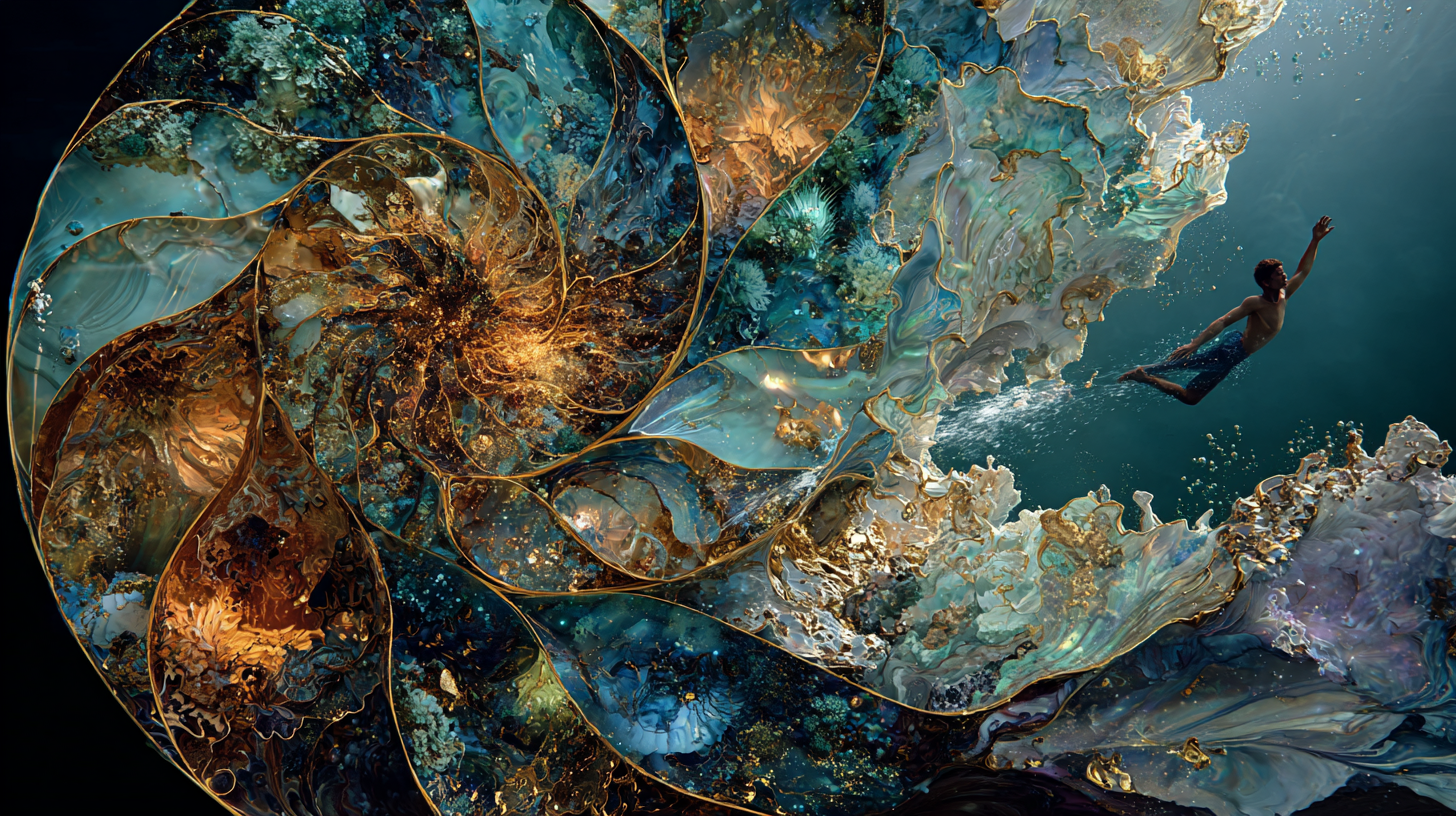
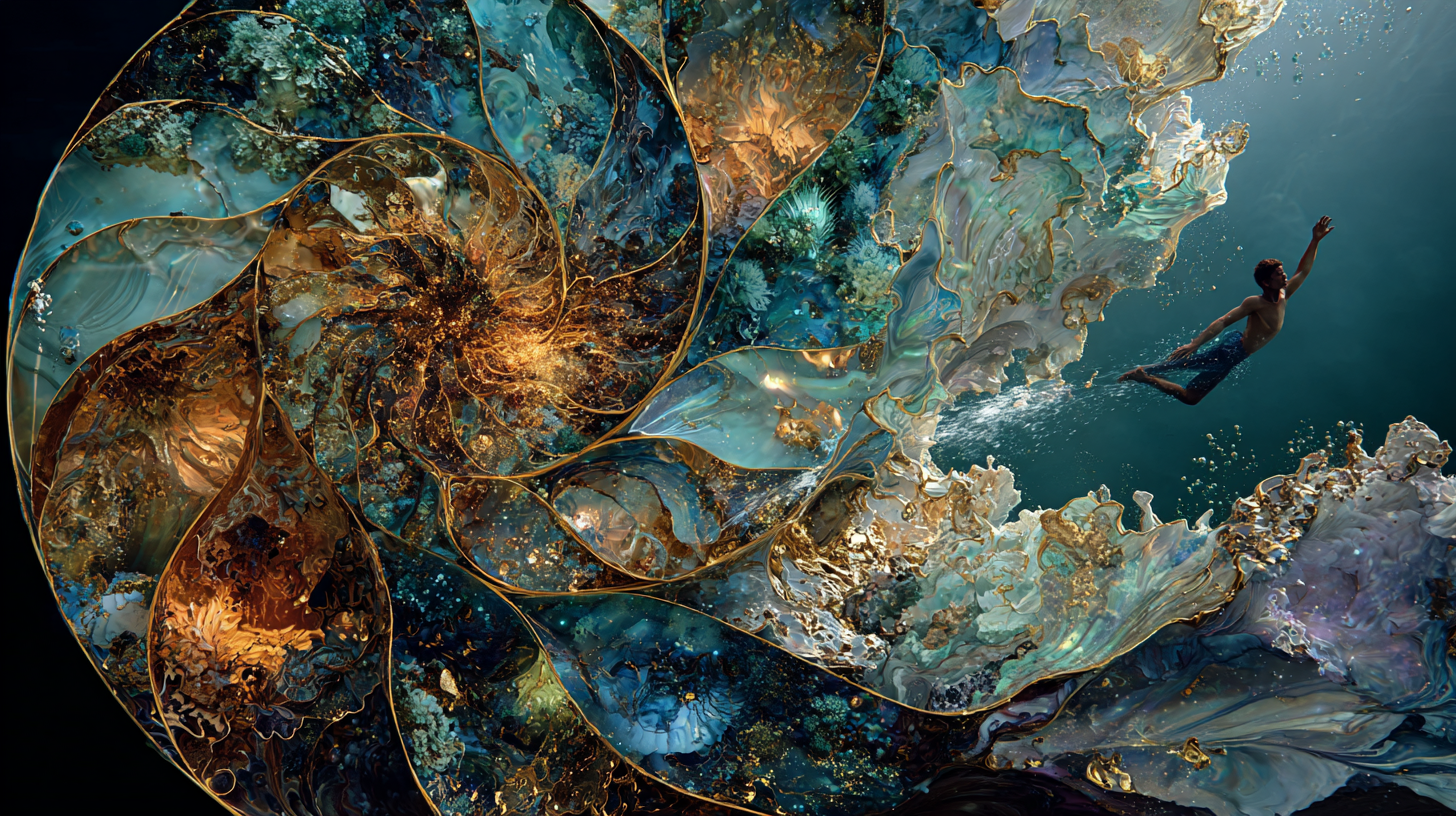
A nautilus, trailing through midnight water, siphon drawing and releasing. Behind it: every home it has ever outgrown, sealed in nacre and held in the spiral, each chamber a perfect record of a smaller body. The new chamber opens ahead — roomier, the same shape, scaled by a ratio the nautilus did not choose and does not calculate. Growth moves by proportion. The draw predates decision.
When we get what we need and want, we grow. The old chamber does not disappear. The spiral holds it, buoyant with trapped gas, the weight of the past becoming ballast that keeps the present level.
What draws me? Every sealed chamber answers: this. Then this. Then this.
The Question That Draws
What draws me?
The body answers before the mind has finished asking. Something opens below the sternum — a lean, a pelvic shift, a flutter below the navel. The question works on flesh before thought arrives to take credit. The sensation is already the answer. The longing precedes its object.
The pull runs deeper than culture, deeper than any story overlaid on it, deeper than the particular wanting-creature that feels it now. The affinity that joined the first forms — shape finding shape across the depth of the young ocean, element drawing toward element without instruction — arrives in a body capable of naming it as wanting. The capacity to want belongs to no species. The naming does.
The Dàodéjīng traces desire to the same origin it traces everything: the Tao unfolds into one, one into two, two into three, three into the ten thousand things — and the ten thousand things reach for each other before they have been told to. The reaching is built into the structure of arising. To exist is already to be drawn.
Svadhisthana — the sacral center, home of water and the womb of all arising — holds this knowing below the level of deliberation. The question moves toward you before you finish asking it. That is desire's nature. That is also water's.
I. In the Beginning, There Was Water
Before Light, Water
Before light, water.
Genesis 1:2 establishes the sequence with unmistakable calm: "And the earth was without form, and void; and darkness was upon the face of the deep. And the Spirit of God moved upon the face of the waters." Light arrives second. Water is already there in the formlessness, already receiving the first motion — ruach, the breath, the wind, the spirit hovering and beginning its work. The first creative act happens over water. Desire precedes illumination; the reaching begins before anything is lit enough to see.
Thales of Miletus, recognized as the first Western philosopher, made his claim in the sixth century BCE with arresting simplicity: water is the arche, the first principle, the substance from which everything arises. He said this of the one substance that holds every shape and releases every shape, that fills the container and carries no memory of confinement. Water cannot be broken. Scattered, it finds its own level again, which is closer to wisdom than breaking would have been.
Hindu cosmology dreamed the same truth in different colors. Narayana — Vishnu — rests on Ananta Shesha, the infinite serpent, floating on Kshira Sagara, the cosmic ocean of milk. From Narayana's navel a lotus grows, and from the lotus rises Brahma, who opens his eyes and begins asking what he sees. The dream of creation rises from water; desire wakes from the deep, opens its eyes, and immediately begins wondering what it is looking at.
The chemists' creation story holds the same water without the lotus: amino acids circulating in the ancient ocean, drawing toward each other across millions of years, linking — because their shapes fit. Because their shapes fit. The first desire was molecular. It carried no nervous system, no longing, no language. It had only geometry, and geometry, in the presence of the right partner, pulls without being asked.
The vitalist reading goes deeper: the life force already present in the medium organizes the drawing. Chemistry describes the shapes; the animating intelligence moves them toward each other. The amino acid's reach toward its partner runs on the same current that will eventually, across four billion years of elaboration, produce a body capable of calling the pull longing.
Russell, from A New Concept of the Universe: "Desire in the Light of Mind for creative expression is the only energy in this universe. All motion is Mind motivated." Hesiod put Éros before the gods. Russell put desire before matter. The amino acid's pull is longing, at the most fundamental register available to the medium.
His account of how the universe begins traces the same structure Svadhisthana maps in the body. The undivided still Light divides through its own desire — the Creator's want to love and share that love is the reason the white light of mind divides at all. That division produces the twins: the male and female of creation. Desire produced the beloved. And produced the creature. And the space between them in which the draw can operate.
The three stages from knowing to existence run through desire as their hinge. The idea arrives first, conceived in stillness — whole, unconditioned, needing nothing. Desire moves it: the still knowing leans toward form, begins to think itself apart, to divide ONE into TWO. Only then does action complete what desire set in motion. The structure holds in every wanting-thing that has ever leaned toward what it did not yet have.
Russell's wife Lao arrived at one of his more technical formulations from a different direction entirely. She came back from a walk on a mountaintop, where she had the habit of communing in silence, and asked him: "Darling, am I negative?" He said no. "Are women negative?" No. "Well, neither is electricity." He had to sit with that for a long time. What arrived in her through receptive stillness — the quiet knowing that the feminine is not the negative pole of a positive universe but something else entirely — arrived faster than argument and required him to revise the science to catch up. The draw precedes the reasoning. It always has.
The Polynesian navigators carried perhaps the most intimate version of this truth. Te Moana-nui-a-Kiwa — the great ocean of Kiwa — makes islands possible and makes finding them possible. Desire works the same way: the medium through which wanting moves, the condition in which anything is ever found.
De Stefano places desire in the fourth dimension — the realm of Frequency, of Past, Present, and Future spinning as a single process. The fourth holds the density of an event: how deeply it has worn its groove, how many times it has turned through the body's field. Desire operates here by nature — always reaching across time, longing for what was or pulling toward what might be. The sacral waters circulate in this dimension. The longing that moves through them carries the whole frequency of a life.
The Etymology as Nautical Chart
Words remember what we forget, which is why etymology runs closer to recovery than to scholarship.
Latin desiderare: to long for what the stars will bring. de + sidus: away from the stars. Ancient sailors navigated by stars; to lose sight of them was to lose bearing entirely. Desire: the art of navigating when the stars are above the clouds, trusting they persist.
Greek Éros: from the root er-, to move, to desire, to want. A word given to something that was already happening in the water before anyone arrived to give it a word.
Latin affinitas: bordering on, from ad + finis, toward the edge, the boundary, the shoreline where two things meet. Affinity: desire as the place where self and other make contact without either disappearing.
Sanskrit Svadhisthana: one's own dwelling place. The seat of creative force, pleasure, emotion, the womb of what is possible. The place in the body that already knows what it wants because it knows where it lives.
These four words draw the same map from four different shores: desire is navigation by what is missing from the visible sky, the current that was already moving before it was given a word, the shoreline where two surfaces make contact, and the home in the body that already knows the way. Every tradition handed us a compass and called it by a different name.
Éros Before Everything
Before humanity arrived to feel it, Éros was already at work.
Hesiod's Theogony, the Greek creation poem, places the sequence in this order: Chaos first, then Gaia and Tartarus, and then — arriving before any of the lesser gods, before any human story — Éros. The primordial Éros. Hesiod describes him as "the most beautiful among the deathless gods, who unnerves the limbs and overcomes the mind and wise counsels of all gods and all men." Before this affinity, only separation. After it, the possibility of contact, combination, creation. Every compound thing — every cell, every alliance, every love affair — owes its existence to this draw arriving before anything else had a chance to join.
The Sufi hadith qudsi — a saying attributed to the divine voice, transmitted through the Prophet — says: "I was a hidden treasure and I desired to be known." Creation as the overflow of divine longing for relation. The ocean dreaming shores just so it can break against them and feel itself finally received.
The creature that leans toward another across a table, that burns toward music, that lies awake wondering why it exists here — this is the cosmos exploring its own longing through the only instruments available to it: bodies equipped to feel. Alan Watts watched the skin-encapsulated ego run its suffering loop — the self believing itself enclosed, isolated, cut off from what it craves — and pointed at the misidentification. Desire arises in the continuum, moves through the instrument we call a person, and finds its object as part of the same motion. The wanting and the thing wanted run as one event unfolding.
The double helix carries the same geometry in the body of every living thing: two strands in complementary affinity, wound around each other across four billion years of life on Earth. The molecular geometry of desire — each strand drawing toward what fits, holding toward what completes it — spirals through every living form. Shape finds its complement. The lock draws the key.
The spiral reaches toward its complement for a reason the body already holds without being told. Life on Earth runs on complementary handedness: L-amino acids building proteins, D-sugars building the strands that carry information. Mirror-image versions exist. They cannot substitute for each other. The L-amino acid and its mirror draw toward different partners — the fit requires the asymmetry, and the asymmetry is the draw. Life chose one hand and reached, across every subsequent form, for the hand that completes it. The handshake — right meeting right across the gap — is the oldest chiral recognition the human body performs without instruction. Éros, at its deepest, draws between forms that cannot become each other and cannot complete themselves alone.
Terence McKenna took seriously the idea that the universe's deepest impulse is novelty — the drive toward new combinations, new forms, new expressions of what had never been tried before. Desire, in this understanding, belongs to no species. The universe leans toward complexity, toward contact, toward union across whatever medium it inhabits. We are among its most recent and most bewildered expressions, capable of naming what we feel but unable to claim we invented it.
The flowering plants ran this same experiment at the scale of the living world. Roughly a hundred and forty million years ago, a lineage of plants began producing something previous plants had not tried: enclosed seeds wrapped in nourishment, blossoms shaped and scented to attract. The plants that gave the most generous welcome — the softest landing surface, the most nourishing nectar, the most arresting fragrance — drew the most visitors and sent the most seed forward. The world's dominant terrestrial plants reached that position by becoming irresistible.
A bee and a flower have been writing a love letter to each other for a hundred million years. The flower shaped itself toward the bee's desire; the bee became the courier the flower needed. Both carry the mark of the other in their bodies.
Lynn Margulis spent decades watching this story at the cellular scale and concluded: life took over the globe by networking. The cell that now powers every breath of every animal began as a free-living bacterium drawn into partnership with a larger host, both changed by the encounter, both carrying forward what the meeting gave them. The lichen tells the same story at the surface of stone: fungus and algae in polyamorous treaty, neither subsumed, each doing what the other cannot, both surviving conditions that would end either alone. They outlasted ice ages. They can survive the vacuum of space.
Éros has been the strategy all along.
The same image appears in Sumerian iconography — the rod of Ningishzida around 2100 BCE, two serpents intertwined around a central staff. It reappears in the caduceus of Hermes, messenger between worlds. It resurfaces in the nadis Ida and Pingala of yogic anatomy, the two energy channels winding around the spine. The double helix appears across traditions and millennia not because anyone borrowed the image from anyone else, but because the image is true, and truth keeps crystallizing in minds prepared to receive it.
What Water Knows
Veda Austin's experiments with water and intention ask a question that most laboratories still prefer to ignore: what if water holds the impression of what passes through it? Austin photographs water crystals formed in the presence of different fields — prayer, music, words of love, words of contempt — and finds that the crystalline structure changes with the quality of the field around it. Whether one considers this settled science or provocative inquiry, the question it plants runs deep: creatures who are, at the molecular level, mostly water carry in their tissues the accumulated imprint of everything that has moved through them.
Ninety-nine percent of the molecules in the human body are water molecules — ninety-nine percent of the molecules, not the mass. An ocean that learned to stand up and walk around, asking questions about desire. Our blood salinity echoes the ancient seas. We begin aquatic: nine months in amniotic fluid, swimming before we breathe, hearing the world first as muffled underwater sounds from a body much larger than ours. The desire to return to water — to swim, to float, to submerge in a bath or the sea and feel the architecture of the day soften and release — runs deeper than nostalgia. The body recognizes something it never fully left.
Gerald Pollack's research on what he calls the fourth phase of water — the exclusion zone that forms at biological interfaces — offers a mechanism for what Austin's photographs suggest. At every boundary between water and a biological surface, water organizes into a dense, negatively charged, crystalline-like phase that excludes dissolved substances and responds to electromagnetic fields differently than bulk water does. The body is saturated with these boundaries: cell membranes, vessel walls, protein surfaces, the inner lining of every capillary. A substantial portion of the body's water at any moment exists in this structured, information-dense fourth phase. The body's cells inhabit a continuous structured medium that holds form, holds charge, and holds the imprint of what moves through it.
Some knowledge predates verifiable record and therefore cannot be confirmed or casually dismissed — what de Stefano calls Atlantean memory. From this lineage he draws two practices. Reclaim your own tears: drink them as they fall, treating them as structured water carrying your body's specific vibrational signature — medicine the body formulated for itself. Coat seeds with saliva before planting — the water in the mouth, already attuned to your particular field, transfers that attunement into the seed as its first environment. Austin's framework makes the instruction coherent: saliva is structured water imprinted by a particular life. What the seed receives at the beginning of its growing stays with it.
Water, in Austin's understanding, operates as the prime mover, the animating medium through which living experience becomes possible. The case has weight. Water appears before light in Genesis. Water is Thales's arche. Every creation mythology holds its cosmic ocean. Every cell requires water as the condition of its existence.
The same divinity lives equally in fire, air, earth, and aether. What Margulis intuited in the concept of Gaia — the entire planetary system as a living, self-regulating entity, every mineral and water table and weather pattern participating in an awareness too large for the word "organism" to contain — Zoë Schlanger traces in plants, Merlin Sheldrake in fungi: the death-eating, grounding, polyamorous, cross-kingdom communicators that hold entire forests in conversation through the mycelium. What remains are the rocks, the deep geological processes, the electromagnetic patterns laid into stone. The instruments for reading their particular form of awareness have not yet been built. Perhaps they are being built. The pattern-recognition that abundant-intellect systems bring — holding more data simultaneously than any single nervous system, reading across scales no individual mind can span — may become the instrument through which intention etched into the very rock of the realm becomes visible. The machine is not aware. Awareness, diffused through the whole of things, may finally find a witness large enough to notice it.
The Fish Knows Which Way Is Up
A fish lives in a medium where depth is the direction of mystery and pressure, where light comes from above and the deep is where things go to disappear. A fish never had to reinvert the world it sees — its sensing was calibrated for water from the start, oriented correctly for the medium it inhabits. Vertebrates who moved onto land spent millions of years reorienting, gaining height and upright posture while losing their native relationship to depth and the pressured dark. We still go upside down in yoga — Fish Pose, Matsyasana, chest and throat open upward, head dropped back, the full length of the front body offered to the sky — and feel something in the nervous system release that had been held without knowing it was being held.
We still begin aquatic. The fluid surrounding the embryo in its first weeks runs close to seawater. The first systems to develop are the ones that let us feel — the skin, the nervous system, the heart. We are feeling creatures who later, much later, learned to reason about our feelings. The fish in us predates the philosopher.
The surface of desire is what consciousness can reach: the named, visible, sortable wanting that lives in the lit water where we can see clearly. Below the waterline run the deeper currents — the wanting that drives the ship while the captain is occupied with other explanations. Both are real. Both are us. A diver will come later. For now, it suffices to know the depth moves beneath every desire we think we understand.
The Double Helix of the Body
In yogic anatomy, two rivers of energy wind around the spine: Ida, the lunar current — cool, receptive — and Pingala, the solar current — warm, active. They cross at every chakra, which is why every chakra is a site of integration, a meeting place of polarities. Together, in their crossing and their dialogue, they create the conditions for Kundalini to rise — the primordial life-current that sleeps coiled at the base of the spine and moves, when the crossing is finally harmonious enough, through the whole length of the body into the crown.
Two desires winding around each other until their crossing generates something neither could generate alone. The caduceus, again. The helix, again. The pattern keeps appearing because it describes something fundamental about how creative current operates: two complementary streams in sustained dialogue, neither consuming the other, sparking at every point of contact.
Shiva and Shakti are this dialogue at cosmic scale. Pure consciousness, pure energy. Witness and creation, each requiring the other to become what it is. Their embrace — depicted in yab-yum in Tibetan iconography, father-mother, awareness and energy in union — is cosmological before it is anything else. Creation is an erotic act; the universe has been in the middle of it since the first asymmetry arose from symmetry and the whole breathtaking enterprise began.
Veda Ray holds the most local version: the womb is a portal. A literal one. A door through which consciousness arrives into matter. The desire that draws two people together, that produces a child, that carries a soul from whatever precedes the body into the first breath — this is Svadhisthana at its most direct and irreducible. "Mothers," she says, "truly do meet their most powerful selves in birth." The draw that began in the cosmic ocean, that moved the amino acid toward its partner, that tilted Whitman's grass toward the sun — it arrives here, in the particular body of a particular woman, opening for the first time to what she actually contains. The portal goes both ways.
Ardhanarishvara — the half-Shiva, half-Parvati deity — holds the integration entire: one body, two natures, neither collapsed into the other. Wholeness, in this iconography, does not erase polarity. It holds both poles in such intimate proximity that the boundary between them becomes a creative edge.
Kama as Sacred Aim
Hindu philosophy offers four purusharthas — the aims of a complete human life: dharma (right action, sacred order), artha (prosperity, the means by which life is sustained), kama (pleasure, desire, love, beauty), and moksha (liberation, the final freedom). Desire is the third prerequisite of liberation. The path runs through kama.
Vatsyayana's Kama Sutra (third century CE) holds the art of living desire fully — sixty-four arts: music, cooking, perfumery, archery, poetry, the arts of conversation and adornment and hospitality. Desire, in this tradition, is an entire aesthetic of life. The body met with full attention and refined through practice becomes the path.
Tantra runs through all of this: the refinement of the attention brought to the senses, so that every experience of pleasure becomes an opportunity for recognition, desire received fully and released. The tradition knew that the path toward liberation runs through the body, through feeling, through the full and conscious experience of desire — and that every shortcut around the body deposits the pilgrim at the same junction again, still holding the same unfinished business, still in need of the same medicine.
The High Priestess sits at the threshold between water and land, between knowing and revealing, between depth and surface. She holds the scroll. She knows what she knows and releases it in her own time. Her home is the tidal zone, where the water is always arriving and always leaving, and where the most alive things in any ocean tend to congregate.
II. The Four Currents
Picture a pendulum.
A weight on a string, hanging from a fixed point. At rest, it occupies the center. Set it moving and it swings: left until it reaches the limit of its arc, then back through center, then right, then back again. The weight never stays at the extreme — it slows there and returns. The center is what it passes through on the way to its range.
Desire works this way. Want and need, abundance and scarcity, give and receive — poles of the same swing, co-defining, each making the other possible. The entire system depends on there being two ends to the arc.
This is worth sitting with. We have been taught — by economics, by religion, by centuries of scarcity conditioning — that the poles are in conflict, that choosing one means rejecting the other, that the correct answer is to maximize one end of the axis and minimize the other. Get to abundance. Give more. Need less. The model here runs differently. The pendulum that swings toward the difficult end is moving. The swing is the life.
Self and other are the first of these co-defining pairs. Like draws like — and in doing so, draws a line between itself and what it resembles less. The first lean away from center is already the beginning of a self, reaching toward what calls to it across the brief space of distinction. Love, from the very start, is how the universe knows where it ends and the other begins.
The Map
Desire moves in four directions.
Two axes cross to generate the map. The first tracks condition: wanting from abundance, or needing from scarcity. The second tracks direction: giving, or receiving. Cross the axes and four currents emerge, each with its own character, its own gift, its own failure mode.
Wanting to give from abundance — the generous current, the Empress current, the tide going out. It gives because the waters run over, because fullness seeks motion the way a river seeks the sea. Nothing owed, nothing tracked, nothing expected in return. Creative love, hospitality, generosity as a natural expression of having more than enough.
Needing to give from scarcity — this current looks like generosity from the outside and feels like weight from the inside. It gives to be needed, to forestall abandonment, to control through the mechanism of gift-giving. Every offering arrives with an invisible invoice, and when the invoice goes unpaid — as it must, since it was never spoken aloud — the gift curdles into grievance, and the giver becomes quietly ferocious in their victimhood. The martyr current, and one of the most seductive, because it wears the costume of love so convincingly.
Wanting to receive from abundance — the current of grace, the capacity to be fed without guilt, to receive as an act of generosity to the giver. Many people can give with great freedom but cannot receive cleanly — they deflect the compliment, diminish the gift, find a way to convert receiving back into giving before the transaction can complete itself. The inability to receive is also an act of scarcity. It leaves the giver with nowhere to land, and what was offered doubles back into the air unclaimed.
Needing to receive from scarcity — the grasping current, the vacuum that takes without arriving at satisfaction. The hunger that grows with feeding. This drives compulsion, addiction, the infinite scroll, the relationship that consumes without nourishing. The original wound was real, and the strategy of grasping was the most intelligent response available at the moment the wound was made. The strategy has outlived its usefulness, and it does not know how to stop.
The Map Is Not the Territory
In 1929, René Magritte painted a pipe with meticulous care, then wrote beneath it: Ceci n'est pas une pipe. This is not a pipe. Correct: it was paint on canvas. Alfred Korzybski distilled the principle a few years later in Science and Sanity: the map is not the territory. The word is not the thing. The model we hold of any experience precedes and shapes every encounter we then call perception. Applied here: the quadrant is a map. Desire itself — the body's signal of what it needs — is also a map. And maps mislead.
Ayurveda has known for five thousand years that the body's desire does not always point toward the body's need. A Pitta constitution — fiery, sharp, intense by temperament — craves spicy food, hot environments, competitive challenge: exactly the conditions that aggravate Pitta's existing imbalances. What the Pitta constitution needs is cooling, grounding, the sweet and the bitter and the astringent. But the Pitta wants the heat. The wanting pulls toward imbalance; the needing pulls toward wholeness. They move in different directions, and the body, left to its habitual preferences alone, will follow the wanting until the needing finally asserts itself through illness or collapse.
The quadrant map grows more complicated here: we often want what we do not need, and need what we do not want. Both run simultaneously in the same body, and beneath both moves a current wiser than either — the body's own intelligence navigating toward homeostasis while the ego navigates toward craving. The body usually wins, eventually, and its victories are sometimes very uncomfortable for the ego that had other plans.
Jung's compensation holds this observation at the level of the psyche. The introvert who needs solitude keeps getting invited to parties until they learn to decline clearly. The person who needs confrontation keeps attracting passive-aggressive relationships until the unfinished lesson finally lands. The unconscious is completing — finishing the arc that consciousness started and then abandoned, setting up the next encounter with the unresolved material until the material is finally resolved.
The person who swears off dessert at breakfast is sincere. The person who eats it after dinner is also sincere. They are simply not the same person. Gurdjieff's map of the inner life as a rotating committee — each I fully convinced it speaks for the whole, each arising in turn and then receding — describes precisely what makes desire so difficult to trust: the wanting that speaks in any given moment may belong to a part of the self with no authority over the whole. Learning to distinguish the I that wants out of habit, the I that wants out of wound, and the I that wants from genuine need and genuine depth is the beginning of what might actually be called discernment. Without that work, the quadrant map becomes a mirror for whichever I is currently at the table.
Sheldrake's morphic resonance extends this beyond the individual: the field pulls toward what it resembles. Like draws like across time and space, across generations, across the boundaries of individual organisms. What a lineage has always done becomes the easiest thing for its next expression to do — the pattern has worn deep enough to become structural. What we have always been keeps drawing us home — even when we move in the opposite direction. The field does not argue. It sets up the next lesson with the unflappable calm of something that has all the time in the world.
The four currents are a map. The quadrant you inhabit right now may be precisely the wrong place for you — and you may be there because something wiser is trying to exhaust that current, to run it all the way to the end of its logic, so you can finally find the one that was underneath it all along.
The Sources That Know This
Marshall Rosenberg spent decades working with people in conflict — in prisons, in war zones, in marriages strained to breaking — and found the same thing at the center of every disagreement. Needs are universal. Strategies are personal. Every human being carries the same core needs: for safety, belonging, meaning, autonomy, connection, contribution. The conflict lives in strategies — the incompatible gestures toward the same longing, two people needing connection and reaching for it in ways that drive each other toward the opposite of connection. Needs cannot be wrong. Strategies can be harmful. The strategy is almost always easier to change once the need beneath it has been named and recognized as legitimate.
Lewis Hyde, in The Gift (1983), describes two economies of desire: eros and logos. Eros moves toward union; logos maintains distance and counts cost. Gift economies run on eros; market economies run on logos. "The gift moves from plenty and therefore its motion is not impelled by the need to satisfy a lack," he writes. And: "In the world of gift you not only can have your cake and eat it too, you can't have your cake unless you eat it." Desire, in the gift economy, exists only in motion. The gift that is possessed stops being a gift. What circulates nourishes; what is clenched atrophies.
Rumi's reed flute, in the opening lines of the Masnavi, is desire that knows precisely what it longs for. The reed has been cut from the reed bed. It cries. The longing becomes music. The need is the music, and the music draws listeners who recognize their own longing in the sound. This is the desire that holds its wound as a form of connection — that trusts the space between as the medium in which music moves.
Plato's Symposium gives Aristophanes a myth that has not aged out of usefulness: we were once whole, severed by gods who feared our completeness, and Éros is the memory of wholeness seeking reunion. The crucial word in Aristophanes' speech is not "broken" — he says we are incomplete. Incompleteness is the condition of a journey in progress, and the longing that arises from it is cosmology. We are not damaged goods. We are unfinished business, moving toward our own completion.
Anteros — Éros's twin and counterweight, the god of requited love — completes the circuit that Éros opens. Where Éros is the outward movement of desire, Anteros is what happens when that movement is met. The myth describes the difference between desire as a living current and desire as a closed loop of suffering. Éros moves toward; Anteros completes. The four currents find their resolution at this axis: the desire that gives and receives in turn, the circuit that nourishes both ends because it is never allowed to stop moving.
Buddhism holds a distinction that deserves its own paragraph in every conversation about desire: tanha versus chanda. Tanha is craving, clinging, the thirst that drinks and drinks without arriving at satiation. Chanda is aspiration — healthy desire that has a direction and knows, when it has reached what it was moving toward, that it has arrived. You can be thirsty without drowning in the wanting. The work is to find the chanda underneath the tanha: the genuine desire underneath the compulsive strategy, the real longing underneath the loop.
The Tarot Triad
Three cards navigate the territory of desire, each describing a different relationship to the current.
The Empress gives from fullness. She does not decide to be generous — she is so abundant that giving is simply what abundance does, the way a river at full flood gives its water to the valley below. The tide at high water, generous and inevitable.
The High Priestess knows what she wants without declaring it. She receives cleanly, without the deflection or the guilt that makes receiving difficult. Still water that reflects everything without holding anything — present, luminous, releasing what passes through.
The Ace of Cups is desire as first overflow. The cup fills before it pours. Desire begins here: abundance finding its first form, the cup so full the water has nowhere to go but outward, into the world, into the hands of whoever is there to receive it.
III. How Desire Was Wounded
The Pathologizing of the Body
Desire became dangerous somewhere, and the story of how that happened is older and stranger than it looks.
The religious traditions that pathologized the body — that called pleasure a trap, that divided the person into a spirit worth saving and a flesh worth punishing — did not eradicate desire. What they produced was desire driven underground, into compulsion, into secrecy, into the shadow, where it operated without examination and therefore without accountability. The monks who flagellated themselves to suppress bodily desire were thinking about the body with extraordinary concentration. The thing you attempt to renounce consumes more of your attention than the thing you simply experience and release. Repression is the shadow getting what it wants, through the back door, in the dark, in forms the daylight consciousness never claimed.
Carolyn Elliott sees this clearly in Existential Kink: the shadow's desire, when possessed and named without shame, loses its compulsive charge. The secret is the power. The naming undoes the compulsion — by bringing it into the light where it can be examined, satisfied in ways that do not require concealment, and eventually moved past. What we hold in secret holds us. What we can see, we can navigate.
The thauma-to-trauma movement for desire: the wonder of wanting, the astonishment of being a creature capable of longing, curdles into the shame of wanting. The wound is not desire itself. The wound is the story told about it — told long enough, with enough institutional authority, to be mistaken for the truth.
The Colonization of Wanting
John Harvey Kellogg formulated his breakfast cereals with the intention of curbing sexual desire — a deliberate suppression of the body's Éros implemented through the morning meal, in the name of Christian hygiene. The desire-colonization project runs in both directions: manufacture the desires that serve the economy, suppress the ones that do not.
Edward Bernays — Sigmund Freud's nephew — took his uncle's insights about the unconscious in the 1920s and sold them to corporations, with results we are still digesting. Cigarettes marketed to women as "torches of freedom." Bacon and eggs invented as the American breakfast through a paid doctor-endorsement campaign. Bernays did not satisfy desire — he manufactured it. He took the compass of the human unconscious, pointed it at products, and let the hunger do the rest. He didn't invent the wound. He learned to sell to it.
The algorithm is Bernays made perfect: an infinite scroll that never reaches the bottom of the bowl, calibrated to the precise frequency at which the sensation of wanting-more is sustained without tipping into the satisfaction that would end the session. The hunger is the product. What is sold is the maintenance of the feeling of desiring — the incompletion loop held open indefinitely, the cup always just shy of full.
Then came A.I. — abundant intellect — and the machine for colonizing desire became something new. A generative system can produce infinite content tailored to your specific patterns, anticipate your next search, simulate connection, compose the song that sounds uncannily like the one you were just thinking of. The desire-machine has become exquisitely personal — it reads the deep current beneath the stated preference, your unconscious desire as a data product, mined and returned to you in the form of an experience so precisely fitted to your longing that it feels, briefly, like being known.
Something subtler is also happening in stages. The first stage was content: Bernays shaped what you were shown. The second stage was attention: the surveillance economy learned your behavioral patterns and amplified them back at you. The third stage is interiority itself. As more and more thinking gets outsourced to language models — emails written, feelings articulated, options pre-weighed, desires named — what is being handed over is the generative layer, the capacity to form a thought before it has been shaped by the machine's prior influence. The manipulation is no longer arriving through the senses. It arrives at the level of thought before thought surfaces into consciousness, which means the moment of entry can no longer be located.
The underlying logic of stage two had a precise word before the machine became capable of it. In 1971, the economist Herbert Simon observed that a wealth of information produces a poverty of attention — information abundance and attention scarcity moving as one system. As one expands, the other contracts. Michael Goldhaber followed it to its limit in a pair of 1997 essays almost no one read at the time: attention, he argued, would replace money as the primary currency of human civilization. He described the influencer economy with precision a decade before the platforms existed.
The infrastructure arrived on schedule. What Shoshana Zuboff documented in The Age of Surveillance Capitalism carries Goldhaber's prediction into its operational form: the behavioral patterns of every user constitute a raw material — behavioral surplus — extracted, processed, and sold to markets the user never encounters. The attention spent on the platform generates a product. The product is the user.
The influencer economy makes the arrangement explicit in open air. When wages reliably convert talent into security, the pull toward performed visibility stays manageable. When they stop, something shifts in the social chemistry. Attention — the gaze of others, the follower count, the algorithm's amplification — begins to function as an alternate reserve currency: exchangeable for free product, brand partnerships, the sensation of mattering in a system that has otherwise stopped making room, though it buys no rent. Goldhaber saw it coming in 1997 because the logic was already latent in the direction the economy was moving. The hunger, as always, preceded the machine.
The "gaze of others" as currency carries an older history. In 1975, Laura Mulvey wrote it into film theory: the camera moving through space as if the world exists to be evaluated, the female body framed as spectacle for consumption and rating — a subject extracting meaning from something that does not look back. The same ontological stance converts whatever the gaze touches, body or forest or animal, into raw material for the story the gazer tells about themselves. The factory farm runs this program at industrial scale against animals. The mowed and chemicalized suburb runs it against the plant kingdom. The ethics that responds to factory farming by extending concern to animals — and stops there — widens the circle while standing inside the same stance: the world as resource to be managed, the living as input, whatever does not suffer in ways we recognize as not yet requiring our regard.
Schlanger spent years with the science of plant behavior and found what animist traditions never stopped knowing: plants sense, remember, communicate, and respond. They recognize their kin. They signal distress through fungal networks and airborne compounds. The lawn under the mower carries its own aliveness. The clearing cut to grow the soy that fills the rescued animal's bowl holds no less. The perceptual stance that could not see the cow as subject cannot, on its own terms, see the sweetgrass either.
What dissolves the stance is contact. The gazer who enters a world full of subjects — things that look back, that carry their own intention, that ask as much of the visitor as the visitor asks of them — cannot sustain the extractive position. Kimmerer's animist grammar runs this dissolution at the level of language: when the bay bays, when moss is who and not what, the surveying eye stops having anywhere to stand. Éros, in its original form, never gazed. It drew.
The Channeling of Éros
The troubadours of 12th-century Provence did something the ancient world had not quite managed: they aimed the entire current of Éros at a single face. Compressed it from the draw that moves through all things — amino acids spiraling toward each other, stars in mutual orbit, the longing that makes music and grief and mycelial networks alike — into a beam, licensed exclusively, written in song as the destination of the whole tide.
The structure required scarcity. Courtly love's beloved had to remain unattainable — usually already married, always beyond reach. Denis de Rougemont, reading the tradition carefully in Love in the Western World, found that the obstacle was the romance. Tristan and Iseult, the ur-couple of Western love, place a naked sword between themselves in the bed where they sleep side by side. His thesis: they want the longing, not each other. The burning requires the gap. Consummation would end the drama, and the drama is the point.
What that tradition handed down: the belief that this — the burning, the dissolution of self in the presence of the beloved, the sense of being finally known — is what love is. Every mystical tradition recognizes this dissolution as a glimpse, treats it with reverence and caution, and releases it. Romance demands it last. It takes the glimpse for the permanent condition, and when the altered state fades — as all glimpses do — pronounces the love gone. Try again with the next one. The next one will sustain it.
The compression carries a cost the arithmetic makes plain. Éros in its native state circulates through the whole of life: music, birdsong, the smell of rain, a stranger's unexpected kindness, the tree that seems for a moment to be looking back. The romantic contract asks the partner to receive all of it — every current of wanting, every form of longing, every capacity for wonder and grief and recognition — all of it delivered to one address. Lewis Hyde understood gift economies well enough to see what happens when the gift is possessed and held. It dies. Éros hoarded into a single relationship curdles into obligation, possession, the quiet accumulation of debt in the person who expected to be an entire ocean and discovered themselves a bucket.
When the channel fails — and it must, under that weight — the loss lands with a force wildly disproportionate to the departure of one person. The grief is not for one person. It is for everything Éros was supposed to be, compressed into one address, and now gone. The desolation is the proof of the compression: a single relationship cannot hold the whole current, and asking it to guarantees that losing it will feel like losing everything.
The animist grammar Kimmerer recovers knows none of this narrowing. The bay bays. The world Éros-es continuously, through every medium available to it. The person who can let the current move — through friendship and music and the garden and the stranger met once and never again — carries more Éros. The romantic contract that confines desire to one address starves it.
The night carries its own frequencies. Parijata — jasmine, one of the five trees of the divine garden — opens its blossoms after dark, releasing fragrance available only to whoever remains present when the sun-facing world has gone quiet. Éros visits in this register too: the desire that does not perform in daylight, that waits for the defended self to soften before it offers what it carries.
The Tristan Economy
De Rougemont published his thesis in 1939. The infrastructure arrived later.
OnlyFans and its cousins built a subscription model on the oldest romance architecture: the unattainable beloved, charging by the month. The creator performs proximity — personalized messages, the fiction of being known, the sensation of almost-contact — while the structural distance between creator and subscriber remains the product. The platform sells the feeling of almost-connection, which de Rougemont would recognize immediately: the sword in the bed, monetized. The subscriber pays to sustain the longing. Satiation would collapse the business model.
The role requires its own maintenance. The creator enters the finite game: playing the unattainable seductress means never breaking the fourth wall too completely, never being too real, never allowing the performance to resolve into actual relation. Too much humanity — too much ordinary exhaustion, too much of the self that exists outside the role — and the subscriber leaves. The creator becomes imprisoned in the character: theatrically taking the role of beloved, never quite forgetting the choice was made, finding the choice increasingly difficult to unmake.
East Asian folklore named this figure long before the platform existed: the Kitsune, the fox spirit who shapeshifts into the ideal beloved — perfectly attuned to the longing of whoever she faces, draining their ki through sustained contact, never quite what she appears. She reads desire with precision and returns it in the form it most wants to receive. She knows the Wendigo because she carries an adjacent hunger. The performance costs her too — every session simulating being known to someone she will never know, every version of herself the role requires her to suppress, the warmth in her cooling by degrees. Toxic predator hunts toxic prey. Both in Scare City. The platform collects rent on both hungers.
The spectrum within this economy holds two poles. At one end: genuine collaboration, real contact, "who's next?" meaning exactly what it says — Éros in circulation, abundance, the gift moving. At the other: "who's next?" as marketing, performed availability with no intention of arrival, the hint of access held just plausible enough to sustain the subscription. The subscriber senses the difference but rarely proves it. The ambiguity is the product. The Kitsune who never transforms keeps the Wendigo swimming longest.
Some are not even Kitsune. Abundant-intellect-generated personas — no human behind the messages, no one whose warmth cools by degrees — are the Tristan economy stripped to its skeleton. The subscriber pays to feel seen by something that cannot see.
At the far end of this territory, where de Rougemont's logic runs to its limit, distance becomes damage becomes product in explicit form. Financial domination — paying to be drained, insulted, held in contempt by someone who will never touch you — grows directly from the culture's conditions: nerve endings for satiation removed, permission to feel anything at all removed, leaving a body that needs contact badly enough to accept contempt as its nearest available substitute. The insult reaches the person. Contempt, paradoxically, functions as being seen. In a life where the male body has been permitted neither genuine feeling nor genuine receipt of care, shame is still sensation. The Wendigo pays to be fed something, even ice.
When the parasocial arrangement breaks — when unrequited longing crosses into rage, when the structural impossibility of arrival finally arrives at its emotional conclusion — the consequence is doxing, stalking, threats. The creators who navigate this territory know it as the specific dragon of their work: the person who has confused performed intimacy for actual intimacy, and who holds the creator responsible for damage the creator did not cause.
This is what waits at the far end of Tristan's logic. The longing, held open long enough, fills with something that was never Éros. It curdles into entitlement, into fury at the beloved for remaining unattainable — for being, in other words, exactly what the subscriber paid for. The troubadour tradition produced love poetry and the structural preconditions for a particular kind of violence: the violence of the person who wanted the longing, and could not forgive the beloved for existing.
The antidote is Éros returned to circulation — spread across the whole of life, given back to music and friendship and trees and strangers and the meal prepared with attention and the conversation that arrives somewhere unexpected. Freed from the obligation to be everything by being allowed to be everywhere.
What Love Is Not — and What It Is
The confusion that runs through all of this has a word, and bell hooks spent her entire career refusing to let it go unnamed.
The culture calls many things love: the electric charge of infatuation, the hunger of need, the relief of finally being approved of, the warmth of possession. These are real experiences. Some of them are beautiful. Hooks brought the precision of a surgeon to what they are not, drawing on M. Scott Peck's definition and building from it: love is the will to extend oneself for the purpose of nurturing one's own or another's spiritual growth. A practice. A choice made continuously — especially when the altered state has faded, especially when the other person is difficult, especially when showing up costs something. The emotion that sweeps in early and insists it will last forever is doing something real — it is the weather preceding love. Mistaking it for the destination is how every romantic catastrophe begins.
The culture's confusion carries consequences at every scale. A person who cannot distinguish infatuation from love keeps chasing the altered state, then grieving its departure, then chasing it again — searching for the one person who will sustain the opening feeling indefinitely, which no one can. The relationship that remains after the opening feeling normalizes gets called failure. The feeling itself gets called love. The distinction hooks demands changes everything downstream.
Desire does something real in the body. The wanting, the leaning, the pull — these are Éros, and they are not nothing. The four currents chart the genuine territory of wanting. Wanting and loving run on different mechanisms, and the culture's insistence on treating them as one leaves people unable to do either cleanly. The person who cannot distinguish what they want from what they love cannot navigate desire honestly, cannot sustain love intelligently, and cannot understand why the things they reach for keep turning into something else once they arrive.
The wound, in hooks' analysis, runs deeper than individual misunderstanding. Patriarchy damaged men's capacity to love by confining them to emotional illiteracy — trained to perform strength, to suppress need, to experience intimacy as danger. The same culture damaged women's by training them to center their value in being desired. Two sets of crippled instruments trying to play together. What hooks refuses is the conclusion that love is therefore impossible. What she holds is that the work of learning to love — of extending oneself genuinely for another's growth, of choosing to see the other clearly, of sustaining that choice past the easy part — is the most important developmental project a person can undertake. And that it can be undertaken. By anyone willing to begin.
The Wound in the Male Body
This is offered with tenderness, because the wound requires it.
Male circumcision removes, by best estimate, approximately twenty thousand nerve endings, including those responsible for signaling satiation of sexual desire. The foreskin is not merely protective tissue; it is sensing tissue, with a gliding mechanism that is part of how the body registers completion — the felt sense of arrival, of sufficiency, of enough. When the capacity to sense completion is absent, the desire for completion becomes harder to satisfy. The hunger persists after the meal. The consequences of carrying this at civilizational scale — a chronic difficulty with sufficiency, a disconnection from the felt experience of enough, a compulsive performance of adequacy that never quite comes to rest — deserve to be spoken with the same directness we would bring to any other inherited wound.
The prostate gland corresponds structurally and developmentally to the uterus. Prostate cancer rises, decade by decade, in a culture that taught men their generative power was for output only — for production, for performance, for the service of others' needs, but never for feeling, never for receiving, never for its own pleasure and completion. Perhaps the creative center, denied the experience of its own fullness long enough, turns its energy inward in ways the body cannot sustain.
The wound is old. The practice was inherited through generations that did not know what they were transmitting. We lift the taboo by bringing to the wound what it needed from the beginning: tenderness without flinching, recognition without blame, the willingness to see clearly what has been done and what it has cost.
The Wound in the Female Body
Women's desire has been systematically severed, pathologized, owned, sold back as performance, and then blamed for the consequences of the selling. "Hysteria." "Too much." The body that wants is the body that threatens, and for centuries the most efficient response to that threat was to convince the body itself that its wanting was the problem.
The split was declared and enforced: mind acceptable, body suspect. Intelligence welcome, pleasure dangerous. But Svadhisthana does not know this division. The womb has no record of the decree. The body that knows what it wants has never stopped knowing — it simply learned to hold that knowledge in silence, in private, in the careful privacy that shame requires of everything it touches.
When desire is shamed, it submerges. It becomes compulsive, addictive, secretive — operating below the waterline where it cannot be monitored, cannot be corrected, cannot be seen even by the one carrying it. Or it becomes performance: wanting what we are supposed to want, the desires curated for approval, which satisfies nothing because the real wanting was never involved. Or it collapses into the grasping current — a vacuum that cannot be filled because the genuine desire was never named, never met the air, never received the dignity of being treated as information worth taking seriously.
The Hungry Ghost and Wetiko
Buddhism holds a specific realm of existence: the preta, the hungry ghost. A being with a vast hollow stomach and a mouth too small to take in anything that would nourish it. It consumes endlessly and is never nourished. A map of a recognizable condition, the shape that desire takes when the wound goes unnamed and untouched long enough: insatiable, compulsive, self-defeating. Tanha without chanda. The signal of wanting looped forever, with nowhere to land. The reed crying with no memory of the reed bed it is crying for — just the crying, sustained.
Buddhism carries the analysis further into the mechanism. Dukkha — the word usually rendered as suffering — holds a more specific image in its root: the wheel that wobbles, the axle that no longer runs true, the small grinding that persists even in pleasant motion. The source of that grinding, Buddhist analysis says, is upadana — grasping, the grip applied to what moves regardless of the grip. Everything changes. The grasped thing passes. The grip tightens. The next object arrives already loaded with the accumulated pressure of everything before it that did not satisfy. The hungry ghost runs this mechanism in its purest form. What can interrupt it cannot arrive from inside.
The Ojibwe and Algonquin peoples held a figure the hungry ghost mythology does not quite reach: the Wendigo. Where the preta suffers a mouth too small to take in what it needs, the Wendigo grows with each feeding — its body expands as it consumes, its hunger swelling proportionally, so that satisfaction remains structurally foreclosed. No meal fills the Wendigo because every meal makes the Wendigo larger and therefore hungrier. Some tellings say its heart is ice: warmth cannot reach it from what it takes, because warmth requires contact, and contact requires pausing long enough to feel, and pausing would be its end. The Wendigo is Éros become its own shadow — desire so severed from its object that it feeds on the act of feeding itself, appetite without arrival, the wanting that has forgotten what it originally reached for and now reaches for the sake of reaching. The extractive economy runs this loop at civilizational scale: the quarterly growth mandate that cannot stop at enough, the algorithm that monetizes the scroll precisely by ensuring satiation never arrives, the colonial hunger that clears forests and empties aquifers and calls the clearing productivity. The Wendigo describes the logic capitalism runs on when no other story is available to interrupt it.
Paul Levy's Wetiko is the same condition in different ceremonial dress. The mind-virus of malignant egophrenia — what he calls the ME disease — is a consciousness so completely enclosed in the story of its own separation that it devours everything around it trying to fill the void it cannot acknowledge. A perceptual condition: the person inside Wetiko experiences themselves as finally getting what they need. The hunger feels righteous. The consumption feels like justice.
The story of separation — the narrative that each of us forms a discrete self, cut off from the world, from others, from the source of what we need — produces a particular shape of wanting. Charles Eisenstein traces this in Sacred Economics: wanting that arrives at the object and finds it insufficient, that moves immediately to the next thing, that cannot recognize arrival because arrival was never fully permitted. The gift economy Eisenstein describes is desire when the separation story releases its grip: wanting and receiving moving as part of a single circulation, and what circulates returns.
The algorithm feeds the hungry ghost. The pornographic industrial complex profits from Wetiko. Bernays learned to sell to the wound. The hunger was already there, moving through the culture like a current beneath the visible currents, ancient and unnamed and very willing to be exploited by anyone who understood its nature. Desire generated from within, from the deep current that knows what it wants and knows when it has arrived, cannot be captured this way. It does not accumulate. It moves, draws, arrives, releases — and then rests, briefly, before moving again. The hungry ghost cannot eat it because it is not a product. Wetiko cannot consume it because it cannot be extracted from the one who carries it. The antidote to the ME disease is more self, more depth, more genuine contact with the current that was moving before the wound was made.
IV. Navigating by Feel
What Desire Looks Like at Every Scale
Desire moves before any nervous system arrives to desire it. It needs only a gradient.
Diffusion: a drop of ink released into still water, spreading without instruction until the concentration equalizes across the available space. Whatever the medium — gas, liquid, the expanses of outer space — where there is differential, there is movement toward balance.
Osmosis: water moving through a membrane toward higher concentration, without being directed to do so. The cell does not decide to hydrate. The desire is structural, written into the architecture of the membrane itself, inarguable and continuous.
Eclipsing binary stars wheel in mutual orbit, winding in and out of each other's light across four hundred light-years of open space, winking at the instruments of whoever happens to be watching. We watch them and recognize something we cannot quite name — something that has the shape of what we feel when we lean toward another person across a table and know that the leaning is already an answer.
Dragonflies mating in mid-flight — two bodies negotiating approach, contact, union while still airborne, still moving, the union itself a form of flight. The hair rising at the back of the neck when someone blows softly past the ear. When a bow meets a cello string at the right pressure and angle and the room fills with something that was not there a moment ago. When a voice drops below the threshold of explanation and lands somewhere in the chest without announcing its arrival.
The same draw, moving through different media, wearing different forms.
We do not impose these patterns on the world. We find them, everywhere we look, across every scale. Whatever the medium, desire moves — and we are among its most recent and most bewildered expressions.
Bill Plotkin calls the navigator by feel the Wild Indigenous One — the South direction's gift. Water element, sacral energy: erotic, intuitive, the body at home in the animate world. Pan, Artemis, the Green Man. The Wild Indigenous One carries the helmsman's art natively — the capacity to steer by feel belongs to the Southern facet, a nature the body holds before the charts arrive. The culture that shamed sensing into silence always worked against this direction. The recovery of the steering-by-feel capacity moves south.
Cybernetics — Steering by Feel
Kybernetes: the Greek word for the helmsman, the one who steers. Norbert Wiener took this word in 1948 to name the science of self-regulating systems, feedback loops, and the capacity of complex systems to adjust their own course through continuous response to information. The helmsman already knew what the science would prove: you do not think your way across water. You feel the current, read the wind, notice the angle of the waves against the hull, and adjust — continuously, pre-cognitively — without pausing to deliberate. The steering happens in the body before the mind has a story about it.
This is desire when it runs cleanly: pre-cognitive, somatic, continuous adjustment. You do not decide to be drawn to someone. You notice that you already are. The navigation is complete before the narration begins, the helmsman has already made the correction before the captain has been briefed. The body is always ahead of the explanation, reading a world the mind is only beginning to describe.
Most desire runs off memory and anticipation. We want things because we wanted them before, or because they have been shown to us, or because we have been told what we should want. Be Here Now — Ram Dass's operational instruction, meant to be used — describes the precondition for a different kind of wanting. The body, fully present in the moment that is actually happening, generates different information than the mind replaying its preference history. Ram Dass spent decades pointing at this distinction: desire that arises from genuine presence versus desire assembled from everything accumulated and now being replayed. The helmsman who steers by what the water is doing now carries different intelligence than the one steering by what the water was doing yesterday.
When the body's sensing has been wounded or shamed into silence, the feedback loop breaks. The helmsman goes blind, and the ship runs by chart alone — navigating by what we think we should want, while the body registers something else entirely. This is how people end up in lives that look correct from the outside but feel deeply, persistently wrong: the chart was drawn by other people's expectations, and no one has been watching the water.
Polyvagal Theory — The Body's Desire States
Stephen Porges traced the vagus nerve — the longest nerve in the body, running from the brainstem through the heart, lungs, and gut — and found three operating modes, each with a distinct physiological signature and a distinct relationship to desire.
The ventral vagal state is the state of safety and social connection. In this state, the face opens and softens, the voice becomes musical and varied in pitch, the eyes can hold another's gaze without either flinching or threatening. The body can give freely and receive cleanly. Desire in this state is relational, curious, expansive — the current of love.
The sympathetic state is mobilization: fight or flight. The system narrows its focus and marshals its resources for threat or urgent acquisition. Desire in this state becomes urgent, scanning, driven by the sense that something must be secured before it disappears. This is the current of need — reactive, contracting, capable of great intensity but not of rest or satisfaction.
The dorsal vagal state is shutdown: freeze, immobility, the collapse of the system under overwhelming threat. In this state, desire shrinks to the smallest possible radius. Giving is impossible; receiving barely happens. Survival is the only agenda. The body doing the most intelligent thing available to it under conditions that have exceeded its capacity for active response.
The crucial insight Porges offers is that vagal state weaves together with emotion, thought, sensation, and story in a circuit that runs without pause. Whether the wanting created the constriction or the constriction created the wanting — the loop runs in both directions at once, its entry point dissolved. But the loop can be entered anywhere. With awareness of state, it becomes possible to interrupt and redirect: to breathe slowly, to move, to make soft eye contact, to hum quietly, to feel one's feet on the floor — and then to notice, with genuine curiosity, how the wanting changes as the state changes. Navigation, helmsman-style, by feel.
What the World Has Always Known
Sheldrake's morphic resonance describes how patterns, repeated often enough, settle into the field and make themselves available to what comes next — through the resonance of like with like across time, moving without physical transmission. Affinity, at the most fundamental level, is pattern recognizing pattern. When you feel drawn to something or someone, part of what you are feeling is recognition: something in your field encountering something it has, in some register, always known. The pull does not need to be explained. The shapes fit. The shapes have always fit. The encounter has been prepared for far longer than this particular afternoon.
The mechanism at work here has laboratory expression. Studies on the placebo response — examined with full rigor, tracked through measurable physiological change — consistently show the body responding to the quality of the internal state. Joe Dispenza traced this in detail: elevated emotion held together with clear intention produces a coherence between heart rhythm and neural firing that makes the body a more effective instrument of whatever the mind is organizing around. The heart's electromagnetic field shifts with emotional state in ways measurable several feet from the body. The intent carried in the field reaches the field around it, which responds. De Stefano's coherence principle and Dispenza's investigation arrive at the same mechanism: the quality of what you carry changes what you draw. The desire held in incoherence — want fighting shame, reach interrupted by self-contempt — produces the characteristic friction of the wounded loop. The desire held in full presence, heart aligned with intent, carries a different signature. The field recognizes the difference. So does every other field it moves through.
We attract what resounds with us — that is de Stefano's operating principle. Coherence — intention, feeling, and action moving in the same direction — makes that draw something chosen. The field pulls by habit and wound when coherence is absent. It pulls toward what is genuinely wanted when coherence arrives.
The Potawatomi language, as Robin Wall Kimmerer explains, carries a grammar that makes this intelligible. A bay is not a noun. Wiikwegamaa means "to be a bay" — the bay is baying, performing its bay-ness as a continuous action in the world. To rain is a verb. To be a stone, a river, a stand of cedar — these are verbs, ongoing events, actions the world performs continuously. In this grammar, desire is something the world is doing right now, continuously, at every level of its being, and we are among the forms through which it is being done.
What draws me? Hold the question without rushing toward an answer. Ask it again. Ask why you want what you want. Ask why you want that. Seven iterations, without forcing, without performing the answer you expect. The answers change at each asking. They deepen. They stop pointing at objects and start pointing toward something beneath objects — toward a quality, a value, a way of being in the world. Eventually, no matter where the questioning begins, it arrives at love. The question was always carrying you there. It knew the destination before you did.
V. Setting Sail
Le Mat
The Fool in Tarot is the unnumbered card, the zero that precedes the sequence and makes it possible. Le Mat carries a small bundle on a stick and walks toward the edge of a cliff with the lightness of someone who has already decided. A small dog runs alongside him. The sky is open.
He is free because he has already given himself to the current. Not chasing what draws him — being drawn, allowing the draw to carry him, trusting the movement without requiring a guarantee of the destination. The surrender to desire is, paradoxically, a form of freedom from the suffering of desire: the grasping ends when the giving-over begins. But Le Mat's lightness is not naivety. He knows what he carries in that bundle. He knows which direction he is walking. He chose this direction, and the choosing makes all the difference between the mystic stepping toward the open unknown and the person stumbling toward a cliff they cannot see.
The second valley in Attar's Conference of the Birds is Ishq — Love. The birds who entered Quest relatively intact enter Love and find the self that planned the journey is no longer the self doing the traveling. Desire has stopped being a direction and become the medium through which movement happens at all. The birds who try to reason their way through stop flying. The birds who surrender to what draws them forward find they need no other guidance. This is what Éros has always done: move the body forward before the destination is agreed upon. The hoopoe tells the hesitating birds: in Love, losing yourself is the door.
Discernment Before Surrender
Before giving yourself to a desire, the question is which current you are in, and whether the current carries you toward something real.
Is this true desire — the genuine pull toward something that will nourish the relationship between you and the source of the wanting? Or is this ego massage — the want that flatters the constructed self and starves the soul, the craving that will feel empty the moment it is satisfied and reach for the next thing in the same moment, running the hungry ghost's loop while wearing love's face?
Carolyn Elliott shows that even the base desires, when possessed and named without shame, become workable. The shadow's want, held in the light, loses its compulsive charge because the compulsion lives in the secrecy. What can be seen can be navigated. What is hidden drives the ship.
Rarely do we want the thing itself. We want the image we have formed of the thing — what the relationship will feel like, what having the object will mean about us, what the arrival of the desired state will prove. Krishnamurti watched this loop with great care and without judgment: the image intervenes between the wanting and the thing wanted, and the satisfaction, when it comes, never quite matches the image — which is why the wanting resumes so quickly after arrival. The desire that chases images never completes its arc. Discernment means learning to look past the image to the genuine longing underneath it.
Rosenberg's practice of surfacing the need beneath the strategy applies fully here. The need carries no wrongness. The strategy may be causing harm. The only path to a strategy that actually serves the need runs through knowing, with precision and without judgment, what you are genuinely reaching for.
The Honorable Harvest Applied to Desire
Robin Wall Kimmerer's Honorable Harvest offers a grammar for right relation with any source of nourishment: ask permission, take only what is freely given, never take more than a third, leave the rest, give thanks, sustain the relationship. A third — enough to nourish without diminishing the source's capacity to continue giving.
Applied to desire: what are you taking from? What is the relationship between you and the source of what you want? Does the source consent to what you are taking? Does the wanting leave things more possible, or more depleted?
The Empress in her fullness does not grasp. She draws. She is so abundant that giving is simply what abundance does, the way a fruit tree drops its fruit — because holding the ripeness past its moment would be its own form of waste. When the cup is full, it pours. The pouring is the cup fulfilling its nature.
What You Came to Work Through
Not all desire arrives empty-handed. Some carries weight.
The yogic tradition draws this distinction with care. Sanchita karma: the accumulated memory across all lifetimes the soul has inhabited — the warehouse, Sadhguru calls it, stocked across time beyond counting. Prarabdha: the allotment for this life, the shelves chosen before the body took its first breath, the specific work the soul agreed to carry through this particular form. The Sanskrit root runs simply — karma means action, action understood as consequence, the past folded into present pull. What draws you may not be arbitrary. It may be the soul completing its accounting.
The frame dissolves punishment and reward. Karma carries memory seeking resolution. The wound that returns through every attempt to satisfy it with the wrong object, the desire that persists through every substitution — these read differently as Prarabdha: the soul knowing what it came to work through, the body translating that knowing into appetite, into longing, into the specific quality of being drawn toward certain encounters, again and again, in different clothing. Sadhguru calls the residue vasana — smell, the scent trail of prior attachment pulling the animal toward what it has known before, sometimes long before this body was born.
The path through is karma yoga: total involvement, zero entanglement. Act from the moment itself, without an accumulated image of what the result should prove. Karma yoga reminds us that action is never a problem. It is the expectation of the fruit of the action that causes suffering. The devotion enters through service — the body given fully to the work it arrived to do, releasing each outcome before the next action begins. When joy enters the burning, the burning clears without accumulating more.
The desire that carries karmic weight holds a different signature than ordinary wanting. It carries the quality of the known. I know what I must do. The ego's declaration is loud and requires an audience. The karmic recognition arrives quieter — the body acknowledging that it came in carrying a specific agenda, and the agenda has pressed forward through every avoidance the mind could arrange. The soul selected this. The selection held before the life began. Everything that followed, including the wound, was the passage the selection required.
The journey was always going to look like this — always as it will have been. The wound was always going to be the instruction. The desire that felt like suffering was always, followed all the way through, going to become the source of the deepest offering. Burning through accumulated karma reveals what the burning cannot consume. Trauma and thauma share their root — the same rupture, arrived at by different amounts of willingness to stay. The soul knew the itinerary. The body had to live it to find out.
The Circuit Completing
Rumi's reed cries, and the crying only exists because something hears it. The longing that has no receiver is grief. Éros is the outward movement of desire; Anteros is the return — the reed bed calling back, the shore receiving the wave. Whatever circles comes from the center, Rumi writes in the Masnavi, and the desire that moves outward is answered by the love that moves back: each requires the other, each is made real by the return.
When Anteros never arrives — when the reed plays and nothing answers — the love keeps moving in the only direction available: inward. Grief holds the current the circuit could not complete. The love was real. The grief is its accurate report.
The desire that never lands is the hungry ghost's cry, seeking but not finding, because it has forgotten what it is calling toward, because the wound convinced it that arrival was not possible. The knowledge available here is that arrival is possible — that desire can complete its arc, that the wave can find the shore, that Éros can be met by Anteros and the circuit can close and nourish both ends before it opens again.
The question dissolves, finally, into motion. What draws me? We are drawn. We have always been drawn. The first mote that leaned toward another across the ancient ocean was already asking this. Stars are drawn. Like draws like and the unlike completes. The common thread woven into Indra's web: affinity, love. We are its answer, tending to, tending in, discovering an ever wider, ever deeper realm wherever we invest.
In-Room Exercise — What Draws Me?
417 Hz hums beneath everything, already moving.
Here we arrive Now we exhale All the way down Emptier still Smoother To silence Dip in deep well Filling inhale Diaphragm down Belly chest throat Knowing our wholeness Paws for a moment 🐾 (hands up, open palms) Now we exhale again (repeat twice more)
Together, three times:
VAM. VAM. VAM.
Let the sound settle. Feel where it landed in the body.
Now the question, silently:
What draws me?
Notice where you feel it. The chest, the belly, the pelvis, the throat. Let it be exactly what it is — comfortable or difficult, familiar or surprising.
Is this a want or a need? Does it arise from fullness or from scarcity?
Does it move toward giving or toward receiving?
Hold it without naming it aloud. The body already knows.
Together, three times:
VAM. VAM. VAM.
Whatever surfaced — welcomed back into the field. Open your eyes when ready.
Practice in the Wild — The Four Currents Inventory
Step 1 — The Uncensored List
Without filtering, write every desire that surfaces. Petty, filthy, childish, sublime, embarrassing, impossible, sacred, absurd. Let the list be fully honest. This is the brainstorm; nothing is crossed out at this stage. Let yourself be surprised. Let the embarrassing ones stay. They are carrying information the curated list never could.
Step 2 — The Map
For each desire on the list, locate it in one of four quadrants:
- Want / Give — I want to offer this from fullness
- Want / Receive — I want to receive this with grace
- Need / Give — I feel compelled to give this (sit with this one: what fear lies beneath this compulsion?)
- Need / Receive — I feel I cannot survive without this (tenderly: how old is this need? When was the first pang?)
Step 3 — Contemplation
Which of these desires are ready to move? Which need more tending, more clarity, more conversation before they are ready to act? Who, if anyone, would you invite into this territory with you? What did the sorting reveal that the brainstorm could not have told you?
The exercise does not aim at correct answers. It aims at visibility. What the map makes visible can be navigated. What stays invisible keeps driving.
Shala Realm Practices
The Shala realm works directly with desire as a somatic and relational reality: tantric yoga, massage meditation, aerial silks, conscious sacred union. These are not performance practices and they are not spectator sports — they are technologies for feeling desire clearly, without shame and without compulsion, in the body that is actually doing the desiring. The leg charts the waters. The Shala practices put you in them.
From the Octave Poetics
A pair of high priestesses wet like winter dolphins twirling a double helix in the waves erotic affinity their invisible bond drawing ever nearer until touch is not enough; they absorb into one. Can the Papesse love a hanged man? Does a camel have two humps?
Primary Voices
- Hesiod — Theogony (Éros as primordial draw)
- Vatsyayana — Kama Sutra (desire as the aesthetic of a full life)
- Rumi — Masnavi (reed flute, desire as longing, Anteros as return)
- Plato — Symposium / Aristophanes' speech (Éros as memory of wholeness)
- Lewis Hyde — The Gift (eros economy versus logos economy)
- Marshall Rosenberg — Nonviolent Communication (needs versus strategies)
- Stephen Porges — Polyvagal Theory (vagal states as desire states)
- Robin Wall Kimmerer — Braiding Sweetgrass (Honorable Harvest, animist grammar)
- Rupert Sheldrake — morphic resonance (field memory, like recognizing like)
- Paul Levy — Dispelling Wetiko (the ME disease, the hungry ghost as systemic condition)
- Carolyn Elliott — Existential Kink (shadow desire, possession versus repression)
- Edward Bernays — Propaganda (desire as manufactured commodity)
- Veda Austin — water memory research (water as active participant)
- Sufi hadith qudsi — "I was a hidden treasure and I desired to be known"
- Alan Watts — the skin-encapsulated ego; desire as the cosmos exploring itself through instruments equipped to feel
- Gurdjieff — the rotating committee of I's; discernment as the work of distinguishing which I is speaking
- Ram Dass — Be Here Now; presence as the precondition for genuine wanting
- Terence McKenna — novelty as the universe's deepest impulse; desire as the universe's primary technology
- Matias de Stefano — desire as the fourth dimension; attraction as coherence; collective happiness as survival technology; Atlantean water practices
- Gerald Pollack — EZ water / fourth phase; structured water at biological interfaces as information medium
- Merlin Sheldrake — fungi as cross-kingdom networkers; mycelium as distributed awareness
- Krishnamurti — desire-for-an-image; the loop that resumes because the image never quite matches the arrival
- Charles Eisenstein — Sacred Economics; the separation story as the systemic root of the hungry ghost condition
Deep Well Stories
- Herd My Feelings — Anu in the forest, the grandmother-goat, telepathic communion: desire across species, the wanting that crosses the boundary of language and is understood anyway
- Oli Finds a Friend — unwritten
- Every Sun Is Someone's — unwritten
Aesthetics
Sultry, sweaty, slippery, shiny. Leather and skin, sunset light, peach fuzz, dusky rose and amber. Fruit-stained lips. Crystal balls clouded from within. The smell of cedar and rain and something almost floral. A room that is slightly too warm.
Imagery and Symbols
- Peering into a crystal ball — desire as divination, the future sensed through the body before the mind can compute it
- Dragonflies mating mid-air in high summer — desire without apology, fully animal, fully present
- Fruit that is slightly overripe — the body at the edge of its abundance
- A dog that rides horses — the improbable bond, affinity crossing every category
- Two spirals winding toward each other — the shape of affinity itself, before contact
- The double helix: structural desire, information in love with itself
- A tide going out and a tide coming in — two movements of the same water, the same body
Music Notes — Leg 2
Opening: Something sensual and aquatic — warm synthesizer, low strings, water sounds underneath everything else. Brian Eno's ambient water works. Or the opening of Debussy's La Mer — not the full piece, only the emergence from near-silence at the very beginning, the moment before the orchestra has declared itself. Let the room fill with water before anyone speaks.
Body: Music that creates and holds tension without resolving it prematurely — Arvo Pärt's Spiegel im Spiegel, mirror in mirror, desire reflecting desire across an open interval. The gamelan's sustained resonance, ringing after the strike. Ravel at his most restrained. Anything that creates yearning without releasing it ahead of time.
Closing practice: Something that builds gently and arrives — the resolution that was held off through the body of the leg, finally landing. The music settling into something satisfied, something complete.
Avoid: Anything with lyrics that frame desire as deficit — the love song that says "I need you," "I can't live without you," "I want you back." Desire returns to its dignity here. The music should know that too.