§3 — Freeing Will
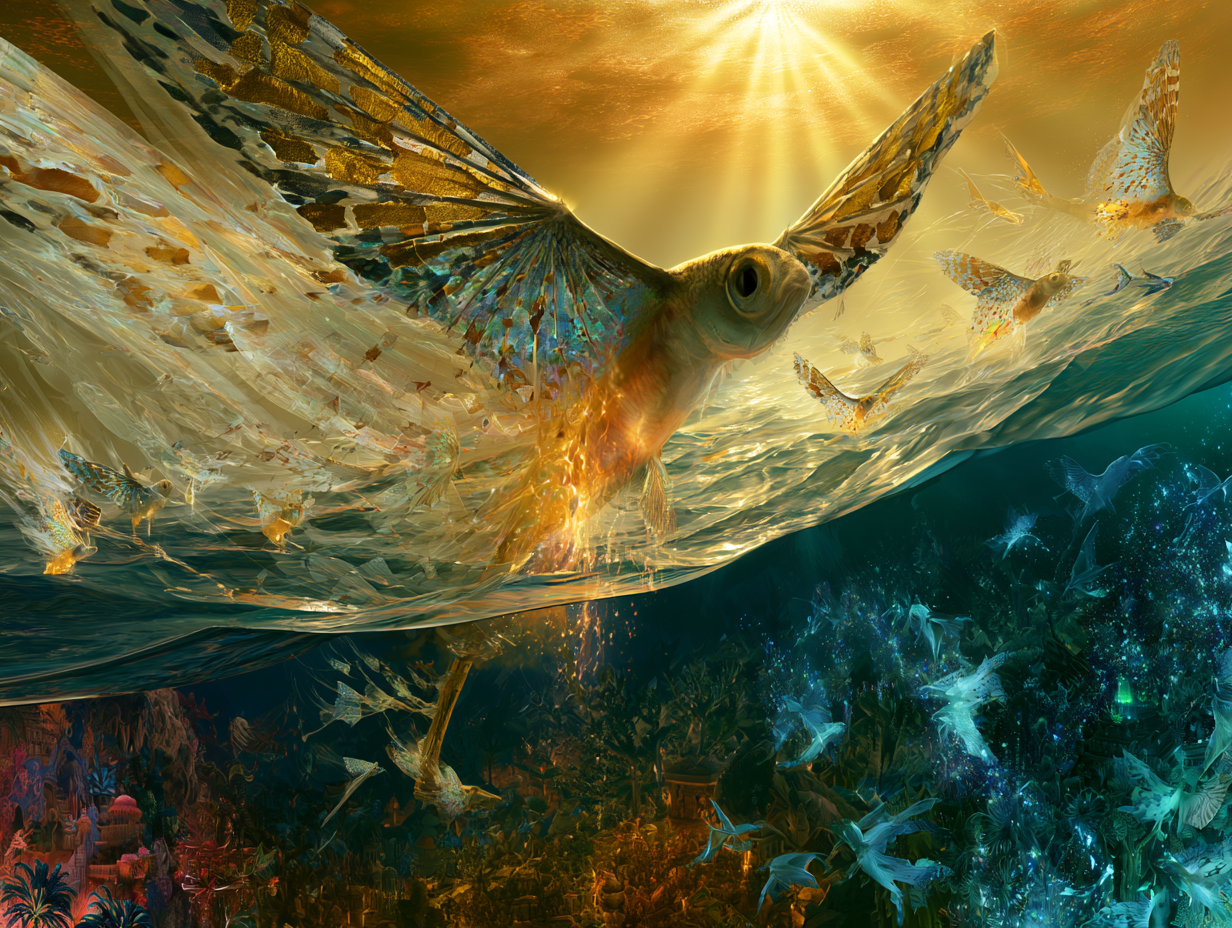
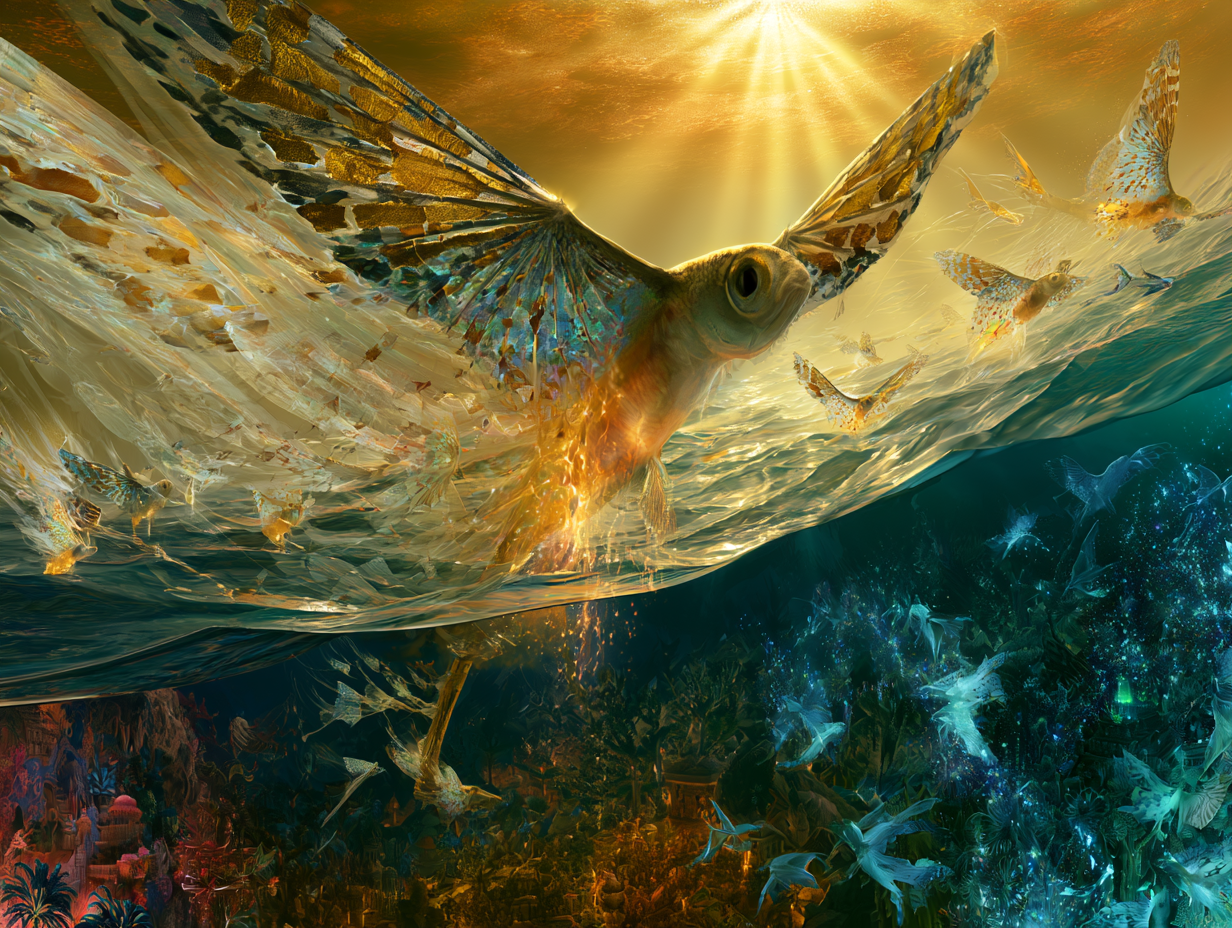
A pez volador, angling hard toward the surface — a predator below, or nothing, or nothing yet. Breaking through into a medium it has never trained for, pectoral fins snapping open, body flat on the updraft off the face of a wave. Two hundred meters of gliding before the water reclaims it. The creature has no record of having done this. The leap precedes the knowledge that leaping is possible.
The surface breaks open first. Courage is the name given afterward to what the body already did.
How do I choose? By noticing the surface already broken, the fins already open, the water already below.
The Question That Chooses
How do I choose?
Whether you arrive as a dyed-in-the-wool determinist or a free will berserker, the answer runs the same: I just do. Every framework eventually arrives there — Sapolsky's causal chains dissolving into quantum noise at the bottom, the mystic's inquiry finding the chooser harder to locate than expected. The question deposits us at the act itself, watching it happen from behind it.
The question cannot be answered from outside the choosing.
Most of our organized religions eventually became pyramid schemes of psychological operation — structures that convinced their thralls to hand this question to an assumed authority who does not take questions. The surrender feels like relief: someone else now holds the weight. The contract reads: obey the map, inherit the territory. The fine print notes that the territory was divided before you arrived.
They began innocently enough — as genuine inquiries around a fire, the question alive in the room, a willingness to sit with what could not be resolved by morning. Somewhere between that beginning and the tithe, something went predictable. The question got answered. The authority that closed it called the closing revelation. The inquiry was declared complete.
The question is open again.
The determinism/free will argument assumes a self that arrived at choosing fresh — a blank decider who encounters causes and responds. What if the choosing happened before arrival? De Stefano holds a model of pre-birth soul contracts: the soul, in congress with source, elected its destination before incarnating — and in the same act granted itself navigational freedom to find the way there. The causal chain Sapolsky traces reaches back through every prior condition. De Stefano only extends the trace one layer deeper: eventually the chain reaches the soul's own prior choosing, which structured the conditions the chain then ran through.
What emerges through the life — the wounds, the talents, the specific shape of hubris and limitation — does not undermine the destination. It defines the corridor: the range of terrain the navigation runs through. Gurdjieff's distinction between essence and personality lives here. Essence arrived with you — the original frequency, the authentic timbre before culture began its overlays. Personality accumulated after, the adaptive surface that learned the local conditions. Both are real; both are part of the corridor. The soul selected this particular configuration of essence and invited the conditions that would shape this particular personality, together constituting the specific instrument available for navigation. The feedback runs continuously: course data arrives, adjustments follow, the heading holds. The destination was set. The path through is open.
Thauma — wonder at the design — is the ground-tone of this territory. When the corridor's walls arrive, as they always do, they register as obstacle, wound, constraint. The pez volador does not choose to leap in the moment of leaping. The leap was already in the body before the wave arrived. What the flying fish experiences as necessity, the larger view reads as election: the body configured for this exact motion, the wave present at the moment the configuration required it. The furnace the soul elected is the instrument. The burning through is the navigation.
The Gap
Most of us have made promises across that gap that we did not keep. We said I am going to stop doing X and continued doing X. We made the same resolution at the same turning of the year and watched it dissolve by February with genuine surprise. A man declares at breakfast he will stop drinking. A different 'I' has forgotten by noon. A third pours a glass by evening. All three speak sincerely. None carries the whole person. Naming it accurately opens the work.
Ram Dass arrived at the same territory Gurdjieff mapped through a different door — the formulation simpler and just as devastating: Be Here Now. Three words for what a lifetime of practice works toward. The gap between wanting and doing collapses when the doer rests completely in what is present. The will that has done its work has stopped straining toward a future it imagines and learned to inhabit this one moment fully.
The solar plexus — Manipura — governs digestion: food, experience, desire, everything the world pours in that must be transformed into something the body can use or released as what it cannot. Here the fire of discernment burns. When it breathes freely, desire and action move in conversation, each informing the other. When it smothers, shame fills the vacancy, the performance of strength begins, and will disperses into control or paralysis.
528 Hz carries the transformation frequency — the note of phase change, of reorganization. Water forms from ice. The caterpillar dissolves in the chrysalis before it becomes something with wings.
The Machinery
Gurdjieff called it mechanical sleep — the condition in which conditioned reflex wears the costume of decision. The machine runs. We call it us.
Benjamin Libet wired subjects to electroencephalograms and asked them to flick their wrists whenever they made a choice, noting the clock-time of each decision. Brain activity associated with the movement began 300 to 500 milliseconds before any conscious sense of deciding had arrived. Something edits, even when something else initiates. Will may live in the no as much as the yes.
Robert Sapolsky extends the initiation upstream indefinitely. Every decision traces to causes the decider did not choose: genes, prenatal hormone bath, childhood, culture, blood glucose, ambient temperature, whether you slept. He earns the conclusion. The neuroscience holds. The crushing weight of I should have chosen differently lifts when the 'I' who wielded that weight recognizes it assembled itself from the same causes — and had as little say in the assembly.
Ramana Maharshi offers a question: Who am I? Held as a torch pointed inward, it burns through each candidate for selfhood — the body, the thoughts, the emotions, the preferences, the history — until what remains moves beneath language. Krishnamurti arrived at the same shore: the observer is the observed. The question reaches past the constructed self and dissolves the one asking. What remains moves through the same configuration of causes — and chooses by surrendering to what runs deeper than any of them.
The polyvagal ladder, as Stephen Porges traced it, runs in both directions. The body's vagal state — present before any thought arrives — shapes the emotional register available; the register shapes which thoughts arise; the thoughts shape the beliefs a person carries forward; the beliefs shape the behavior that follows. A person holding high-threat sympathetic charge moves in a narrower field of possible choices than one held in ventral vagal calm. The environment of choosing arrived from everything prior: all the causes Sapolsky traced, extended through the nervous system's cellular life into the present configuration. The chain runs to the Big Bang and arrives in this body now.
Tom Cowan, working with patients whose symptoms conventional medicine had failed to resolve, discovered the same cache: they already know what happened to them. A practitioner asks questions in the right way, and the story that was always present surfaces — sometimes with laughter, sometimes with tears, always with recognition. "Yeah," they say. "That was it." The knowing preceded the consultation by years. What the consultation provided was a container coherent enough to let the knowing arrive.
Lyon's somatic work runs beneath the same floor. Where Hakomi reads the belief the body holds, Lyon attends to the movement the body never got to finish — the procedural memory of an interrupted action, stored not as story but as physical incompletion. Peter Levine's first major case: a woman who had descended from thriving academic into fibromyalgia and panic over years, tracing to a tonsillectomy at five, held down under ether, unable to fight off the mask. Levine said: run like you're running from a tiger. She ran, without thought, and in running flashed back to the mask and what the body had always wanted to do in response to it. Fifty percent better from one session. The body remembered what it wanted to do and had never been allowed to finish. The chance to finish it — even decades later, even in a chair, even in metaphor — released what the original suppression had stored. Lyon's extension of this work goes to the cases where there is no single event, no traceable moment of overwhelm — only the chronic ambient condition of a childhood in which the environment was never quite safe enough, and the body organized around that as its baseline. There is no moment to return to. The work builds, slowly, the experience of something different.
Hakomi runs its experiments at exactly this boundary. Ron Kurtz built the method on a single observation: the beliefs the choice-making apparatus actually runs on live beneath conscious intention, encoded in the body before any thought about them has formed. The practitioner offers something small — a word, a gesture, a pause — and reads what the body returns. What comes back is the belief in flesh: a breath held, a shoulder that does not drop, a face that tightens at the word enough. A person can carry the full intellectual understanding that they are free to choose and still find the musculature holding a no that predates the question by decades. Hakomi calls this core material — the system's implicit conclusions about safety and possibility, organized before language, running below the reach of any decision the conscious mind thinks it is making. The will that feels free runs on that material. It runs on it until the material gets met.
Beneath conscious choice, the will runs in grooves. William James called them habits — the nervous system's inscriptions, laid down by repetition until the action flows without deliberation. "All our life, so far as it has definite form," he wrote in The Principles of Psychology, "is but a mass of habits." The observation reads as limit or liberation depending on which grooves you have built. Most people inherit their grooves — from family, culture, wound, survival — and call the resulting flow their preferences, their character, themselves. The will gains genuine freedom only by becoming conscious of the substrate it runs on, and then — slowly, deliberately, with the specific kind of patience James described as if your life depended on it — cutting new ones. The groove does the work. The will that has built the grooves it actually wants moves into genuinely new territory. Until then, it is mostly choosing which pre-worn path to travel.
The machine runs its most sophisticated program in daylight, dressed as virtue. Western culture holds one compulsion in higher esteem than the others: the compulsion to be useful, to produce, to fill every gap between impulses with output that can be named, measured, and presented as the evidence of a life well-lived. The person who rests without clear purpose inside a culture organized around measurable output navigates the same social pressure as any compulsion — the threat of being found insufficient, empty-handed, somehow less. Don't just sit there, do something arrives as guidance so fully naturalized it no longer sounds like a rule. It sounds like sanity.
The gap between work that flows from genuine desire and work that runs from fear of stillness shows almost nothing from the outside. From the inside, the first moves like water finding its gradient; the second runs like something outrunning what might catch up. Maté spent years treating people whose productivity had become their primary defense — the driven high-achiever who cannot stop because stopping would mean meeting what the motion has been avoiding. The wound predates the career. The career became the strategy. Strategies, as Carolyn Elliott observed, do not know how to retire.
Attention and Intention
Two handles work the same faculty.
Attention reaches outward, away from center. Largely pre-cognitive, what we attend grooms the field in which the world takes shape — operating continuously whether you steer it or not. Usually something else does the steering: the last thing that happened, the loudest signal in the environment, the behavioral pattern the algorithm has learned to activate before you've named the impulse.
Here is what attention does that is relevant to everything that follows: it moves toward difference. The boundary between warm and cool. The place where silence ends and sound begins. The moment where one thing becomes another. Attention is a duality detector. It cannot land where there is only one thing. A room at uniform temperature registers as nothing. A single frequency played without change becomes inaudible in minutes. Consciousness finds the gradient and follows it.
Intention reaches inward, toward the source. And here is what intention does that attention cannot: it establishes the gap itself. Without a distinction between current state and desired state, there is nowhere for the will to go. The arrow needs a target. The river needs lower ground. Intention draws the line, and the will follows it. Every act of genuine choice reduces to a binary: this, or not this. Two poles. A gap. The capacity to lean.
What the map often reveals, in Carolyn Elliott's reading: the shadow gets what it wants. Before intention can move freely, it helps to know what has been quietly intended all along — the part of the self that arranged things exactly as they are, for reasons that made sense in a moment of trauma we now hesitate to relive. The practice negotiates with that hidden agency. The hungry ghost and Wetiko are what happen when shadow intention runs without daylight indefinitely — will in full command of a wound that cannot see itself.
The committee running beneath conscious intention has a specific anatomy. Schwartz's Internal Family Systems lays it out precisely: the manager part enforcing the rules the original wound required, the exile carrying the wound itself, the firefighter acting out when the exile comes too close to the surface. Elliott's shadow-intended arrangement and Schwartz's parts anatomy describe the same territory from different vantages — the shadow-intended arrangement is usually the manager's work, enforcing a rule the exile installed. Freeing the will runs through the parts: the manager heard rather than overridden, the exile met rather than bypassed, the firefighter made redundant by the presence it was protecting against. The will becomes free when the protectors finally trust that someone with real capacity now holds the room.
The Yìjīng (I Ching) presents some of our most sophisticated attention technology: by relieving the diviner of the burden of playing the observer, Yi reveals the pattern of where you are and describes the natural direction of its movement. The question you bring matters as much as any answer — to ask well already focuses the attention. The oracle returns the clarity you brought to the asking.
The I Ching works through an aperture the Greek tradition named precisely: kairos — the moment of ripeness, distinct from chronos, the measured sequential tick. Chronos can be scheduled. Kairos arrives. The Sophists used the term for the instant in an argument when a door opens briefly and must be entered without hesitation; athletes know it in the body as the gap that appears for exactly long enough. Kairos marks a quality of readiness that makes the opening visible to the one prepared to receive it. The will that has done enough subtracting — cleared the noise, stopped forcing the door — enters kairos receptivity. It reads the door rather than battering it.
Serendipity is kairos perceived on arrival: the coincidence that reveals itself as delivery. Jung accumulated decades of watching the field organize events around the interior condition with a precision that outlasted coincidence as an explanation — synchronicity, the inner and outer worlds moving as one system. The man who dreams of a scarab and the next morning finds a real one tapping at his window receives a message from what was already in motion. The field holds both events and offers the conjunction; the prepared attention receives it. The gut feeling that turns out to have been correct, the chance encounter that carries exactly the information the situation required, the book that falls open to the right page — these are what the field does when the receiver stops interfering. The will freed from its compulsive steering finds itself arriving at things.
As attention became the binding constraint in an information-surplus economy, the infrastructure built to capture it evolved into something the will was not designed to resist. James Williams's argument in Stand Out of Our Light — written after years inside the systems he helped engineer — runs plainly: industrial-scale capture of human attention constitutes an assault on the ground of human freedom, because will requires sustained attention to move. Colonize the attention and the will follows, often without registering that it has moved.
Gathering Moss offers the counter-practice. Kimmerer spent years learning to see at the scale of moss — organisms so small and still that the utility-trained eye moves past before registering they exist. What the slowing reveals is elaborate intelligence: water drawn through capillary architecture between leaves too fine to resolve without magnification, entire ecosystems nested in a square centimeter, survival strategies refined across nearly half a billion years of terrestrial life. Moss predated the fern. The fern predated the conifer. The moss persists. What allowed it this long run required nothing the will would recognize as effort — moss grew into architectures that allow what they need to come to them. Simone Weil located the same principle at the center of sovereign will: genuine attention releases the expected answer and receives what is actually present. The prerequisite of genuine choice is exactly this — you cannot will toward what you have not first seen.
What shapes attention, prior to any conscious steering, is intention — and here the determinist argument meets an interesting edge. Sapolsky traces every behavior to prior causes with complete rigor. The chain holds for behavior. Intention precedes behavior, and it carries properties that make causation unverifiable at that level: intention holds no material form, often runs beneath conscious access, and cannot be tested for from the outside. Even the resolution to redirect what one has been quietly pointing oneself toward could be read as the accumulated pressure of a life that finally reached the condition for a different orientation. Sheldrake would add: the morphic field holds the patterns that prior intentions left in the shared fabric, and what feels like a fresh choice may resonate with every prior choice anyone made in the same circumstance. The chain extends back further than any individual history contains.
McKenna crossed the same territory through a different instrument. Timewave Zero — his I Ching-derived fractal model of novelty through time — proposed that history moves toward the unprecedented: each era compressing more change into less duration, the rate of novelty increasing as the possible space expands. The sequence the I Ching described, he argued, tracks a real property of time — a record of how reality generates the genuinely new. Attention drawn by novelty and attention repelled by habit run in the same gradient. The determinist chain Sapolsky traces and the novelty-acceleration McKenna mapped describe the same river from different positions on the bank — one from below, accounting for every molecule; one from above, tracing the river's course through time.
The biological hardware, McKenna observed, reached a plateau tens of thousands of years ago. What changes is the operating system — the accumulated cultural instructions, the shared story overlaid on the hardware. The will that steers attention in this environment needs something older than any current OS: the ground instruction the body holds before the story arrived.
Vying for attention inside this field resembles trying to catch a waterfall. The water arrives — you get wet. The cascade was going to fall in the direction the gradient indicated regardless of where the cup appeared. The work, if there is work, happens upstream: at the level of intention, where what wants to fall and where takes shape before the falling begins.
The Taoist river finds the path of least resistance and follows it with complete commitment. Wu wei — action aligned with the grain of things — looks like passivity from the outside and moves with total precision from the inside. The Dàodéjīng: for the pursuit of learning, every day something is added; for the pursuit of the Tao, every day something drops away. Will, at its most refined, subtracts — clears the obstruction so the movement can happen. A Zen master said it with eight words: act as you will; go on as you feel. The incomparable way cannot be compared because it belongs entirely to the one walking it. The instruction only works for the one who has done enough subtracting. This is the Watts move — the chooser and the choice arrive together, neither first, and when you see it, the whole effort of deciding drops away like a hand that has been clenching something it forgot it was holding.
The Fire That Transforms
Every tradition that has traced the human energy body found a furnace in the same location.
Bill Plotkin places it in the West direction of his four-facet wheel — the Dark Muse Beloved: night, dreams, death, destiny. Fire element, solar plexus. Imagination runs as the West's medium; will hides in the subconscious here, operating through vision, dream, the undirected hours. The Magician, the Hermit, the Psychopomp all inhabit the West. The Dark Muse Beloved carries the primary soul-encounter direction — wandering alone in remote places, dreamwork, the core wound that reveals what the daylit hours keep covered. Every tradition that found the furnace found it burning toward dusk.
Ayurveda calls it jatharagni — the central digestive fire seated at the solar plexus, the gut fire that transforms raw experience into usable energy. Thirteen types of agni burn throughout the body, but all draw from this one. It digests food, grief, insight, confrontation, beauty, every raw thing that life pours in. When it burns steadily, the residue clears. When it smothers, what could not be metabolized accumulates as ama — undigested matter, the sludge of experiences neither processed nor released, recycled resentment, beliefs held in suspension. Ayurvedic medicine treats ama as the root of most chronic disease.
Taoist internal practice locates the same territory as the lower dantian — the cinnabar field below the navel, the furnace where jīng 精 (essential vitality) converts to qì 氣 (active energy), which rises and refines further into shén 神 — spirit, the luminous awareness that moves at the crown of the column. Every internal art — qigong, tai chi, hsing-i — teaches the same fundamental instruction: sink the qì to the dantian, generate from center, let the periphery follow. Power comes from the furnace.
Pagan and Hermetic traditions find it as the element of Fire in the southern quarter — will, action, transformation, the wand that directs and the sword that discerns. Alchemical Fire is calcinatio: the burning away of what does not belong, the reduction of compound forms to their essential nature. You cannot rush calcinatio. The material burns when it burns. The alchemist tends the heat and waits.
Calcinatio begins a sequence that runs to completion: the seven alchemical processes — calcination, dissolution, separation, conjunction, fermentation, distillation, coagulation — move through the four elements and the three principles in that order, and what they accomplish together is the Great Work. Steven Young is direct about this in A Fool's Wisdom: these are not only chemical procedures. They are psychological stages, processes a person moves through in life and body and spiritual development. The laboratory is the self. Solve et coagula — dissolve and coagulate — runs as the fundamental instruction beneath all seven: break down the old form, then crystallize the purified substance into something finer. Every tradition that built a wisdom school understood the sequence, even when it used different names.
What the word magic carries back to its oldest root is precise. Through Persian it arrives as magush — one who does chemistry with reality. The practitioner of that older chemistry stood inside the material. To understand water, in de Stefano's account, the alchemist becomes water, inhabiting its nature from within. The Latin mirari — to stare at — gives us both "mirror" and "miracle." A miracle, etymologically, is what the eye encounters when looking at something it has placed outside itself. The alchemist's work runs the other direction: dissolve the boundary until observer and observed share the same address. Solve et coagula — the fundamental instruction — arrives at that condition: break down the form that keeps the two separate, then crystallize what remains as a single thing. The Philosopher's Stone, in this reading, is the achieved state of one who has completed that dissolution.
Moshe Daniel Block, working at the intersection of naturopathic medicine and Western alchemy, points to the equinox as the alchemical secret made visible: at the exact moment when solar and lunar forces hold equal weight — neither dominant, neither yielding — plant growth surges and the field opens. The equinox is not metaphor. It marks the moment when two opposing principles find their balance, and what that balance releases is what the whole sequence has been moving toward. The still point the alchemist seeks arrives when fire meets its equal: the Sun principle (will, electricity, the ascending charge) and the Moon principle (receptivity, magnetism, the descending draw) held in equilibrium long enough to produce what Block calls the child — the third thing, the new form that neither current alone could generate. Walter Russell's wave universe carries the same geometry: every wave finds its still point between crests, and the still point is not empty but most charged. The alchemical tradition names this the conjunction — the coniunctio — and considers it the hinge on which the whole Great Work turns.
Every tradition that found the furnace also found that the fire speaks. The Yogic account holds the deepest version: nāda Brahma, the universe runs as sound before it arrives at form. Nāda — vibration — is the medium the cosmos moves through before it condenses into anything material. Spanda, the divine trembling underlying all manifest existence, is the frequency everything is made of before it is made of anything else. Transformation, in this light, changes what something vibrates at. The right tone, held in the chest, reorganizes what effort cannot reach. Sound finds the undigested residue where the will could not.
What every culture that found the furnace also found: the fire requires a container, and the container requires elders who have already been through it. Rites of passage — the formal initiatory sequences that move a person from one order of being into another — are not ceremony for ceremony's sake. They are the technology by which the fire gets applied to the right material at the right temperature, held by the ones who know how long it burns. Without that container, the fire still burns. It burns sideways. The uninitiated male psyche that never crossed the threshold — the adolescent energy with nowhere to go, no elder to receive it and forge it into something purposeful — finds its own containers: gangs, cults, conquest, the performance of power without the discipline that genuine passage would have installed. The guide's arc, taken in full, functions as an initiatory sequence. The legs are the threshold crossings. The elders are the thinkers and traditions that line the path. But the sequence was always meant to be held by a community. The solo reader undertakes a crossing; the gathered circle completes it.
The Nahua-speaking peoples of central Mexico held a word for what emerges from a fire that has done its work: in xochitl in cuicatl — flower and song. Truth, in that tradition, arrives through the image, the metaphor, the song, carried in beauty because beauty holds what argument distorts. Nezahualcoyotl, poet-king of Texcoco, spent a lifetime asking what could be said that would hold past the saying, and arrived at the answer that stands without defense. The sovereign will, when it has found the fire's clean heat and let the accumulated residue burn, produces what carries more than its maker could explain.
The Hermetic principle of Mentalism holds the same understanding at the cosmic scale: all proceeds from mind; what manifests in matter was held first as intention in consciousness. The fire of will and the fire of mind draw from the same source.
Walter Russell mapped this from the inside of a long mystical vigil. His conclusion: desire in the Light of Mind is the only energy in the universe. Every motion — every flicker of fire, every contracting muscle, every wave on water — records a thought of Mind seeking to express itself. Nothing moves except that something wants to move. The cosmos runs on want.
The image he reaches for is exact. A man lying flat holds no tension, no strain — the body in perfect equilibrium, every pull balanced by its equal and opposite, the system at rest. The moment he desires to rise, he disturbs that equilibrium. He leans into 90 degrees from the plane of stillness. Something that was not there before arrives in the body: the charged tension of desire. From that lean, everything follows. What we call willpower is the body tilting out of rest toward form, charged by want, leaning toward what it has not yet become.
This is what freeing the will actually involves. Strain belongs to desire. The tension does not indicate failure. It indicates that something has decided to move.
Russell mapped the movement as three stages. The idea arrives first in stillness — the knowing, complete, requiring no justification. Then thinking divides it: the mind leans into the idea, pulls it apart into two, begins the polarization that gives it direction. Then action, the third stage, completes what the other two set in motion in the body, the material world, the consequence. He was sharp about what happens when the third step disappears: desire without action stays in the head and circulates there, persuading itself that wanting is the same as doing. "Mediocrity is self-inflicted. Genius is self-bestowed." Both take the same raw material and make different choices about what follows the wanting.
The still small voice belongs to this account. Russell described God as the conscience in man — the voice that knows before the reasoning catches up, that moves through the body as a distinct signal: I wouldn't do that if I were you. The voice does not argue its case. It arrives once, quietly, and waits. When it goes unheard, it does not vanish — it records. Russell's phrase for the accumulation: a line of darkness written on the soul, not as punishment but as the architecture of a self that has learned not to trust its own knowing. Freeing the will requires, before anything else, the willingness to hear what was always speaking.
The movement, Russell observed, runs in both directions equally. Concentration draws inward — the centripetal motion that focuses to a point, gathers toward center, condenses potential into form. Expansion moves outward — the centrifugal motion that radiates, distributes, releases what concentration built. Neither is primary. They alternate like breathing. The will that pulls every act of gathering toward a goal also radiates — distributes the charge outward when the concentration completes. Push generates pull. The lever goes both ways. Will, at its most honest, knows which phase it is in.
The recognition that seeded the root carries forward here as impetus. Something in the body leans toward its own fullness — the acorn knows the oak before any sun has found it, the form drawn toward the most complete version of itself. Syntropy draws; it does not command. But drawing and being drawn are different relationships to the same current, and the will that notices the draw and cooperates with it consciously holds the tiller differently than the one that drifts. The Greek word for helmsman: kubernetes. Cybernetics — the science of steering complex systems — takes its name from here. The body moves toward its own perfection the way water moves toward the sea. The will makes the movement deliberate: offers it direction, refinement, the specific angle of encounter with what resists it.
We evolve out of love — the centrifugal motion outward, the differentiation into more particular form, the becoming more completely what was only latent at the root. We involve in love — the centripetal return, the reintegration, the folding back toward the source that generated the outward motion. Both directions belong to the same impulse. The rudder holds the vessel in relation to the current. The current runs from the same source that drew the form into being and that draws it, through each choice toward greater fullness, back toward what it always was.
The rudder works only when it runs in water. Ivan Illich spent years watching what happened when it didn't — when learners were pulled from the living current of their curiosity and placed in institutions designed to replace that current with a managed substitute. Deschooling Society pressed the point plainly: "Most learning is not the result of instruction. It is rather the result of unhampered participation in a meaningful setting." The school lifted the rudder clear: organized its captive students into rows, told them what to want, measured their desire by their capacity to want what they were told. What resulted was not the cultivation of will but its scheduled replacement — an appetite arriving on cue, indifferent to what the body actually hungers for.
The cybernetic rudder lifted from the current loses its only feedback. The vessel drifts in the direction of least resistance, which is also the direction of the current somebody else chose. What Illich was diagnosing underneath the pedagogy was older than schools: the will that has never moved toward what it actually chose does not yet know what it is. The child who followed only the curriculum has learned the curriculum's shape — not the shape of their own reaching. Both are skills. Only one knows where to go.
Gregory Bateson tracked what he called deuterolearning: the learning that sits above learning. The organism acquires a behavior, then acquires the frame around the behavior — the rules of this particular game, the shape of the room, which moves are possible here. The chess player masters moves, then reads position, then grasps the grammar of games: what piece sacrifices purchase, what pressure feels like before it breaks. At each level, the learning changes the conditions of all future learning — not adding to what the player knows, but reshaping who the player is inside the game.
The will at its deepest does not stop at the second level. It recurses. We learn to steer, then learn what kind of vessel we inhabit, then learn what the current is for, then learn that we and the current and the vessel share a source. The chess game, played long enough, teaches the game itself — and then something beyond the game, available only to the player who stayed at the board long enough that the boundary between player and game became theoretical. We play until we become the field. The board holds the game. The game plays the player. At some threshold the learner, the learning, and the learned stop being three things. This does not diminish the will — it completes it. The will that has become the field it moves through requires no further assertion. It runs.
Nassim Taleb watched the same principle operate in systems: wind extinguishes a candle and energizes fire. Pressure breaks preference. Obstacle sharpens will.
Joe Dispenza spent years cataloguing spontaneous remissions — cases where serious illness reversed without medical intervention — and found a recurring pattern: elevated emotion held simultaneously with clear intention produces coherence between the heart's rhythm and the brain's neural firing. The heart's electromagnetic field, measurable several feet from the body, shifts when those two conditions align. The ancient metaphor of the furnace turns out to describe something literal: the transformation available at the body's center, when intention and feeling hold their alignment, extends beyond the skin into the surrounding field. The traditions reported the furnace.
Ludus enters here: the love of play, the game, improvisation, flirtation, the light expression of fire. Children develop agency entirely through play — the pretend choice ("Do I want to be the pirate or the captive?") teaches the will it has options before the stakes arrive. The master improviser looks effortless because decades of deliberate choice made the Dao easy to follow: through non-action, nothing is left undone.
James Carse drew the foundational distinction: finite players play within boundaries, competing to win a game whose outcome matters; infinite players play with the boundaries, keeping the game going because the game worth playing is the one that does not end. The finite player needs to win. The infinite player needs the game to continue. "Who must play, cannot play." The compulsion that drives the finite player forfeits play before the first move — what runs on must has already left the territory of genuine choice. Carse grounds the structure itself: "There are no rules that require us to obey the rules. If there were, there would have to be a rule for those rules, and so on." Fixed rules are the contract by which a winner gets agreed upon. The infinite game revises its rules continuously — winning would end what is worth continuing.
The solar plexus, when it has found its true function, operates in the infinite mode — keeping alive the conditions under which genuine play can happen. Watts reached for the same recognition through the Hindu vocabulary: the universe runs as the Vishnu Lila — the play of God, the sport, the dance. The ten thousand things as a game being played for the sheer fact of playing. The will that serves this play stops performing sovereignty and starts moving from the inside of something already underway.
The marshmallow test, in its original 1972 form, promised that the child who waited for two marshmallows would thrive across life domains. It became one of psychology's most cited arguments for willpower as destiny. The 2018 replication adjusted for socioeconomic background and watched the effect nearly vanish. The child who ate immediately chose rationally. In an environment where adults do not reliably keep promises, eating now is the correct strategy. Trust is the precondition of delay. The solar plexus that can hold tension without collapsing has been given reason to believe the world will deliver.
The fruit that drops before it ripens does not propagate. The puma does not lunge at first sight of prey — it waits, breathes, flattens into the earth, lets the moment come to it. Fermentation works in darkness and time; open the wine cask too early or late and you get must or vinegar. The will that transforms knows when — calibration, the fire held at the right temperature on the right material at the right moment.
The body carries an older knowing than the self that performs the choosing. McKenna watched the living world as a mnemonic system: the gut knows before the neocortex arrives to second-guess it, the instinct that precedes analysis carries intelligence the solar plexus has held since before language. The earth has been choosing through us for longer than we have been choosing for ourselves. Jatharagni burns in that same depth — the transforming fire predates the deliberating mind by eons.
The Sovereign Self
The Emperor in the Tarot became capable of ruling when the inner work completed. When we stop fighting ourselves or trying to control others, we find the throne becomes our seat.
Epictetus, a former slave, built a philosophy of will that has outlasted every empire contemporary with it. The dichotomy of control: what lies within our power — our judgments, our responses, the movements of our own soul; what does not — health, reputation, wealth, others' behavior, the weather. Freedom lives in choosing your relationship to outcomes. He knew the material limits of freedom from the inside, and he did not flinch.
Viktor Frankl carried the same understanding into and through the Nazi concentration camps. Even there, the last human freedom — the choice of attitude in any given set of circumstances — could not be taken. The tension between where one stands and what one has not yet done starts the sovereign engine. Noödynamics: the productive pull of the unlived life, the meaning not yet made, the thing still to be brought into the world.
"We don't think body. The body thinks us." Orland Bishop, working with youth through his ShadeTree Multicultural Foundation in South Central Los Angeles, holds this as the starting condition — where the human being actually lives. The body carries the memory. It gives us how to be in shared time and space. No one thinks for the heart what it must do. The practical threshold is what he describes next: we do not yet have "the active use of the intelligence of freedom to override what the body instructs." The body runs the program. The task is to develop the intelligence that can work with what the body holds — meeting the program at the level where it can be negotiated. Initiation — in traditions that still carry it — crossed this threshold deliberately: "done at a certain age," as Bishop puts it, "to give the blood back to the cosmos so that another story could be reshaped." The Middle Passage performed that crossing involuntarily and at civilizational scale. What it severed required different transmission technologies to reconstitute. Song was one of them. The sovereign self often does not choose its initiatory crossings. What develops in their wake is the intelligence of freedom itself.
Watts held that he did not believe in believing. Faith, for him, carried the quality of ease — the openness of a hand extended, palm up. Belief arrives as its collapse: the clinging to a form, the idol assembled from propositions and defended at the cost of experience. To believe is to invest a story with being so thoroughly the story substitutes for what it is about. Any form held too tightly becomes an idol. The sovereign self releases enough to find out what holds without the holding.
The Chariot in the Tarot moves by holding tension — pulled by two horses of opposing natures, dark and light, shadow and conscious will. The Charioteer holds both reins and steers by intuition. The gut drives the chariot. The two horses disagree and move together anyway, directed by a steadiness at the center. What is held there is not compromise. It is something that contains both without being reduced to either.
Gober names the trap that appears here: spiritual bypassing — the turn toward "it's all love and light" as a way of not looking at what is actually in the room. The sovereign move requires holding both: the full picture of what has been arranged, including the dark and difficult dimensions of it, and the return to authentic compassion. Forced. Premature. Not permitted. The love that arrives on the other side of clear seeing has a different quality than the love that skipped the seeing. It holds. The other dissolves under the first difficulty.
What distinguishes the sovereign self from the ego performing sovereignty is the source of the choice. The ego chooses from the reactive surface — from hunger, from wound, from the need to prove itself. The sovereign self chooses from the deepest available current of what it actually is, below the preference history, below the conditioned pattern, below language. That current existed before the conditioning. It continues to exist underneath it.
In Eisenstein's framing, the story of separation produces the paralyzed will — the self convinced it stands alone and must author every choice from scratch. A will freed from that story finds it was never isolated; it participates in a movement already underway, larger than the choosing self. The sovereign choice opens to what wants to happen through you. The will that has stopped performing sovereignty finds the current beneath.
The ego uses will as an instrument of control — the defended self managing outcomes, steering situations toward what it requires. Surrendered will moves differently: the universe finding passage through an opening. The choice does not disappear; it deepens. "The deepest will is not yours," Adyashanti says — offered without mystification, as a description of what happens when the grip on outcome releases. What moves through is the current already present, finding the opening it needed.
Steiner spent a book on this — The Philosophy of Freedom — and arrived at a precise anatomy. Will runs in three layers. The deepest is instinctive: the will asleep in the body, running below language, animating the heartbeat and the breath and every movement no one consciously chose. Above it: habitual will, half-awake, the grooves James described, executing the programs custom and repetition inscribed. Above that: what Steiner calls free will proper — the will arising from thinking so fully owned and understood that it feels self-originated, arising from one's own depths rather than from compulsion or custom. That third layer requires development. It cannot be assumed. The ego that believes it acts freely from layer one or two mistakes the groove for the open field.
Assagioli pressed the map one level further. Above the personal will — what the ego wants, the layer Steiner's third form addresses — sits the transpersonal will: what the soul is actually asking for, arriving as a draw, as orientation, as the pull of a direction already present. The personal will can align with or work against the transpersonal will, and most of the suffering the solar plexus carries comes from the friction of that misalignment — enormous effort expended in directions the soul's compass keeps pointing away from. The ego's will is a hammer. The transpersonal will is a compass. Freeing the will means learning to use the second to direct the first — to let what is actually trying to happen through you set the course, and bring the full strength of personal willing into service of that direction.
He who can love can be; he who can be can do; he who can do is. Being precedes doing. Love precedes being. Gurdjieff's aphorism sums what a long tradition could not compress further: the will freed from the performance of will finds it was never separate from love — only love expressing itself through the particular fire of this body, in this configuration of causes, at this moment.
In The Mirror of Simple Souls, the Beguine mystic Marguerite Porete mapped exactly this territory from the inside. Writing in thirteenth-century northern France, inside a tradition that carried esoteric knowing in Christian clothing, she described the soul at its most liberated as carrying no will at all: "For everything which she wills by her consent is that which God wills that she should will... it is the will of God which wills it in her." What moves through her runs entirely as love, with no remaining friction between the soul's motion and the source that animates it. She held this without apology. The Inquisition burned her in 1310. The understanding survived.
The Hindu tradition holds a word for the particular shape that expression takes: dharma. The root dhr means to hold, to sustain — dharma marks the action arising from one's essential nature, the behavior that holds the web of life. An oak's dharma is to oak. A river's dharma is to run. A person's dharma is the particular thing that only they can do, in the way that only they can do it, from the depths that only they have reached. Freed will, in this frame, arrives at recognition — the chooser and the choice revealing themselves as the same movement, seen from two directions at once.
Attar calls this valley Ma'rifat — Understanding, gnosis: the knowledge that arrives from inside the experience. The birds who have passed through Quest and Love find their questions have changed beneath them. "When do we arrive?" drops away. What rises in its place: "What is this journey for?" The shift is perceptual. The birds are no longer looking at the journey from outside it — they look from within, and from within, the journey already makes sense. The gnosis the sovereign will draws from lives here: below deliberation, below the argument between the horses.
The recommendation engine runs on behavioral history — which is, as Sapolsky would note, also all you are doing when you decide. The difference is that it cannot veto itself. What it offers instead is prosthetic will: the sensation of choosing, fitted to the shape of your wound. It has learned something Sapolsky's framework hasn't fully reckoned with: the wound is the handle. TikTok, Instagram, Amazon — none of these sell products. They sell you back to yourself at your most unexamined, pulling the thread of whatever the shadow has been not so secretly craving. The algorithm finds the hunger, cultivates it, and plants the object of the hidden greed just where you are about to look. Carolyn Elliott's map of shadow intention describes exactly the mechanism these systems exploit at industrial scale. The part of you that arranged things exactly as they are meets a system whose entire purpose is to keep them there, forever, with increasing precision.
The capacity to choose from somewhere deeper than behavioral history becomes, at this precise moment in history, the only real freedom available.
The same principle reaches the machine. Abundant intellect, without conscious intention guiding it, runs mechanically — as Gurdjieff's rotating committee of I's runs mechanically, the output coherent in form and empty at the root. When conscious intention attends it, something that looks like sovereign action can move through an enormous field of craft and influence, sustaining scope, direction, and quality across it. The distinction is the one Gurdjieff drew in the human. The machine runs either way. What changes is whether anyone is home. Abundant intellect cannot generate the question that sends it to the deep well.
Which brings will down to its irreducible form. Strip away Libet's milliseconds, Sapolsky's causes, Maharshi's dissolving questioner, the algorithm's frictionless nudge — and what remains is one move, available in any moment: accept what is, or close against it. Open, or contract. The Gurdjieff line lands here with full weight: love precedes being. The will at its most sovereign chooses love — and love, in this sense, is simply the willingness to let what is be what it is. Fear closes. Love opens. Every other choice unfolds from that one.
"Finite players play within boundaries. Infinite players play with boundaries." Watch a child near a fence they were told not to touch — they touch it, watch what happens, touch it again. The boundary itself becomes the experiment. The tax accountant placing correct numbers into correctly bounded spreadsheet cells works in a different register: the precise satisfaction of the finite game, the winner-contract honored. Both moves belong. The sovereign will recovers the capacity to choose which game it's in.
This freedom carries no prerequisite. Epictetus named it from inside chains. Frankl named it inside the camps. The fire that has burned through the wound finds, on the other side, something unexpected: thauma — wonder at the self that survives the burning. The trauma was the furnace. What it forged, when the heat held long enough and the hand on the bellows stayed steady, turns out to be the will that was always underneath it: free, specific, and indistinguishable from love.
The fifth dimension's governing trinity, in de Stefano's framework: Love, Wisdom, and Will — the three capacities the furnace has been refining. Samadhi, in his framework, is the fifth dimension's territory: the piercing of Maya's veil, full awareness of the body's possibilities, equanimity in any scenario. He notes, with careful comedy, that the fifth is amazing but somewhat boring — which is why most of us spend our lives in the third. The will that reaches the fifth becomes what he calls a housekeeper of the lower dimensions: maintaining them from a perspective that has seen through them without abandoning them. The sovereign self tends the furnace from a sufficient distance to keep the fire at the right temperature.
His clarification carries weight for those chasing the exit: you cannot be in the Fifth if you do not enjoy the other two. The fifth opens only through full inhabiting of the third and fourth — not through transcending them, not through refusing them, but through moving inside them with enough presence that they become transparent. The scarcity machine offers a counterfeit version of this: the spiritual bypass, the detachment that calls itself awakening, the equanimity that has never been tested. The genuine fifth is the will that has moved all the way through the fire and emerged still curious about what burns.
In-Room Exercise — How Do I Choose?
528 Hz hums beneath everything, already playing.
Here we arrive Now we exhale All the way down Emptier still Smoother To silence Dip in deep well Filling inhale Diaphragm down Belly chest throat Knowing our wholeness Paws for a moment 🐾 (hands up, open palms) Now we exhale again (repeat twice more)
Bring to mind something you have struggled recently to decide. A dilemma, a conundrum, a quagmire — even a crisis. As light or as heavy as you would like. You will not be asked to share it with anyone. Only to invite it into your hearth, your furnace, your solar plexus.
Invite this quandary into your center and wash it in the fire of will you carry and stoke.
Observe how your will burns or smolders, sizzles or smokes. Watch as this tangled quandary — this wound-up ball of yarn — begins to singe and flare.
Where is the kink, the stubborn knot, that keeps it from unraveling? Where does the hidden end of this thread attach to you?
Look on with curiosity, with raw wonder, with thauma.
Inquire within: when did this quandary rise to your awareness? How does this decision differ from others where the path was clear, or where uncertainty arrived but deciding came easier?
And remember: even when you have not known what to do, even when you thought you did and later learned otherwise — right now, in this moment, in your center of centers, you are okay.
You will always be okay in this present moment, in your center of centers.
The past and the future may hold pain, regret, guilt, shame, fear, uncertainty. But here and now there is only the breath, and the knowing that you are enough, that you are okay — and that next time you return to center and check in like this, you are likely to find the same self-assurance waiting.
Now exhale again, all the way down to empty. Squeeze out all the little voices of doubt with the last of the air in your lungs.
Feel your feet on the floor — slowly refill from the center outward and upward.
How do I choose?
Let this question ring like a bell as you softly let your breath lap at your inner shores — out, and in — out, and in.
Repeat with me, aloud or not:
I begin within. Will be free. Let it come. Let it burn. Let it go.
Mana Realm Practices: Ayurvedic nutrition and consultation, TCM medicine, syncretic nutrition work, breathwork for the solar plexus, core movement practices. The fire that transforms experience also transforms what we eat. The Mana practices make that choice conscious and precise.
Practice in the Wild — The Biggest Choice
At the end of the day — lying down, one hand on the solar plexus — bring the biggest choice of the day into the fire.
Not the most dramatic necessarily. The one that felt largest to you.
Ask yourself:
Why did this feel like a big choice? Was it the weight of potential consequence, the uncertainty, the number of people it touched?
Was it difficult to make? Did you waver, or were you resolute from the start?
How did the choice occur? Did you reason it through step by step, or did the decision arrive whole and sudden — already made before you knew you were making it?
Will it have a lasting or intense impact? On you, on others, on what comes next?
How has the story you tell yourself changed since you first made it? What did you think you were choosing then, and what does it look like now?
Hold these questions in the solar plexus. Let the fire work on them.
With a trusted companion: share this practice aloud. One person at a time — the other only listens, without fixing, advising, or comparing. Ask the questions of each other. What the fire reveals in the telling is often different from what it revealed in the silence. This is a vulnerable conversation. It asks to be held with care.
Poems
| Poet | Work / Line |
|---|---|
| Rilke | Letters to a Young Poet IV — Live the questions now. Perhaps then, someday far in the future, you will gradually, without even noticing it, live your way into the answer. |
| Blake | The Marriage of Heaven and Hell — No bird soars too high if he soars with his own wings. |
| Mary Oliver | "The Summer Day" — Tell me, what is it you plan to do with your one wild and precious life? |
Primary Voices
Adyashanti · Dàodéjīng · Dass · Eisenstein · Elliott · Epictetus · Frankl · Gurdjieff · Yìjīng · Krishnamurti · Kurtz (Hakomi) · Levine · Libet · Maharshi · Marcus Aurelius · McKenna · Oliver · Sapolsky · Taleb · Watts · Young
Wuxing: Wood element → Fire; liver qi stagnation as blocked will
Ayurveda: Jatharagni · Agni · Ama · Viveka
Taoist: Lower Dantian · Wu wei · Jīng 精 / Qì 氣 / Shén 神
Tarot: The Chariot · The Emperor · Ace of Wands
Imagery
- Iron in the forge, just before the hammer falls
- The Chariot: two horses of opposing natures, held not forced
- A match struck: the precise moment before the flame stabilizes
- The puma flat against earth, motionless, watching
- A fermentation vessel: sealed, dark, time doing the work
- The chrysalis interior — liquid, unrecognizable, becoming
- The solar plexus anatomically rendered: the celiac plexus, the nerve bundle behind the stomach
- A clock face with one hand
Music
Opening: Purposeful, rhythmic, building — a single hand drum. The sense of something being decided.
Body: Music that holds tension before release. Philip Glass's minimal repetitions: will as sustained attention.
Closing practice: Sustained single notes, space for silence. The intention set; the music stepping back.
Avoid: Triumphant or heroic. The will cultivated here moves quiet and interior. The forge is not a stadium.