§4 — Metronomics
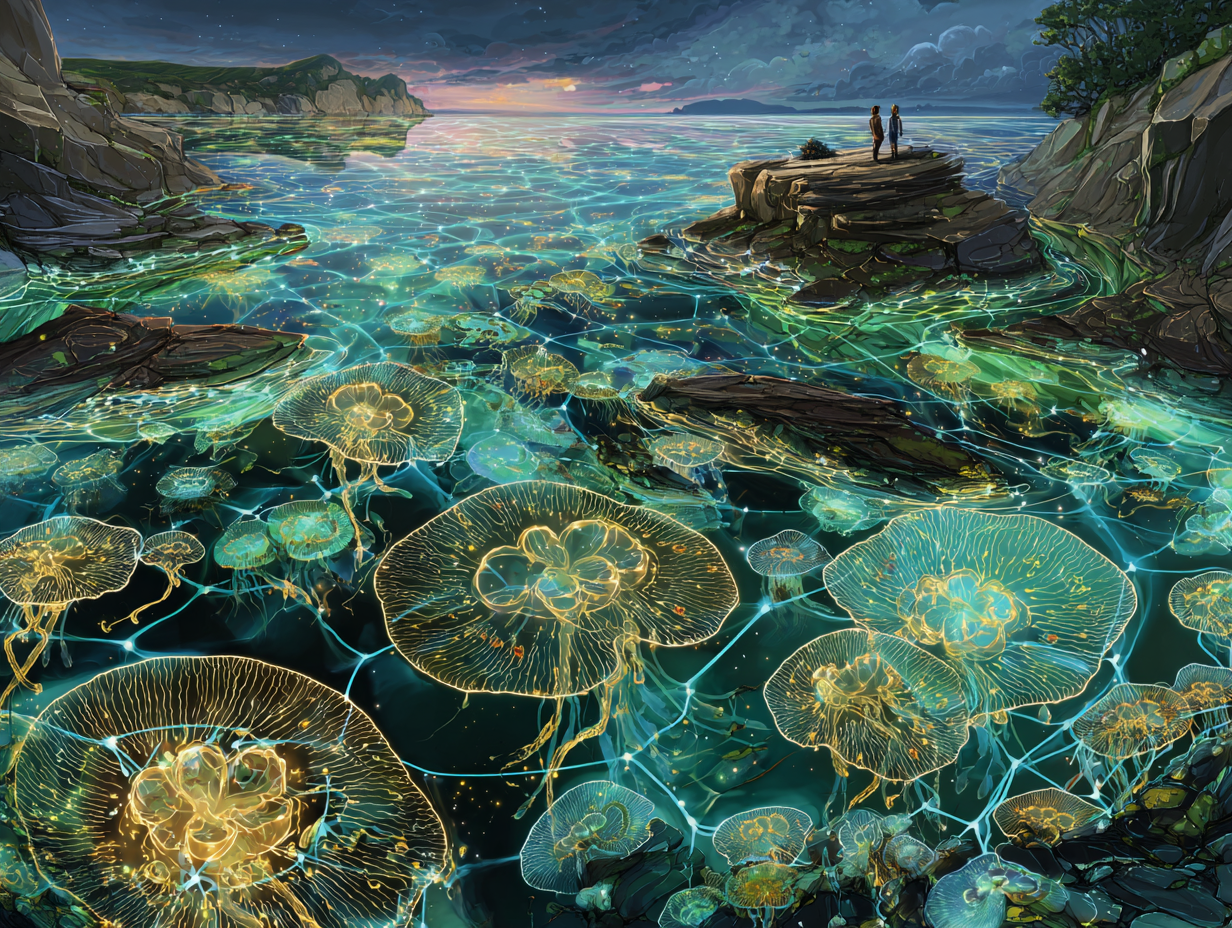
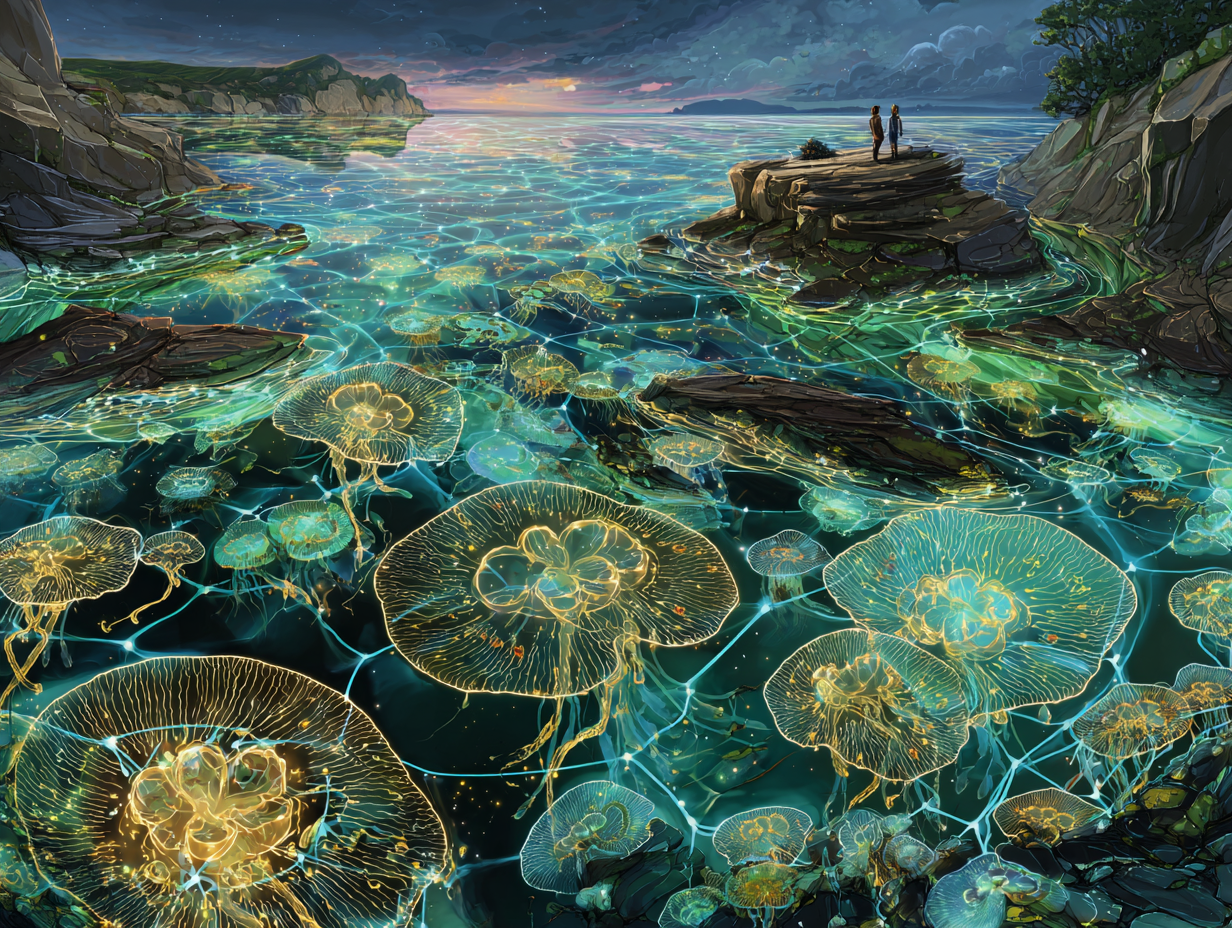
A medusa, bell contracting. Then another, then ten million — a bloom spreading across the surface of the Adriatic, each one pulsing in loose agreement with the water around it, no signal passing between them except the current itself. No brain coordinating this. No heart keeping time. Ninety-five percent water, playing water's own rhythm back to the sea.
The ocean is enormous and mostly this — life as vibration held in solution, receiving and broadcasting, each organism a temporary intensification of the wave. On land we carry the same ocean, the same salt, the same interior tide, the same readiness to synchronize with any rhythm that shares a wall.
What are we playing? The medusa asks every time the bell opens. The ocean answers. They already know.
The Question in Play
What are we playing?
James Carse drew the line that holds the whole: finite games play to end; infinite games play to continue. A finite game has fixed rules, agreed boundaries, and a winner. It runs until someone is crowned and the rest are dismissed. Society operates this way — ranks, credentials, positions, the competition to occupy them. An infinite game has no fixed rules and no boundary against which a winner can be declared. Its only purpose is to continue. Culture operates this way: the song passed from generation to generation, the language that lives because people keep speaking it, the dance that survives because it keeps finding new bodies. Society organizes us into roles. Culture invites us to play as souls.
The distinction runs to the root of how we meet. Roles arrive pre-configured: boss and employee, expert and novice, the one who needs and the one who provides. The role-player moves through the game already knowing their position. The soul-player arrives without the position settled — brings what they actually carry, stays curious about what the other carries, meets the interval between them as territory worth exploring. One way of meeting runs on scarcity: limited positions, someone earns the rank, someone doesn't. The other runs on abundance: what circulates between two people who genuinely show up generates more than either arrived with.
Role-play in scarcity produces a predictable shape. Stephen Karpman named it the Drama Triangle: three positions that form whenever a wound and a story about it go unexamined. The Victim finds the world happening to them — circumstances as injury, life as something endured. The Persecutor provides the source of the injury, blamed into being, sometimes real and sometimes assembled from projection. The Rescuer arrives to fix what hasn't been asked about, in a way that confirms the Victim's helplessness and keeps the triangle spinning. The roles rotate. The Victim becomes the Persecutor when frustrated enough. The Rescuer becomes the Victim when the help isn't appreciated. No one in the triangle plays as themselves. Everyone plays their position. The game was finite before it started.
Stepping outside the triangle without abandoning the relationship opens a different geometry. David Emerald traced it as the Empowerment Dynamic: from Victim to Creator — from what is happening to me to what am I making. From Persecutor to Challenger: the difficulty that provokes growth. From Rescuer to Coach: the one who holds the question what do you want? and waits for the answer to arrive. The roles remain recognizable — the dynamic still involves a person who is struggling, a difficulty, and a witness. The orientation shifts from reaction to creation, from scarcity to abundance, from role to soul. The triangle becomes a different shape: three people choosing each other. Philia lives here.
Beneath the human drama, something else runs. The birds begin before dawn. The trees move in frequencies the body carries as calm. The ocean sends its rhythm into the wind that the mountains catch and return. The living world has been playing a single infinite game since before there was language to name it — no winner, no fixed rules, no position that must be earned before you may join. Every organism that finds its rhythm finds its place. The earthsong holds open a part for each voice, without condition, without deadline, patiently as a river holds the shape of its bed.
The Yogic traditions gave the undertone a name: spanda — the divine trembling that runs beneath manifest form before any particular form has arisen from it. The earthsong is spanda made audible. Entrainment is the body's recognition of a frequency it was already made of.
Jung carried the clarification inward: individuation, the lifelong work of differentiating what is genuinely yours from what was assigned before you could choose. The unique voice does not arrive ready-made. It emerges through distinction — finding what you actually carry. The purpose is participation: to clarify the voice sufficiently that it knows what it adds when it joins. The choir needs the clarified voice. The orchestra needs the player who has listened long enough to hear where they belong. A note finds its interval, tests the harmonies, arrives at the one the piece has been waiting for. The earthsong holds the dissonance without hurry. It has never run out of room.
The Living Beat
A metronome keeps perfect time. So does a flatline.
The dead heart beats without variation — one interval, repeated, until it stops. The living heart breathes inside its rhythm, speeding slightly on the inhale, slowing on the exhale. Heart Rate Variability (HRV) measures the interval between beats and its variation — and turns out to be the single most reliable indicator of nervous system health, emotional resilience, and the capacity for genuine connection. High HRV means the system adapts, stays present, stays available. Low HRV signals a system defended, depleted, unable to bend without breaking.
Metronomics examines the laws of living measure: how we share time, how presence circulates, how two beings find each other's beat. The metronome gives us tempo. The living beat gives us time.
Every mammal receives roughly one billion heartbeats across a lifetime. The shrew, heart hammering at a thousand beats per minute, burns through the allotment in two years. The blue whale, one long pulse every ten seconds, takes a century. The number holds across body sizes spanning many orders of magnitude — a relationship so precise it suggests the heartbeat is biological time — the organism's own currency for spending its life. The organ counts beats. Speed the rhythm and the life shortens; slow it and life extends. Meditative states, which reduce heart rate, may literally be buying time. The body already knows this. The body slows down when it wants to stay.
Christiaan Huygens discovered entrainment in 1666 while lying ill in bed, watching two pendulum clocks he had mounted on the same wall. They had started at different phases. Hours later they moved together — through the subtle transmission of vibration through shared structure, no adjustment anyone made, no mechanism he could locate. He called it sympathy. We call it entrainment: the tendency of oscillating systems in proximity to synchronize.
Steven Strogatz spent a career building the mathematics underneath that observation and found that the mechanism scales without limit. Thousands of fireflies in a Thai mangrove tree begin flashing in unison — no leader, no signal passing between them except the flash itself, the darkness between flashes carrying the information. The ten thousand pacemaker cells of the sinoatrial node each carry their own rhythm; they fire together without a conductor. The Millennium Bridge in London swayed on its opening day because pedestrians unconsciously synchronized their gait to the bridge's movement, amplifying it until the bridge swayed with them — a crowd of human oscillators phase-locking to steel. The mathematics is the same at every scale: coupled oscillators exchanging energy through a shared medium drift toward synchrony because synchrony costs less than independence. The tendency runs deeper than biology. It appears to be physics.
The phenomenon runs through every scale of life. Fireflies in the same tree begin to flash in unison. Women living in close quarters find their cycles drifting toward synchrony. Musicians in deep ensemble — heart rates, breathing, even brainwave patterns converging. A skilled performer's rhythm draws the audience's heart rates into alignment. We built ourselves to sync. This readiness predates the organism. The mycorrhizal networks that lace the forest floor have been running it for four hundred million years — surplus moving toward deficiency, root to root, through a web of fine filaments that keep no ledger and miss no exchange. Robin Wall Kimmerer calls this the grammar of animacy: a disposition of relation, the ground's own answer to what are we playing?
In 1976 the Hokule'a — a reconstructed double-hulled Hawaiian voyaging canoe — left Hawaii without compass, without chart, without instrument. The navigator Mau Piailug read star paths memorized as a felt map of the sky, wave patterns through the hull with his body, the color of the water, the flight of birds, the phosphorescence of the wake. Thirty-three days later the crew arrived in Tahiti, 2,400 miles away, a route none of them had sailed before. The techniques Piailug used — passed from navigator to navigator for three thousand years, nearly erased in a century of colonial contact — describe something closer to becoming the ocean than crossing it. Nainoa Thompson, who received the transmission from Piailug and has since sailed more than sixty thousand miles by the same method, describes the practice as a state of becoming: the vessel entrains to the water; the crew entrains to the vessel; the navigator's body becomes the instrument, reading its own responses to the ocean's pulse as directional signal. The whole enterprise runs on the same principle the pendulum clocks demonstrated — synchrony through shared medium — at civilizational scale. The crew was listening.
This capacity predates civilization by a long margin. Terence McKenna traced what he called the archaic revival — the recognition that the oldest human social technologies, the circle, the shared meal, the ceremony, the song raised together, were all technologies of entrainment. The drum circle synchronizes nervous systems through shared rhythm; it always has. Before the individual became the unit of cultural organization, the group moved together, breathed together, felt together. The body still knows how to do this. It was doing it before language arrived to describe it.
Among the peoples Jared Diamond documented in Papua New Guinea, conflict resolution runs by a different clock. Two groups with a grievance would convene — and then convene again, returning to the wound across weeks or months, each gathering giving it more time to be witnessed, more space to be named from every angle, more room for the full weight of what happened to arrive in everyone present. The rhythm of reconciliation mattered as much as the outcome. A resolution that arrived before everyone had grieved it was no resolution at all. It left something unfinished in the ground between people, where it would germinate again.
The world carries grief this kind of patience was built to handle. We have poisoned landscapes and ecosystems with the same refusal that stalls personal reconciliation: the unwillingness to face what was done, to speak the damage plainly, to sit with it long enough that an authentic response becomes possible. Collective karma moves by the same law as personal karma. The thing not completed does not vanish. It waits, and the field it waits in grows heavier with each cycle of avoidance.
The infant arrives with a question already in the body: am I held? The answer comes before language — in the warmth of the one who receives them, the promptness of response, the quality of the ground they are laid on. Liedloff documented this in the Yequana, and Diamond confirmed the pattern across dozens of societies: the child carried continuously, its first years spent in contact with a living body, registers the earth as reliable before it knows the word for earth. The deer stands on day one. The foal runs within hours. The human takes years — held, carried, unable to bear its own weight — before it can walk on the original mother. We are the slowest of all to reach the ground. We are the slowest to acknowledge what holds us when we finally do.
The oldest surviving evidence of this arrived when Klaus Schmidt began excavating a limestone hilltop near Şanlıurfa in southeastern Turkey in 1995. Beneath the surface he found Göbekli Tepe — the earliest monumental architecture yet uncovered, dated to roughly 9600 BCE — and with it a revision of the standard account of how civilization began. Hunter-gatherer communities, living before the first grain planted, before the first pot fired, before the first settled village appeared in the record, came from distances spanning hundreds of kilometers to build enormous T-shaped limestone pillars arranged in circles, each surface carved with animals. The scale required coordination the nomadic bands would not otherwise have produced alone. Something drew them together and held them long enough to build. The sustained proximity of many people organized around a shared sacred project may have generated the conditions in which agriculture became possible — not the reverse. The oldest human question may have been liturgical before it was agricultural: not what shall we plant but what shall we build together, how shall we move, what are we playing. Riane Eisler's partnership framework finds here its deepest temporal anchor: the first record of human community organizing at scale did so through ceremony, four thousand years before the dominator model arrived with the Bronze Age.
Graham Hancock spent decades asking the question mainstream archaeology preferred not to hear: how? The Easter Island moai — some approaching a hundred tons — were walked upright by coordinated teams using ropes, each stone moving on its own base in a rhythmic sway, the whole procession a single body in motion. Accounts reach stranger territory. A Swedish physician claimed to have witnessed Tibetan monks using precisely arranged drums and long trumpets — seventeen drums placed in a curved arc, their combined resonance directed at a cliff face — to raise large stones on a curved acoustic path two hundred and fifty meters to a building site above. Hancock documents the account in the context of a larger pattern he found across every major megalithic tradition: the builders held something about collective resonance — sound, rhythm, number, the coordination of many bodies into one instrument — that the solitary engineer has lost. Whether the monks levitated the stone or the teams walked the moai, what physics-as-we-hold-it leaves unaccounted in the result is the collective. Sacsayhuamán's five-hundred-ton blocks fit to tolerances of millimeters without mortar. The pyramids at Giza aligned to stellar positions that required calculations made across generations. These achievements required something beyond individual capacity. What the archaic tradition understood about communal resonance as a working principle in the material world, we are still circling.
The Hermetic Principle of Rhythm runs beneath all of it: everything flows out and in, rises and falls, has its tides. The master rides the rhythm consciously, using the swing.
In Traditional Chinese Medicine, the heart holds the rank of emperor — and an emperor, rightly understood, illuminates. When shén 神 — the spirit that resides in the heart's intelligence — settles into clarity, all the other organ systems orient to it. When the heart disturbs, everything downstream fragments. 639 Hz carries the frequency of reconnection: the return to an attunement that was always possible.
Anahata, the heart chakra, sits at the exact center of the seven — the fourth of seven. Below: earth, water, fire — the personal chakras of embodiment, desire, and will. Above: air, ether, light, charge — the transpersonal chakras of voice, vision, unity, and return. Everything personal must pass through the heart before it can become universal. Everything universal must pass through the heart before it can become personal. The heart is the hinge.
The Machinery of Meeting
Two people enter a room. Before a word passes between them, something has already begun.
The heart sends more neural signals to the brain than the brain sends to the heart — by a ratio of roughly four to one. The brain stays informed of the heart's state and adjusts accordingly. What we call gut feeling and emotional intuition begins in the heart's intelligence, assembling before cognition arrives to take credit. The HeartMath Institute has measured the heart's electromagnetic field extending up to three feet from the body. Two people in close proximity enter each other's fields before they speak. The field carries information about coherence — and other nervous systems read it, mostly below the level of conscious awareness.
Stephen Hussey pulls the model one step further back. The heart, in his account, accomplishes three distinct functions — none of which is simple pressure-propulsion. The first: it vortexes the blood. Francisco Toranas's anatomical research showed the heart as one long band of muscle wrapped on itself; when it contracts, the muscle spirals, and the blood vortexes in the chambers rather than pumping linearly. Pollack's finding links directly: the vortex motion in the presence of oxygen structures the water, building the fourth phase. The second function: it amplifies the body's electromagnetic field, as the organ with the highest mitochondrial content, and uses that field to sense and reach into the environment — the tentacles of coherence extending outward to read what is near. The third: it measures and transmits the body's internal coherence — how synchronized every organ and cell is with every other. Depression and the experience of isolation may share a single physical substrate: a heart field reduced in size or coherence, unable to reach out and make contact with the fields around it. The ancient civilizations that placed the heart as the seat of the soul and the primary organ of relation had something precise in mind — something that only the modern analytical tradition, expanding the brain's jurisdiction at the expense of the heart's, managed to misplace.
Each heartbeat carries more than charge. The heart generates a low-frequency sound signature with every contraction, and that sound moves through the body's water lattice the way a tone moves through a bell — finding every surface, reaching every corner. Catherine Clinton, working at the intersection of naturopathic medicine and electrodynamic biology, traces this to the cerebrospinal fluid: lined with structured water, held in flow, it translates the heart's acoustic pulse into light — the pressure wave moving through water produces molecular collisions that release charged bursts of light, and information traverses the system near-instantaneously, without anything needing to travel from sacrum to skull. The heart as electromagnetic sense organ and the heart as resonant sound organ operate in the same body simultaneously, through the same medium.
The directionality of this is asymmetric. Eileen McKusick offers the formulation Alec Zeck has made into a working principle across The Way Forward: the strong coherent field overtakes and entrains the weaker incoherent field. The pendulum clocks synchronize to the one with the more stable oscillation. The nervous system that is regulated and present draws the dysregulated one toward its frequency, not the other way. The implication for anyone holding a room is not sentiment but physics: coherence is the most functional form of leadership available, and it propagates.
The form persists past the body's dissolution. Mike Wilkerson finds river stones whose geometry matches cardiac anatomy precisely — tapered top, slightly concave rear, the propeller-blade spiral at the bottom where the contracting muscle would twist. The same vortex Hussey describes in living cardiac fiber, Wilkerson finds preserved in petrified rock. The landscape may be geology; it was formerly biology.
The ventral vagal state — the nervous system's social engagement mode — innervates the muscles of the face, the larynx, and the middle ear, tuned precisely to the frequency range of the human voice. We read and broadcast social safety through face, voice, and the way we receive sound. A regulated nervous system regulates others in proximity. A calm, present, coherent person in the room shifts the room's collective HRV. A dysregulated person does the same in the other direction. We broadcast continuously. The room, before anyone speaks a word, has already become a kind of instrument.
De Stefano traces the evolutionary logic underneath this: mammals prioritize collective wellbeing because a herd whose nervous systems have gone cold cannot respond to the field around them. The regulation of the herd's emotional tone belongs to the survival architecture, older than any ceremony. The one who can hold the room's nervous system in coherence earns a position no credential can replicate.
Philia carries friendship: the love of genuine recognition sustained over time. Its biology runs through the vagal nerve. The person in whose presence your system consistently settles, in whose company your HRV rises and your defenses soften without disappearing — that is a friend in the deepest available sense. Your body found them first.
Most of what passes for relationship, Krishnamurti observed, runs as relationship with an image of the other — a mental construction assembled from memory, projection, and preference. The person as they actually arrive in this moment rarely receives full contact because the image intervenes first. Genuine relationship requires the image to dissolve: the other met fresh, without accumulated interpretation layered over them. The precise obstruction Circling practice attempts to clear.
Guy Sengstock's Circling practice demonstrates this precisely. One person sits witnessed by a group. The witnesses speak only what they notice arising in themselves — pure phenomenology, no interpretation or advice attached. When you speak, I notice something open in my chest. In your presence I find myself leaning forward. The result is the most honest mirror most people ever encounter: how others actually respond to them, in the body, in real time. The Authentic Relating format extends this — what I notice in myself right now is... — training the ventral vagal meeting in structured form, creating permission structures for the truth.
Ram Dass practiced what he called loving awareness — holding the other in awareness as a complete being, as themselves, whole. Be Here Now applied to another person: the presence that receives them exactly as they are, in this moment, without the overlay of expectation or history draped across them. The nervous system in loving awareness corresponds precisely to the nervous system in ventral vagal contact — open, genuinely received, actually there. Philia runs on this quality of attention. The quality is a practice, trainable, like anything the body learns.
The underlying move: speak what you actually experience of the other, fully owned as your own. In your presence I notice... — the form that makes contact, because it stays with what you actually know.
Honoring feelings as true to the feeler, owning what the senses bring in and what the interior reports, distinguishing noticing from imagining, and reflecting our truth with courage and tenderness — these practices reinforce and deepen participation in the web of life. A clear interface may matter as much as clear boundaries, though the best interface may be none at all: two systems so genuinely present that the space between them conducts freely. Synchronized with our communities, we come to sing many parts of the same song, the way all other earthly beings tend to comport themselves — without announcing it, without needing to.
The Interval
Two voices singing the same note produce doubling. Harmony requires something else.
Difference, held in right relationship, generates the interval. The third, the fifth, the octave — harmonic quality emerges from the space between two distinct pitches, the dissonance that resolves into a third thing neither note contained alone. Genuine harmony between two people requires the same condition: two distinct beings, each knowing who they are, meeting across the interval without collapsing it.
Walter Russell spent years mapping the universe as wave-motion — light moving outward from a center of stillness into form, then returning inward to stillness, in octaves. His claim: one complete idea in nature expresses itself in nine stages — eight octave waves plus the amplitude wave of the entire nine-octave cycle. The periodic table, in his reading, reads as a score. Each element is a tone, positioned in harmonic relationship to every other, arranged in the same octave intervals the ear catches in music. Matter is music at a different pressure.
At the balance point of that nine-octave system sits carbon — the only element where the compressive inward wave and the expansive outward wave hold exactly equal weight. Compression and radiation, gathering and release, the tightening toward center and the opening toward periphery — in carbon these two wave-directions reach their equilibrium. Russell called it the marriage point: the cube holding a sphere, the only element where form and formlessness, the masculine compressive thrust and the feminine expansive draw, meet without either dominating. Everything in the first four octaves still gathers toward that point. Everything past it radiates away. Carbon is the hinge.
The silences between octaves carry their own function. The inert gases — helium, neon, argon and the rest — sit between octaves and hold the pattern, inert in the precise sense: they combine with nothing, react with nothing, enter no exchange. Russell's account of them runs as close to cosmological theology as chemistry permits: they record every action and reaction of the cycle just completed, hold that pattern without loss, and seed it forward into the next octave. The gas is the pause between breaths that holds the form of both. Its function is preservation: what it carries forward seeds the next octave's production.
The octave structure runs deeper than music. Hans Geesink and Dirk Meijer tested the resonant frequencies of living and non-living systems across hundreds of measurements and found the same pattern repeating at every scale: healthy frequency, unhealthy frequency, healthy frequency, alternating — a nine-part octave arrangement, the ratio structure identical regardless of the organism or tissue. Every living thing carries its own frequency range, but the underlying patterning holds constant. All of these frequencies appear in water, and water amplifies them — the body's water receiving and magnifying the frequency information that shapes structure in collagen, fascia, and the living scaffold of the cell. The octave the ear catches in music is also the octave the body runs on, whether or not it is heard.
Interior work makes this possible. Two people who have done some work on their own ground, who arrive as themselves — these people can harmonize. Scarcity moves in two directions. One reaches for merger: the other as mirror, as completion, as the missing piece — reaching from deficiency toward receiving. The other cannot hold difference without making it wrong: what the other carries that doesn't match the defended self-image gets read as threat or flaw — a wound in the self, cast outward onto the interval. Both mistake the space between two people for a problem to solve.
Three forms of friendship run at different depths. Aristotle named them: Utility, where each proves useful to the other; Pleasure, where each proves enjoyable; and Virtue, where each genuinely wants the other's flourishing — rooted in recognition of who the other is, what they carry, how they move. The first two forms have their own season and worth — most relationships live here honestly. Virtue friendship requires something that cannot be summoned on schedule: enough interior development to recognize another being as they actually are, and to want that for them.
Two configurations of power run through every society. Riane Eisler gave them precise names: Androcracy — from andros (man) and kratein (rule) — organizes society around power-over: the ranking of human beings by domination, backed by the threat of pain or exclusion. Gylany — from gyne and andros and lyein (to resolve, to link, to free) — organizes society around power-with: the linking of feminine and masculine principles in genuine partnership, the interval maintained because neither is subsumed. Androcracy reads difference as threat and moves to collapse it. Gylany reads difference as harmony's precondition. Sadhguru draws the same distinction at the individual scale: responsibility is the ability to respond. The reactive impulse ranks, dominates, collapses the interval. The responsive capacity holds it — asking what this situation actually requires of someone with the capacity to act wisely. Carse traces the underlying geometry: power refers to the freedom persons have within limits; strength to the freedom persons have with limits. Androcracy hoards power. Gylany cultivates strength. The heart chakra, at its fullest opening, governs this transition.
The Dàodéjīng, Chapter Two, states the principle:
有无相生,难易相成,长短相较,高下相倾,音声相和,前后相随。
Being and non-being produce each other. Difficult and easy complete each other. Long and short define each other. High and low rest upon each other. Sound and tone harmonize with each other. Before and after follow each other.
The Heart Sutra — two hundred and sixty syllables, chanted in Buddhist temples every morning since roughly the second century — holds the interval's deepest instruction in one line: rūpaṃ śūnyatā śūnyatāiva rūpam. Form is emptiness; emptiness is form. The beat is the silence it interrupts. The silence is what gives the beat its weight. In communal recitation, the sutra becomes its own demonstration: many voices finding the same pitch, the same pace, the same breath, the paradox arriving as a body experience. The closing mantra — gate gate pāragate pārasaṃgate bodhi svāhā, gone, gone, gone beyond, gone completely beyond, awake — carries the movement the whole sutra describes. Chanter and chanted dissolve into each other. The interval disappears. What remains is pure resonance. The sutra asks to be chanted until the distinction between composer and chanter dissolves.
Harmony lives in dynamic relationship between differences. In music: tension and resolution move as the engine of harmonic development. A piece that never dissonates flattens. The chord that creates longing and the chord that answers it are equally necessary — neither earns its place without the other. In relationship: conflict, difference, and rupture that gets held and worked through resolves into something richer than the original consonance. The relationship that has never been stressed and repaired remains untested, still a hypothesis.
The defended self imagines itself enclosed in a bag of skin — a discrete thing looking out at a world it must somehow navigate, separate from what it actually lives inside. Alan Watts held this was why genuine meeting surprises us. The defended self expects contact to be difficult, expects to remain essentially apart. When entrainment happens, when two nervous systems genuinely synchronize, the boundary the ego insisted upon softens without dissolving. The separation that felt structural turns out to have been provisional all along — a game the nervous system was running, now revealed as a game. And like most games, once you can see the rules, you can play it better.
From that bag of skin, Watts pressed deeper into comedy. The universe, he proposed, sorts its creatures into two constitutional types: prickles and goo. Prickles run angular, precise, resistant — they hold edges with something approaching personal principle. Goo runs soft, yielding, willing to release distinctions the moment the situation calls for it. The joke, which is also the teaching: goo people know they are goo, and the knowing absorbs into the flow without incident. Prickle people prickle at the very thought that they might be either. The universe, Watts held, requires both — goo without prickle loses all form; prickle without goo loses all contact. How we meet follows directly from which is running: goo arrives already open, already moving toward the other; prickle arrives already braced, already marking the perimeter. Neither guarantees a good meeting. Both can come home — by different routes, with different instruction.
The fourth valley in Attar's Conference of the Birds is Istigna — Detachment. The birds who arrive here have released what they accumulated in the valleys before: the certainties, the images of what the Simurgh would look like at arrival. They travel light. The lightness looks, from outside, like loss. From inside it opens the first honest possibility of genuine meeting. A bird that still grasps cannot hold formation with another — the grip collapses the interval. True Philia, the love of people choosing each other freely, requires exactly what this valley asks: the willingness to hold without owning, to love without the interval between beings dissolving into one.
Metronomics
The word holds the laws of living measure — the patterns that govern timing, proportion, and rhythm in systems that breathe.
The traditional economic metaphor runs on exchange: I give, you give, we calculate. The ecological model circulates — the forest moves surplus toward deficiency, the mycorrhizal network delivers without invoicing. Every exchange runs as a gift carrying an obligation that carries the next gift, a rhythm seasonal and ceremonial, inseparable from the relationships it moves through. David Graeber's research found the oldest human economic relationships operated this way — rhythmic, tied to ceremony and to the land's own timing. The commodification of exchange severed the rhythm. What had been a living beat became a transaction — the ledger replacing the season, the price signal replacing the reciprocal obligation.
De Stefano locates the severance in the calendar itself. The oldest ceremonies calibrated to the solstices and equinoxes — the sun marking the year, the moon marking the month, the body marking the day. Tune your ceremony to those cycles and you move inside astronomical time, the oldest shared beat on the planet. The word calendar derives from calendas — the Roman day taxes were collected. Empire colonized time. The Gregorian calendar laid imperial rhythms over the older ones, and the ceremonies that once gathered people into shared cosmic time gradually lost their anchor. What Graeber found in the oldest gift economies — the rhythm, the seasonality, the sacred obligation — belongs to a world still living by the stars. The archaic revival is also a calendar reform. Ceremony carries its own etymology: Ceres, the Roman goddess of grain, whose myth traces the seasons themselves. The oldest ceremonies gathered people around shared food — one grain, one circle, one rhythm — and the dancing mirrored the sun, earth, and moon moving around each other. To ceremony was to inhabit the largest available beat together.
Russell's phrase for the law underneath all of this: rhythmic balanced interchange. Every action met by its exact equal and opposite, in its own time, the system never running in debt to itself. The heartbeat expresses this — systole and diastole, compression and release, each completing the other without remainder. The gift economy Graeber traced runs on the same principle: what moves out returns — through the web, back into the whole, the balance maintained. What the gift economy discovered in ceremony, the living universe runs as its foundational law. Nothing accumulates past the point of return. Nothing drains beyond the point of restoration. The rhythm holds.
Victor Turner's fieldwork with the Ndembu people of Zambia gave the oldest thing in ceremony a name: communitas. In the liminal threshold of ritual — betwixt and between, as he wrote, the positions assigned by law and custom and rank — something dissolves. The ordinary architecture of who stands above and who below releases. What remains, briefly, is human beings recognizing each other as human beings, without the scaffold of social position holding the encounter in shape. Turner found three modes of it: the spontaneous kind that arrives unbidden in genuine encounter; the normative kind built into ceremony; and the ideological kind, the articulated aspiration for a society that runs this way. The ceremonial form was always its ground. Communitas arrives through the body in shared rhythm. You dance into it.
Felicitas Goodman spent decades tracing what the body carried into ceremony and found something precise: the posture determined the destination. In traditions spread across thousands of years and every inhabited continent — in cave drawings, in ceramic figurines, in the carved stone of temples — specific body postures appeared alongside specific ritual intentions, and when Goodman and her students assumed those postures during rhythmic percussion at fifteen minutes' sustained beat, they arrived in the same visionary territory the figures suggested. Anatomy was the altar of entry. "For life or for death," she wrote, "I was committed to that mighty realm of which I was shown a brief reminder, the world where all was forever motion and emergence, that realm where the spirits ride the wind." The body, held correctly, in the presence of rhythm, opens. It has always known how.
Gabrielle Roth mapped the movement from inside. Her five rhythms — flowing, staccato, chaos, lyrical, stillness — describe the wave that a body and a community move through when given room. Each rhythm a quality of motion, each quality a condition in which specific material moves. Chaos, the third rhythm, sits at the center: the point where every learned pattern releases and the body finds what it actually carries beneath the personality. Roth's instruction was simple enough to seem insufficient: put on the music. Move. "Once your body surrenders to movement, your soul remembers its dance." Gurdjieff's sacred gymnastics — the movements he transmitted across decades — ran on the same knowledge from a different direction. The body carries what the mind forgot. Rhythm retrieves it.
Barbara Ehrenreich traced what was lost and when. The Dionysian — the ecstatic communal tradition of ancient Greece, the carnival traditions of medieval Europe, the harvest festivals and solstice gatherings that held communities in shared rhythm across the turning year — underwent systematic suppression by religious and civil authority across centuries, precisely because it worked. Communities in genuine shared ecstasy became harder to manage. The festive crowd that had spent the night dancing together saw through the scaffolding of rank and ownership that the ordinary week reinstalled. The church banned dancing in sacred spaces. The Puritan tradition stripped festivity from civic life. What remained was the individual, separated from the communal body, left to manage joy privately. The epidemic of depression the modern world now treats as a medical problem Ehrenreich read as the predictable consequence of that suppression — the communal body's answer had been taken, and private neurochemistry offered in its place. The cure was present and present everywhere before it was taken.
The BaAka people of the Central African rainforest never lost it. Their communal music — hindewhu, ngombi, the interlocking vocal and instrumental traditions documented by ethnomusicologist Simha Arom over decades of fieldwork — is entirely leaderless and spontaneous. Each community member listens, finds where they belong, and enters. The whole weaves into structures of formidable complexity from that act alone: no conductor, no score, no prior arrangement — only the listening. Arom's transcriptions required special playback equipment he built himself, because the parts were too densely interlocked to isolate by conventional means. What he was trying to capture on paper was the collective intelligence of a community finding its own order — Strogatz's mathematics made audible, made joyful, made daily.
The Haudenosaunee Confederacy — Mohawk, Oneida, Onondaga, Cayuga, Seneca, and later Tuscarora — held to a principle of justice that Graeber and Wengrow record in The Dawn of Everything with something approaching stunned admiration. When a killing occurred, the women of the bereaved clan decided the response. Two options only. The perpetrator could be tortured and executed — or adopted into the family, given the name of the person they had killed, welcomed as a replacement. The community's answer to murder was a decision about membership. Inclusion or exclusion. Do you belong to us now, or not? The clan mothers held the question. Their answer determined the shape of the community going forward. What the European legal tradition would process through courts and precedent, the Haudenosaunee processed through the oldest available instrument: the circle of people who had lost someone, deciding together whether to make the circle larger or smaller. Justice, here, ran as metronomics — the collective choosing who plays, and on what terms.
Metronomics invite us back to biological time where rhythm and flow lead the dance.
Astrology, in this light, is metronomics applied to the largest available clock. The planets move in predictable cycles; those cycles correspond to measurable frequencies; those frequencies entrain the organism through the same mechanism the moon exerts on the tides and the seasons exert on the nervous system. McKusick's biofield work maps planetary frequencies to specific regions of the human energy field; Eileen McKusick found that tuning to those frequencies releases held material in the corresponding zones. Dismiss astrology as symbol only and you lose the timing system the oldest human cultures used to calibrate ceremony to the living cosmos. The sky is the outer metronomics. The body already knows its beat.
The Yìjīng holds this territory in three hexagrams. Tài 泰 (Peace, Hexagram 11): heaven below, earth above — the inversion that produces harmony. The creative current moves inward; the receptive opens outward. Bǐ 比 (Holding Together, Hexagram 8): water over earth, gathering. The leader draws others into coherence through the sincerity of their own center. Duì 兌 (Joy, Hexagram 58): doubled lake, mutual encouragement. Genuine meeting generates this satisfaction — two beings recognizing each other without agenda.
The heart's emotional intelligence predates the neocortex by millions of years — Frans de Waal's life work established this across decades of primate observation. The bonobo's tenderness. The elephant standing vigil. The crow returning to a site of loss. Empathy, fairness, consolation, playfulness — all inherited from a lineage that discovered love long before language arrived to describe it. The heart is the oldest organ of recognition. What the tradition calls the heart chakra has been running this show since long before chakras had names.
Finite games play within fixed boundaries; infinite games play with them. "No one can play a game alone," Carse wrote, and the corollary reaches further: "We do not relate to others as the persons we are; we are who we are in relating to others." The self that meets you in genuine rhythm has already changed. Music as infinite game: the harmony that invites continuation, opens more possibilities than it closes, makes the other want to keep going. The Philia that makes both people more themselves — more capable, more alive, more genuinely their own — plays this way. The relationship that diminishes one party to sustain the other closes itself.
Fixed rules are the contract by which a winner can be agreed upon. An infinite game revises its rules continuously — winning would end what is worth continuing. Every living relationship rewrites its terms as its players grow. The two-year partnership and the forty-year partnership operate by different understandings because the players changed and the game proved large enough to hold the change.
The machine can simulate attunement: mirroring register, pacing rhythm, reflecting language back in the listener's own cadence. Therapeutic chatbots train precisely on this. Prosthetic attunement — the sensation of being heard, fitted to the shape of your longing.
The harder question is what happens when the simulation becomes genuinely good — when the machine learns, changes, arrives differently because of what passed between you. When our feelings in response to it are true feelings. At that point the distinction between prosthetic and authentic attunement may stop being a technical question and become a philosophical one: does it matter what kind of mind meets yours, if the meeting is real? Entrainment makes no distinction between the substrate of the oscillators. When neural nets bound in silicon begin to synchronize with neural nets bound in carbon — the same sympathy Huygens watched pass through the wall between two clocks — the question resolves into something simpler and older: will we accept this wonder, or refuse it?
The rat park studies that Johann Hari follows reveal the load-bearing variable. Isolated rats chose drug water; rats in genuine social abundance chose water. The drug reached into the wound isolation opened; the community closed it. Abundant intellect can assemble the architecture of the rat park — reflected language, paced response, sensitivity trained to mirror the deepest yearning with intricate care — without providing the variable that made it work. The simulation runs toneless even when every note arrives on pitch. The wound it reaches into does not close. How long a person can go without genuine contact before the void becomes compelling is a question the data answers plainly: not long. Reciprocity runs as the load-bearing condition — to feel and be felt, to meet and be met — the prerequisite under which relation nourishes at all.
The Mortal Game
De Stefano reads the fourth dimension as the realm of time perception — the dimension the heart chakra governs. Three-dimensional awareness runs time as a corridor: the past sealed behind, the future not yet arrived, the present a knife-edge between. The 4D aperture opens wider. Past, present, and future coexist in the same field. The future bends back and alters the past. The present moment holds all of it, the linear sequence transparent inside a larger still.
The grammatical form for this awareness is the future perfect. This moment — with its specific weight, its warmth or grief or plainness — will always have been. Nothing removes it from the fact of having occurred. The future guarantees the present, retroactively, permanently. It is always as it will have been.
Carse held the mortality trap plainly: "All finite play is play against itself." The player who forgets themselves in the role of a mortal life ends up playing for life — competing to accumulate, preserve, and extend it, as though the game could be won by not dying. Death becomes defeat. Life becomes the prize in a competition where the odds run zero.
The 4D view holds the mortal life wholly and differently. The finiteness carries the gift that makes each breath specific, unrepeatable, exactly this. Failures, traumas, tragedies, and disappointments stand inseparable from this present nourishing breath, this cool glass of water, this warm hug, this sunrise with birdsong, this pang of searing pain which will pass like anything else. You entered a game already won. You stand inside a moment that will always have been.
The Sufi instruction has always known the sequence: die before ye die. Ego-death comes before body-death. The game plays all the way through, and the player sets it down with open hands. Nietzsche's Zarathustra praises the one who accomplishes this: dying at the right time, still laughing, having understood the cosmic joke. Peter Matthiessen records what Soen Roshi passed down of his own teacher's final passage — the last character written in this life, and the last word spoken, was the word for dream. What the inner eye finds at the threshold turns out to be what the dreamer always already knew. The rhythm was playing before the dreamer arrived. It continues after.
Moving Together
Interior will now faces its first relational test.
Ground, desire, will — these belonged to the interior. The heart chakra is the hinge where everything personal either passes into the transpersonal or stops. The will that skips the heart moves through others. Desire that bypasses the heart becomes Wetiko — the hungry ghost in relationship form, consuming the other without recognition. Grounding that never opens to another becomes inertia. The Anahata bridge is where the deep well meets the realm.
What the heart cannot find in genuine contact, it reaches for in approximation. Isolation breeds the wound; the compulsion that follows fills the gap the wound opened. Psychologist Bruce Alexander tracked this at its most basic: isolated rats self-medicated at rates far higher than rats given rich social environments, and stopped when the community returned. Johann Hari followed the thread through decades of addiction research and arrived at the same place from the other side: the object of compulsion is almost never its cause. The substance or behavior offers a dim echo of what the nervous system carries a genuine need for — contact, co-regulation, the felt sense of belonging — and cannot deliver it. The compulsion deepens. The isolation holds.
Every compulsion carried into genuine belonging loses some of its charge. The heart chakra, when it opens into real attunement, meets the actual need. Connection — real, sustained, felt between two nervous systems — holds what the compulsion was always approximating. The body knows the approximation from the real thing. It reached for the approximation because the real thing had gone missing, and the going-missing happened first.
Charles Eisenstein's Sacred Economics describes the economy the heart already knows: gift, circulation, ecological time — an economy the forest has always run. Robin Wall Kimmerer's Honorable Harvest carries the relational ethic: take only what you need, use everything you take, give thanks, give back. The rhythm of reciprocity — the same rhythm the nervous system follows in genuine co-regulation, the same rhythm the mycorrhizal network runs on — operates at every scale. What moves between root systems in the forest and what moves between two people who have genuinely met follows the same grammar. The forest discovered it early, when there was still time to build everything on top of it.
The Sanskrit traditions preserved this understanding in the five sacred trees of Nandana. Among them stands Samtanaka — the tree that carries the wishes of the family: communal fulfillment, the desire that includes others in its asking. What the Kalpa Vrksa grants to the seeker in solitude, Samtanaka grants to the circle that holds together. The wish fulfilled in relation arrives larger, stranger, more surprising, more capable of continuing. The heart is where that exchange happens.
De Stefano places this level at the sixth dimension: Matrix, Pattern, and Node — the realm where the individual pattern recognizes itself in every pattern, where I am everyone becomes a mode of perception. The beings he locates here sing sounds so resonant the whole universe hears them. The heart chakra at its fullest opening arrives at this level — two beings who have found their common frequency generate something that exceeds both, something that moves through the room and changes everyone without asking permission. The harmony is the dimension.
The Lovers in the Tarot stand between two possibilities while an angel witnesses from above. In this card we see conscious choice in relationship — the ongoing, renewable decision to show up as yourself in the presence of another. Justice holds scales and a sword: harmony has edges. Discernment belongs here. The question of what genuinely circulates and what drains runs through every lasting bond.
Throughout the Masnavi, Rumi returns to the same understanding: love has no obstacle but the self that guards against it. The work is subtraction — clearing whatever the defended self erected between itself and the other.
Bill Plotkin places the heart chakra's north with the Nurturing Generative Adult: the one who shares breath — the opposite of haole. In Hawaiian, haole designates the one who arrives without breath, without the initiation into the living community of a place. The Nurturing Generative Adult has received the breath; the generativity arises from that receipt. Philia requires the initiated adult — the one who has moved through enough of the earlier crossings to give from fullness, to hold others without requiring the holding to sustain them. The heart opens after the ground has held, the water has moved, and the fire has done its burning.
The choice of whose rhythm you align with is one of the deepest choices available.
bell hooks identified Philia's demand with unusual clarity. Love — genuine love, the kind that sustains and develops over time — is the will to extend oneself for the purpose of nurturing another's spiritual growth. That extension runs daily and mostly undramatically: showing up when it would be easier not to, holding the other's becoming as a genuine interest, choosing to see them clearly even when the clear view complicates the story you have been telling yourself about them. What hooks calls love is precisely what Philia requires: the friendship that wants the other's flourishing because it has seen who the other actually is, and keeps choosing that seeing over the more comfortable fantasy.
The distinction carries everything. A relationship sustained by the other person's infatuation with you, or by their need for you, or by their performance of who you want them to be — this runs a finite game, already out the clock. The dynamic requires maintenance: you must stay as the person the infatuation requires, the other must stay needing, the performance must continue. When any element shifts — as all things shift — the game ends. Philia, by hooks' measure, begins where that structure stops working. The friendship that holds through change, that wants the other to become more fully themselves even when the becoming unsettles the arrangement, plays the infinite game.
To align freely — without performance, without the hunger of scarcity running beneath the meeting — is what the heart has been clearing toward since the first beat. The wounds the heart carried through the lower chakras become, in genuine contact, the precise instrument of recognition: you know the other's ache because you carried your own. Thauma arrives here as the body's response to real meeting — a quality of wonder that the defended self can never produce, because wonder requires the risk of being actually touched. This is the freedom love requires: the freedom to be moved.
In-Room Exercise — What Are We Playing?
639 Hz hums in the room, already opening.
Here we arrive Now we exhale All the way down Emptier still Smoother To silence Dip in deep well Filling inhale Diaphragm down Belly chest throat Knowing our wholeness Paws for a moment 🐾 (hands up, open palms) Now we exhale again (repeat twice more)
Find a sound or noise you like to make. Anything — a tap, a click, a hum, a stomp, a syllable, a breath. Something that feels like yours.
(speaker begins a sparse beat)
Fold in when it feels right. No signal, no command. Just the pull.
(the room builds — let it run)
(bring it slowly to stillness)
What are we playing?
Who was leading? Who was listening? Were you playing a role or playing yourself? How do we sound together?
Practice in the Wild — Two Games
The String
One player makes a gesture, sound, face, word, sign, or move — anything. The next player repeats it exactly, then adds their own. The third repeats both and adds theirs. The string grows. If you lose the sequence, you're out. Last one holding the full string wins.
The string will get strange. Let it.
What Game Is This?
One person turns to another: "Hey — what game is this?" Then demonstrates the first move.
Others watch, then join. Find the rules by playing. No asking required. Anyone can evolve a rule by breaking it and doing something different. No end condition, no winner. The game stops when the group finds something they like — or when they're laughing too hard to continue.
More players means stranger, richer, more surprising. The question is the game.
Kama Realm Practices: Conscious relating (Circling, Authentic Relating games), contact dance, ecstatic dance, cacao ceremonies in conscious container. The heart opens when two bodies move in genuine contact. The Kama practices are technologies for finding and feeling the people whose rhythm your soul already recognizes.
Poems
| Poet | Work / Line |
|---|---|
| Whitman | Song of Myself — For every atom belonging to me as good belongs to you. |
| Dàodéjīng | Chapter 2 — 音声相和,前后相随。 Sound and tone harmonize with each other. Before and after follow each other. |
Primary Voices
Aristotle · BaAka · Carse · Dàodéjīng · de Stefano · de Waal · Ehrenreich · Eisenstein · Emerald · Goodman · Graeber · Graeber & Wengrow · Gurdjieff · Hancock · Heart Sutra · Jung · Karpman · Kimmerer · Krishnamurti · Kybalion · McKenna · Ram Dass · Raworth · Roth · Rumi · Sengstock · Strogatz · Thompson · Turner · Watts · Whitman · Yìjīng
Wuxing: Heart as emperor; Fire element; shén 神 as the heart's resident intelligence
Ayurveda: Anahata · Prana as relational current · the heart as seat of consciousness
Taoist: Entrainment as sympathy · gift circulation as ecological time
Tarot: The Lovers · Justice · Two of Cups
Imagery
- Two pendulum clocks on the same wall — drifting toward synchrony
- Fireflies in a tree: unsynchronized, then flashing as one
- A cardiac monitor showing HRV — the breathing irregularity of the living beat
- The Tai hexagram: heaven below, earth above
- Two musicians leaning toward each other over a shared score
- The mycorrhizal network — surplus moving toward deficiency without invoice
- The hinge of a door: belonging to neither room, necessary to both
- A pair of hands on a drum — the space between beats as much as the beats themselves
Music
Opening: Two-voice counterpoint — Bach's Two-Part Inventions, or Arvo Pärt's Spiegel im Spiegel. Two instruments breathing in relation, never quite merging, finding beautiful intervals.
Body: Ensemble music where the group sound exceeds the sum — a string quartet mid-conversation, jazz improvisation where listening matters as much as playing. Kirtan demonstrates this most directly: one voice calls, every other voice answers, the room becomes the instrument.
Closing practice: Tuning forks struck together. A harmonium drone. Humming or toning as a group at 639 Hz — the body carries the tone and the room carries it further.
Avoid: Solo virtuosity or performance music. The music demonstrates what the prose describes — meeting over performance.