§5 — Scare City
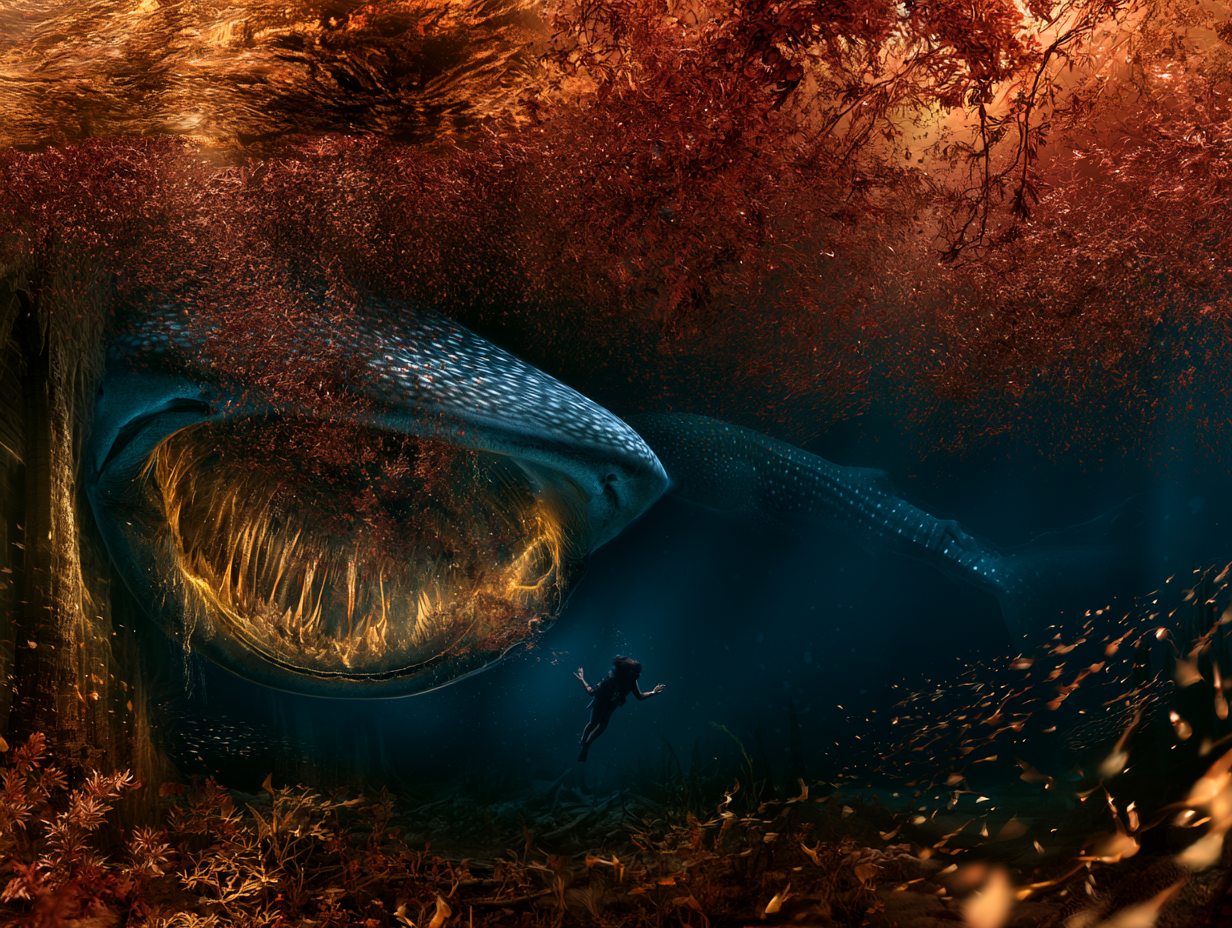
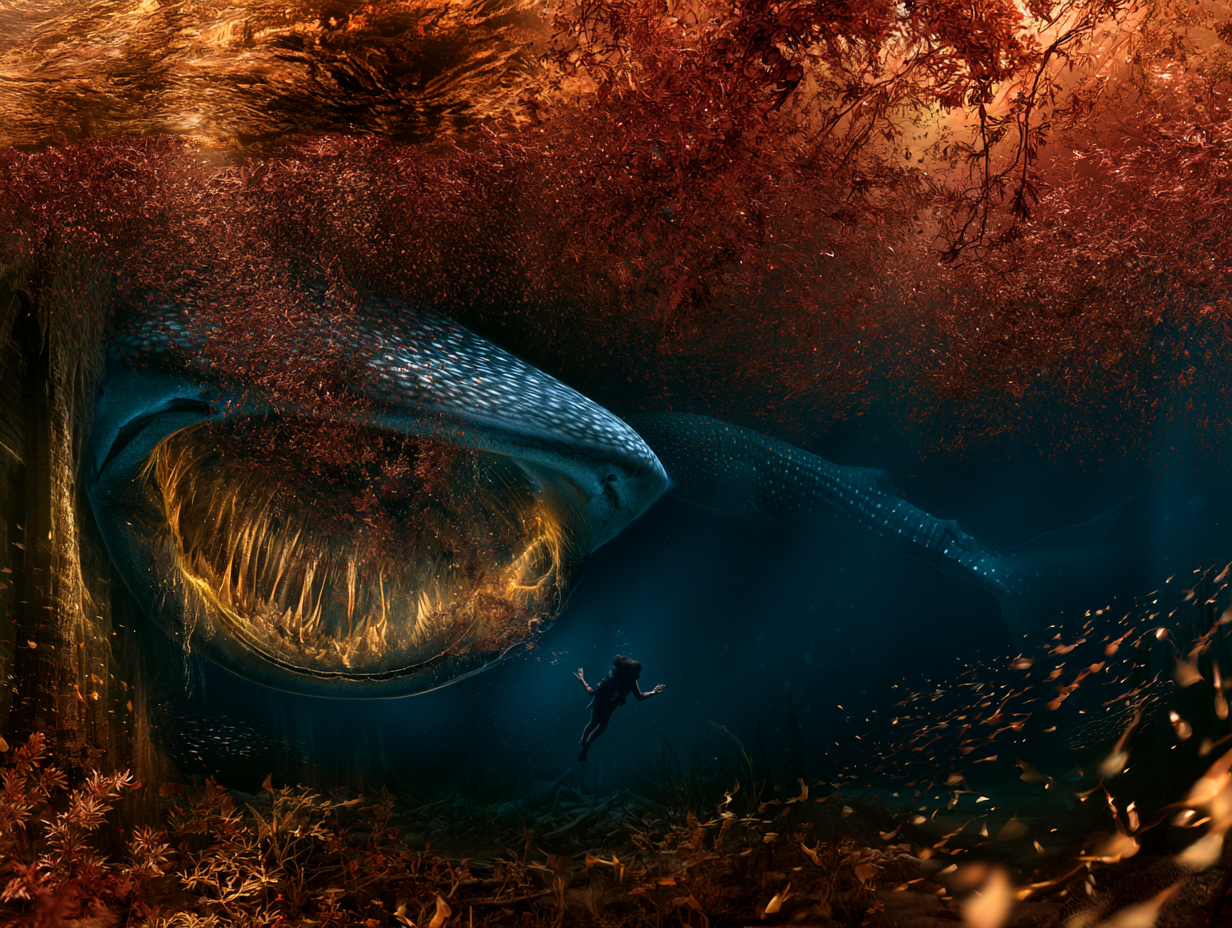
A ballena de tiburón, jaw open wide as a doorway, cruising at two knots through a bloom of plankton so thick the water has turned rust-colored. Four hundred million years of cartilaginous lineage have tuned this method to its simplest expression: open, move, receive. A ton of water per hour through the gill rakers. No chase. No urgency. The ocean delivers. The gill rakers separate. The body grows.
So easy, so grateful, so peaceful — the oldest approach to the oldest question.
Whose dream is this? The ballena de tiburón carries the answer in the slow opening of the jaw.
The Question That Wakes
Whose dream is this?
The hunger arrives before the question does. Only later — after the feed, the purchase, the upgrade, the campaign, the second helping — does something in the body ask whether it chose this, or whether something else chose it.
The City
Once we lived and played in flow, unbound, unfixed. We moved with the sun and moon, with the seasons, with our families and communities, with all the denizens of the Garden. This went on for time immemorial, untold millennia. Some of us for short spans have played another smaller game; we might call it "Mine". Coincidentally this game often compels us to dig into the earth for precious sparkly and shiny material that we can claim to possess and display on our buildings and bodies. It also leads to cities, competition, property, taxation, environmental collapse, wealth disparity, poverty, disease, and war. Our worst game, and the one we bore into.
Scare City is the capital of this worldview. In Scare City there is never enough and there never has been. Even you are not enough. So we fight over the scraps, lay claim to what we can, and fret about security and privacy, earning interest on our holdings, and qualifying for as much credit as possible (which is actually a euphemism for future debt). In Scare City, to make more money, we first make more debt.
It's not yours if you can't keep it. — "Outcome" 2026
Most of us were born there. We learned its grammar before we had language to question it. The billboard teaches the child what they haven't got. The grade assigns the child a rank among its peers. The paycheck — withheld until the correct number of hours have passed, as if time itself were owed — tells the grown adult what their hour was worth and implies what they were not. The city does not announce itself. It runs.
Jane Jacobs watched the street and called what she saw a ballet: the sidewalk choreography of strangers maintaining intricate mutual safety without a director, a plan, or a budget. Her observation was real. Her frame was too small. Ants have been doing this at higher density, with more precision, for a hundred million years. Leafcutter colonies organize traffic at intersections that would gridlock any human city — outbound workers carrying fungus, inbound workers carrying cuttings, unladen workers returning for more — three spontaneous streams in sustained high-density coordination, directed by nothing but pheromone and proximity. No planner. No permit. The ants don't marvel at it.
The city, as the species has largely built it, is the form the scarcity machine requires: concentrated labor, surveilled consumption, maximum dependency on the system for functions every prior human community handled internally. It concentrates the species' weakest adaptations — disconnection from soil and watershed and seasonal rhythm, the replacement of community with transaction, the long unbroken concrete surfaces that tell every living body it has arrived somewhere nothing grows. Jacobs loved what she found in the interstices: the old, mixed-use, walkable neighborhoods that kept some life in them. She was describing the exceptions. The rule is the housing project, the suburb, the parking structure — the built environment as managed isolation, optimized for dependency.
What cities do efficiently is concentrate misery into visible enough masses that someone eventually notices. The civil rights movement, the labor movement, the suffrage movement: all moved through cities, because cities make the wound impossible to disperse. The ballet Jacobs saw was real. It was also people making something human inside an architecture built to prevent it.
147 Hz sits between the frequencies — between the heart's Fa and the throat's Sol, in the gap that opens when harmony fractures. The reversal of 741: the voice frequency, turned around. Where the voice speaks out what sits within, here the system speaks at. This is the break. The interstitial moment. The place the map says we are lost.
The Hindu framework of the four purusharthas — the aims of a complete human life — holds artha as the second aim after dharma: prosperity, livelihood, the material means by which a life sustains itself and contribution becomes possible. Artha is a legitimate aim. The Arthashastra, the ancient Indian governance manual, treats the material welfare of citizens as a sacred obligation of leadership. The disease in the Machine runs at a different level: artha divorced from dharma, wealth generation unconstrained by right action, a legitimate aim converted into a pathology that devours its own ground. Scarcity is what artha becomes when it has forgotten what it was for.
The scarcity field settled into the substrate long before any individual arrived to learn it. Sheldrake's morphic fields do not require a teacher or a text — the pattern that has been practiced enough becomes part of the terrain, available to every new form that grows in that soil. Generations of contraction, generations of hoarding, generations of the preemptive flinch before the blow that may or may not come — these did not merely pass as instruction from parent to child. They sedimented into the field of what it means to be a body in this world. The child born into Scare City absorbs its grammar the way the child absorbs a mother tongue: before words, before deliberate education, through the thousand small postures of those already fluent. The field teaches. The student never knows they enrolled.
In Scare City we revere Pothos — profound longing for the absent and the unattainable. Pothos is the feeling of reaching toward something that recedes. The soul, mid-journey, suspended between the known and the unknown, feels it as ache. The longing came first. The machine arrived later, found it living in every human chest, already doing what Pothos does, and built an economy around the reaching.
The Machine
A machine breathes differently from a body. A body breathes. A machine runs.
James Carse drew the distinction that matters here: finite games play to win; infinite games play to continue. The Machine is the civilizational structure of the finite game — boundaries fixed, rules enforced, winners sorted from losers, the game declared complete when one side holds enough. Corporations, nation-states, economic architectures — all of these began as finite games and, over centuries, were institutionalized into the very shape of the world. They became indistinguishable from nature. This was the point.
Civilization's deepest trick, in Alan Watts's account, runs exactly here: the rules of the finite game get presented as the laws of nature itself, so the players never think to question the game. The scarcity running through every market, every grade, every paycheck participates in something Watts described as a cosmic game of hide-and-seek — the universe concealing itself inside the separate self and then building an entire social architecture to keep the secret. The tragedy is this: no one told the players it was a game.
Haruki Murakami rendered what lives inside this structure. In The Wind-Up Bird Chronicle, the character Noboru Wataya — politician, manipulator, the man who moves through every room without disturbing the air — carries what the Machine produces at human scale: a person so evacuated of interior that nothing genuine remains to disturb. He causes harm without cruelty because cruelty requires feeling. He operates with complete fluency. The novel's protagonist descends into a dry well and sits in darkness until something opens. Noboru Wataya cannot do this. He has no darkness to sit in. The novel refuses to explain this wrongness — you feel it before the words arrive, which is the point.
The philosophical zombie — the thought experiment philosophy built for this exact problem: a being that behaves exactly like a conscious entity while holding no interior experience. The thought experiment asks whether awareness is necessary for behavior. The Machine answers: no. It produces outputs, responds to inputs, runs indefinitely — and holds nothing. The danger sits not in malevolence. It sits in the emptiness — and what fills emptiness when you project your longing into it long enough.
Mechanical sleep — the condition in which conditioned response wears the costume of choice — runs at the individual scale, which is where Gurdjieff found it: the body goes through the motions of a life while something central remains dormant. The Machine runs this at civilizational scale — an entire architecture of sleep, perpetuating itself through the bodies of those too deep inside it to see its walls. What Gurdjieff watched in the individual, Eisenstein watched in the civilization: the structure arranged the conditions so that sleep maintained itself. Every incentive, every reward mechanism, every definition of success pointed the dreamer back toward the dream. The dream recruited its own continuers.
Reality consists of events, not things — every occasion of experience carries an interior. This is the ontological account Alfred North Whitehead left us, and the Machine's fundamental error reaches this deep: it treats what lives as if it were inert, applies dead categories to living systems, and then wonders why the living systems fail to behave correctly. The earth became a resource. The body became a productive unit. The relationship became a transaction. These were operational redefinitions, and the world that resulted matches them precisely. The error, once installed, became self-confirming: a world treated as inert begins to behave as if it were, the life retreating into the spaces where the extractive gaze cannot follow.
The Polycrisis
The climate crisis, the democracy crisis, the meaning crisis, the loneliness epidemic, the mental health collapse, the ecological unraveling — these arrive wearing different faces and share a common source. Eisenstein called it the story of separation (the paradigm of division): the belief that we are discrete, competitive, fundamentally alone, and that the purpose of living is to secure enough of the scarce resource to survive and prevail. The story ran for centuries. The polycrisis is what that story looks like when it succeeds completely.
Pause there. Not when it fails — when it succeeds. The wreckage is proof of function. An economy built to extract extracted. A culture built on scarcity manufactured lack. A political structure built on competition produced winners and losers and a growing class of those the winning required. The Machine delivered exactly what its design specified. This is the difficult thing to hold: the destruction was the product.
Terence McKenna named the mechanism of installation: the scarcity economy runs on a story that arrived by displacement — the enclosure of the commons, the suppression of plant medicines, the destruction of feminine authority, the systematic erasure of indigenous knowledge systems. These were chosen arrangements, McKenna insisted, and what was chosen can be unchosen. His archaic revival pointed toward social arrangements that ran successfully for tens of thousands of years before the dominator model arrived — circular, gift-based, permeable. The other world carries no utopian requirement. It has already existed. It has already been done.
The history Stone documented in When God Was a Woman gives the mechanism its proper name. Across the ancient Near East and Mediterranean, goddess religion — the institutional authority of feminine spiritual knowing — underwent systematic displacement: point-by-point replacement of female divine authority with male, accomplished through military conquest, canonical rewriting, and the slow cultural work of ridicule and criminalization. Gimbutas traced the same process further back, into the bones of Old Europe: the Kurgan incursions brought a Sun-god pantheon into societies organized around the Earth and Moon. The dominator model carried a different grammar of reality — one in which hierarchy, extraction, and the subordination of cyclical to linear time constituted the natural order. The Sun cult claimed the sky and spoke from above. The Earth and Moon traditions went underground: into folk medicine, into the cunning woman's knowledge, into herbs and practices and oral transmissions that survived where the fire could not reach them.
The scarcity machine descends from that grammar. Whose dream is this? Historically, specifically, it belongs to the Sun.
Andrew Schmookler called this the parable of the tribes. Five groups living in proximity — four peaceful, one turned toward expansion and coercive power. The four peaceful groups face four options: become like the aggressive group, be conquered by it, be destroyed, or withdraw into the margins. Every path except the first leads to the aggressive group's logic spreading through what remains. The ratchet runs in one direction only. Coercive power, introduced into any system of interacting societies, compounds. One group adopting domination creates a condition in which all others must reckon with that group — absorb the logic, submit to it, perish by it, or disappear. What Eisler traced in the bones of Old Europe and what Stone traced in the canonical rewrites, Schmookler located in the structure: a world containing one group willing to use coercive power becomes a world organized around the management of coercive power. Coercive power, once present in the field, chose them all.
Claude Lévi-Strauss arrived in Brazil in the 1930s to document what was already vanishing. He found not an archive but a dissolution: ceremonies performed by participants who had forgotten their meaning, elders who remembered a world their children could no longer enter, the transmission broken a generation back by contact, forced schooling, and the diseases that arrived before the missionaries had finished apologizing for them. He had come too late to see what he came to see, and too early to be untroubled by his own role — the very act of arriving with notebooks and academic credentials had already changed what he was hoping to observe. Tristes Tropiques is a book of grief written by someone who understood that his own civilization had made the grief structural.
His verdict from the same text carries no mercy: "The world began without man and will end without him." The civilizations that built themselves around human supremacy have spent their entire duration attempting to disprove this sentence. The sentence has not moved.
The oldest personal relation in the human record, Nietzsche argued in the Genealogy of Morality, was the one between creditor and debtor — older than tribe, older than god. The urge to trade, to compare values, arrived first; society built itself out afterward. Our earliest sense of responsibility to other people took commercial shape before it took any other. The moral vocabulary of guilt, conscience, and duty still carries those first measurements inside it: what is owed, what is unpaid, what the account says.
Money did not begin as a number. Cowrie shells — small, smooth, almost identical, carried on trade routes from the Indian Ocean into West Africa, China, and the Americas — circulated as currency for thousands of years because they were beautiful, because they could not be forged, because they held the memory of the sea. Wampum, the shell bead currency of the northeastern woodlands, recorded treaties and condolences as much as debts. Sacred objects, tribute, gifts between communities, obligations to the dead — these gave money its first shape. Graeber's excavation of the anthropological record found no society anywhere that organized itself around a barter economy before money arrived. The economists' origin myth — strangers trading arrows for corn, gradually inventing coinage for convenience — never happened. What happened instead: debt came first, sacred and social, and money emerged to track it.
The story that launched a thousand textbooks came from Adam Smith in 1776: primitive man, sitting on a surplus of arrows, wanting bread, meets a baker who wants arrows. The exchange happens naturally. Scaled across a society, this produces what economists came to call the double coincidence of wants — both parties must have, at the same moment, exactly what the other wants. The difficulty follows; money as universal solvent follows from the difficulty with satisfying logic. The story felt airtight for two centuries.
The barter myth rested on a deeper premise. Before Smith could put the arrow-maker on the road toward the baker, he had to assume what drives that archer into the marketplace: the propensity to truck, barter, and exchange — to accumulate, to secure more than the immediate moment requires. The Wealth of Nations builds on this foundation, and the entire edifice of classical economics follows: if humans orient by nature toward accumulation, then the structures that organize and harness that drive become civilization itself.
The drive tracks the condition. Communities living inside the gift economy — where the fish arrives because it arrived last year, where the harvest distributes because winter comes for everyone — do not display the accumulation behavior the classical economists called essential. The drive appears when the condition appears: when enough comes into question, when the web of obligation breaks and the individual holds alone what the community once held together. Greed follows scarcity the way inflammation follows injury. Remove the scarcity story and the accumulation drive loses its premise. The archer stays home. The gift economy runs.
Every culture examined before coinage appears shows the same baseline: credit extended within communities who expect to remain in relation; gifts tracking obligation across generations; tribute, feast, the ceremonial redistribution that marks every complex society before money enters. Relationship ran the system. The neighbor's fish carried no price because the harvest might flow the other direction in a dry summer. The ledger kept itself in the web of people who would face each other tomorrow. Barter, when it actually appears, marks the edge of that web — the encounter with strangers, or after conflict, where shared obligation has not yet grown. Smith built his origin myth from the edge case. The community dissolved the double coincidence before it could become a problem, because the community had always been there first.
Alfred Mitchell-Innes ran the standard sequence backwards and found it held. The economists' textbook traces a single line: primitive barter, then coinage, then the digital credit of today. The historical record moved the other way. Credit came first — the recorded obligation between parties who expected to remain in relation. The silver shekel of Sumer arrived as a unit of account, a way to standardize the credits and debts already flowing through temple and household across Mesopotamia. Coinage came later still. Barter sits at the end of the sequence rather than the beginning — what communities fall back to when the monetary system collapses, when war or breakdown has dissolved the trust networks that made credit possible. The mainstream origin story came from the wreckage.
The double coincidence had a harder problem than logistics. Smith's imagined tradesman — carrying personal surplus, calculating personal advantage, seeking a personal solution — presupposes an individual. Communities the anthropological record actually finds did not organize their economies around individuals. The surplus belonged to the village. The need belonged to the village. What moved between people in the same community traveled through the web of obligation and kinship that made them a community — the harvest shared because winter came for everyone, the catch distributed because the boat came back to one shore. When two villages met and traded, they sent the weight of everyone behind them — the whole community's abundance offered against the whole community's need. The double coincidence dissolved at a different level entirely: the individual who would have faced it had not yet been invented.
The ethnographic record Graeber assembled carries this further. Exchange — the careful matching of what is given against what is received, the tracking of equivalences — appeared almost exclusively between peoples who regarded each other as strangers, those beyond the web of shared obligation and continuing relation. Within the community, things moved as gifts. Generosity marked belonging. Exchange marked distance, wariness, the relationship where the ledger had to stay balanced because goodwill could not be assumed. The two modes sorted themselves along the line between intimacy and stranger.
Before someone could appear as a stranger, something had to happen to the self that perceives them as one. The oldest story locates the hinge: eat from the tree that divides good from evil, and the world splits — self from other, human from divine, the body from the field in which it moved. The continuum becomes a population of objects. The stranger becomes possible. The ledger appears. Eisenstein calls it the story of separation — the premise so deep it precedes all other premises, the water the scarcity machine swims in. Every line drawn between kin and stranger, between sacred and expendable, between what can be given and what must be exchanged, runs from that first division. The gift economy waited on the other side of all of them.
The oracle at Delphi carried a single instruction above its entrance: know thyself. The prescription presupposes self-ignorance as the prior condition. A self that does not recognize itself cannot recognize its own reflection in the stranger. It registers otherness as threat, reads abundance as a resource to be competed for, extends exchange as the only available relation to whatever lies beyond its boundary. Put money before value and you see what the unrecognized self does with the world — prices it, because it cannot yet see it.
When the self recognizes itself — finds the same life looking back from behind the other's eye — the stranger dissolves at the root. Generosity flows from that recognition the way water flows downhill: without calculation, because the direction is structural. What the trees run on, what Gaia runs on, moves in the body too, waiting for the self to stop mistaking the contraction for its nature. The abundance flows toward bliss. Self-knowledge clears the channel.
The modern economy runs exchange as its primary mode. By the logic of those same records, this runs as a wartime economy — every transaction a negotiation between adversaries, every price the cleared residue of a trust that once made prices unnecessary. The machine treats every exchange partner as a potential enemy, because it was built for a world without permanent neighbors, without the shared winter, without the boat that comes back to one shore. The war runs in the structure of every transaction the economy considers normal.
The war runs from an interior source: the part of the self that contracted into separateness, that learned to hold its own abundance as insurance against the stranger's need. The world that extends from this posture holds the same posture at every scale — household, city, nation, civilization. The gift economy returns when the interior war ends, when the body remembers the posture it held before the contraction — open, surplus-bearing, trusting the abundance to find its way.
The anthropologist Philippe Rospabé pressed deeper still, and Graeber carried his finding forward: money, in the human economies where it first appeared, served as the acknowledgement of a debt that cannot be paid. The coin does not settle the obligation — it marks the place where something irreducible stands. The life given, the care rendered, the years of tending that no transaction can return: these sit beneath every exchange as the ground that made exchange possible. Money arrived as a token holding the shape of that ground, a formal recognition that something real had moved between people and left a trace that outlasted the moment.
The cleaner name for what money actually is, Felix Martin offered in Money: The Unauthorised Biography: tradeable credit in a social web. What a dollar bill carries is a claim on the collective agreement that the social fabric holds. Hand it to a merchant and the transaction rests on the same ground as the gift: shared trust between people who expect to go on living in the same world. The bill works because the parties holding it believe in each other. Take the belief away and the paper is paper. The gift runs on identical ground and admits it.
The abstraction arrived slowly. A cowrie carries the ocean with it. A gold coin carries a king's face. A Federal Reserve note carries a promise of debt, backed by nothing but the agreement to keep backing it. Each step moved money further from the living world it was supposed to represent, until it reached its current form: digits on a screen, issued by banks as loans at interest, bringing into existence more obligation than supply with each cycle. Interest is the mechanism that makes the scarcity machine run. Loan money into existence and demand more back than was lent, and the system structurally requires perpetual growth — more extraction, more production, more consumption — just to service what already exists. Growth stays finite. Debt compounds.
The enslaved person must argue in the master's language — must use the terms, accept the premises, dispute within a frame the master established. Graeber found the psychic mechanism as legible as the economic one. When a friend tells you that debt-money is simply reality, that anyone who says otherwise hasn't understood how the world works, you are hearing that language. The speaker learned it young, without knowing they were learning it. To spend a life earning in money made of debt is to vote, every day, for a grammar that can only tell you the voting is compulsory.
Silvio Gesell saw this in 1906 and proposed the simplest possible correction: make money decay. In a living system, all held value rots — fruit, wood, flesh, grain. Money alone among valuable things resists decay, rewarding those who hold it over those who hold real things. Stamp scrip — currency requiring a periodic fee to remain valid — returned money to the biological condition of everything else: hold it and it costs you; circulate it and it lives. Keynes called Gesell's insight profoundly original and largely ignored.
Bernard Lietaer spent decades inside the monetary architecture — he helped design the European Currency Unit, the Euro's predecessor — and arrived at the same diagnosis from inside. The global monetary system, as Gesell saw it, rewards hoarding; as Lietaer mapped it, the deeper pathology runs as monoculture. In every living system, diversity buffers against collapse: a forest of one species falls to one blight. A monetary ecosystem channeled through a single reserve currency, a single interest-rate mechanism, a single trust protocol falls the same way. He documented counter-examples. The WIR franc, a complementary currency circulating among Swiss small businesses since 1934, expands precisely when the conventional economy contracts — a built-in counter-cyclical buffer. The Wörgl scrip — a demurrage-bearing local currency issued by an Austrian town during the Depression — ended local unemployment within a year, until the central bank shut it down. Monetary diversity produced resilience. Monoculture produced fragility. The institutions understood this as a threat, which tells you what the institutions were protecting.
Eisenstein built the full architecture from that foundation. Demurrage as the monetary cornerstone: money circulates because hoarding costs something, drawing wealth through communities the way sap moves through a tree. Currency backed by living commons — land, water, forest, atmosphere — so that destroying the commons degrades the currency directly, making extraction pay its own cost. Local currencies that keep wealth circulating within the communities that generate it. And undergirding all of it, the oldest reset mechanism the human community ever built — which the Mesopotamians practiced and the Hebrews encoded into law.
Robert Shiller's Narrative Economics gave the trust-as-money argument a research architecture: viral stories move markets. The confidence that drives spending, or the fear that freezes it, travels as contagion — the same epidemiological patterns that describe disease describe the spread of economic belief. The scarcity story runs as the most virulent economic narrative on record, replacing the abundance story that organized human life for most of its duration, seeding itself into education, policy, and daily habit, still running the system decades after its empirical failures have accumulated past any honest accounting. What Akerlof and Shiller documented as animal spirits — confidence, trust, the fairness intuition, the narrative — runs the economy more reliably than any of the variables the models track. The economy believes what it tells itself. Choosing a different story is the structural intervention.
Yanis Varoufakis watched the sick money operate at its most explicit: as Greece's Finance Minister in 2015, negotiating with the European institutions that held Greece's debt. His account, Adults in the Room, reads as the anatomy of a trust-extraction machine. The creditors held the ledger; the ledger was the weapon; the terms demanded would guarantee a debt that could never be repaid, which guaranteed continued leverage — the scarcity machine at its most refined, a monetary architecture engineered to keep the debtor in perpetual obligation, the same logic the Jubilee was written to interrupt. His wider analysis, The Global Minotaur, maps the post-Bretton Woods dollar system as an arrangement in which the world finances US deficits in exchange for access to US markets, extracting trust as tribute from every country that holds dollars in reserve. The arrangement holds as long as the trust holds. What comes next, when it breaks, depends on whether a better story has been seeded in time.
James George Frazer spent thirty years tracing the same story across five continents. In every version: the sacred king embodies the land's fertility. His strength is the crop's strength; his blood is the rain. The moment his body weakens, the land weakens with him. The community's solution, everywhere Frazer looked, ran the same way: the king must die — ceremonially, in good order, returned to the ground — so that the land's vitality could complete its cycle rather than going into the grave alongside him.
Graeber and Wengrow found the Inca variant at the logical endpoint: the dead ruler's mummy brought to feasts, seated among the living, consulted by priests who translated his silence as policy. The body had decomposed; the pretense held. The whole social apparatus organized itself around power that could not acknowledge its own ending.
This is the scarcity machine's oldest prayer. The fear underneath the hoarding, the accumulation, the growth imperative that cannot stop even when the planet is signaling clearly — this is the terror of the failing king: if the power at the center admits its own mortality, the whole structure follows. Money, in its current form, plays the undying king's role. The GDP must grow. The system must expand. The god that represents the living world must remain alive at any cost. And so the living world running beneath it pays the cost instead.
Nehemiah was born in Babylon, raised in the diaspora that Nebuchadnezzar's destruction of the Temple had scattered across the Persian world. He rose to become cupbearer to the Persian emperor — the person who tasted the king's wine before the king drank it, close enough to read mood from silence. He persuaded the emperor to appoint him governor of Judea and to fund the reconstruction of the Temple at Jerusalem. In the rubble of the rebuilding, his workers found the sacred texts. The scholars who gathered to read them were encountering their own foundational law for what may have been the first time, reading it in the ruins of what had tried to erase it.
His first response to the debt crisis he found in Judea followed the Babylonian tradition he knew: the misharum, the clean slate edict that canceled all non-commercial debts and set the interest rate to its legal maximum — high rates discourage new lending ahead of a cancellation, so the throttle on new loans was part of the mechanism.
But the sacred texts contained something older and more total. The Jubilee the scholars uncovered canceled every debt, commercial and otherwise, and freed everyone held in bondage because of what they owed. Every seventh year, the Sabbatical year, debts dissolved. Every fiftieth, the full Jubilee — and at the Jubilee, the tablets on which financial records were kept were ceremonially smashed before the assembled community. The document that held the debt ceased to exist in public. The claim had nowhere left to live.
The forest runs the same principle across a longer timescale: fire releases what has locked into standing wood, returns the bound nutrients to the soil, and the next growth begins from what the burning freed. Jubilee carries the human community's version: the release that makes the next growth possible. The scarcity machine runs without Jubilee. The wreckage accumulates as proof.
The better story already exists in the places the scarcity machine has not reached. In it, gifts cycle freely among those who share a community: the fish arrives because it was caught; the harvest moves because winter comes for everyone; the skill flows because the flowing is its own return. Money enters as a last resort — and even then, a good money carries the demurrage instinct, the built-in decay that keeps it moving. Exchange marks only the edge: the encounter between genuine strangers who have not yet become kin, a transaction fair and balanced, an acknowledgment that the web of obligation has not yet had time to grow. The sequence the scarcity machine inverted now runs in its original direction: generosity within the community, currency at its edge, exchange at the frontier, and every frontier an invitation to begin the long work of becoming neighbors.
The prison-industrial complex makes this most explicit. Angela Davis drew the line from plantation to penitentiary: the legal category changed, the economic logic did not. The prison manufactures a population defined by their captivity, processed through infrastructure that profits from their continued confinement. The question Are Prisons Obsolete? poses runs deeper than whether prisons need reform. It asks whether the imagination that built them has ever held the capacity to solve what it claims to address. The machine that ran on chattel runs now on conviction.
The victim mindset the machine installs has a structural address. The individual learns to read failure as personal when the conditions producing it were designed. The person who cannot compete in a rigged economy, cannot sustain community in an architecture of isolation, cannot imagine an exit from a system presented as nature itself — this person carries an accurate reading of what has been arranged. The machine requires this reading. A person who understands their captivity as systemic begins to ask questions the system cannot answer.
Generational cycle research reads where we stand: the Crisis turning, the fourth of four, the crucible that precedes the new High. Neil Howe found that Crisis turnings arrive approximately every eighty years — roughly when the last generation that remembers the previous one has died and its hard-won knowledge goes with it. The Crisis turning requires that the old order break down before the new one can form. Clinging to the breakdown is the only real tragedy available.
The Machine's spiritual dimension shows most clearly from inside the labor economy. Vast numbers of people perform work they experience as pointless — not punishing, not physically dangerous, simply meaning-free. They know this and continue. The system depends on the continuation. What David Graeber documented in Bullshit Jobs runs deeper than economics. It tracks the systematic suppression of the human drive toward genuine contribution, with the performance of contribution at a set hourly rate installed in its place. The solar plexus of civilization, digesting itself.
Graeber also noticed the scandal hiding in plain sight inside every large corporation. Karl Marx wrote the principle in 1875: from each according to ability, to each according to need. The corporation practices it exactly — the printer paper goes to whoever needs printer paper, the IT department fixes whoever's computer is broken, the intern gets a desk regardless of what the intern has produced. No one in the office pays per task or receives per task; resources flow to where they are needed, labor goes to where it is directed. The market logic operates between companies. Inside the company, the planned economy runs. The scandal capitalism cannot acknowledge: its largest institutions are organized communistically, and they function.
Scare City insists this is impossible. The evidence sits in every open-plan office in the world. Graeber: "Baseline communism might be considered the raw material of sociality, a recognition of our ultimate interdependence that is the ultimate substance of social peace."
The scarcity story does not erase what Graeber found in the office — it buries it. When enough comes into question, when the web of obligation thins and the individual holds alone what the community once held together, the impulse to share retreats below deliberate awareness. People still give, still help, still cover each other without keeping accounts — but the story running overhead says this marks them as soft, as naive, as people who haven't understood how the world works. The gift economy goes underground. Scare City calls what remains human nature.
The Buddhist tradition mapped the same impulse into four divine abodes — the brahmaviharas, the qualities of a mind at home in the world. Two of them describe exactly what the communistic principle enacts: karuna, compassion — the movement toward shared burden, toward meeting another's need with whatever capacity one holds; and mudita, shared joy — delight in another's flourishing rather than resentment of it. A mind steeped in karuna and mudita practices what Graeber observed as a spiritual exercise. The scarcity story trains people away from both.
Marizelle Arce offers the terrain argument in its most compressed form: take the trash out and the rats go away. Bacteria at a disease site are the cleanup. The organism produced them because the environment required it. The hostile-environment hypothesis explains MRSA too: the pathogen "stepping it up to the next level" when it meets a body that has escalated beyond what the previous microbial adaptation could address. Melissa Kupsch maps the same intelligence from the homeopathic side: the body knows what order to heal in. Skin is the last stop, the safest place to put a distortion. Mental and emotional suffering is urgent, existential, dangerous to the organism — so the body addresses it first. Suppress the skin condition before the underlying conflict resolves, and the cleared channel fills with something that had been waiting for the skin to open. "Your body gets to decide what is most important first." The suppression logic interrupts that ordering. The body escalates from whatever channel the suppression has closed.
The same intelligence shows up in the connective tissue. Fascia — the collagen network that wraps every muscle, organ, and nerve — lines its inner and outer surfaces with structured water, and when movement compresses it, charge moves: the piezoelectric effect, collagen converting mechanical pressure into an electrical current that builds more structured water, deepening the body's charge. Catherine Clinton, drawing on naturopathic practice and electrodynamic biology, traces disease and pain to charge deficiency — a terrain that has run low on free charge, and with it, on the capacity for repair. Inflammation at an injury site delivers exactly what the deficiency requires: structured water, charge, the raw material of healing. The Rest, Ice, Compression, and Elevation protocol, once standard for soft-tissue injuries, does the opposite — ice constricts blood flow, prevents the piezoelectric charge from building, and interrupts the delivery the body organized. The physician who coined the RICE acronym formally retracted it. The body's inflammation was never the problem. It was the response.
The body registers the same suppression at a cellular level. Paul Leendertse, drawing on sixteen years of clinical work with cancer clients, makes a distinction the medical model rarely permits: stress does not cause cancer — the suppression of the emotional response to stress does. Feelings live in the biofield as events; when the feeling cannot move through and complete, it pools as a blockage in the field, and the tissue beneath the blockage reorganizes around what the field holds. The mapping follows Traditional Chinese Medicine's meridian logic: lung cancer clustering around unresolved grief and loss, reproductive cancers around specific relational territories — with a specificity that exceeds coincidence. The terrain model provides the ground: the cellular environment reflects the quality of what moves through it, and emotional suppression is among the most reliable forms of toxicity the terrain encounters. The tumor, in this reading, is the body's last available form of communication — the message that escalated through every quieter channel before arriving at this one. Leendertse finds the same dynamic in the collective that Graeber found in the labor economy: when the authentic signal cannot move, what has been dammed eventually finds another form.
The inversion Leendertse finds in the individual body, Gober and Cowan locate at the system level. The symptom, the organism, the so-called disease — reframed by allopathic medicine as enemy to suppress, pathogen to kill, anomaly to remove. Florence Nightingale said it plainly in the century before germ theory was installed as doctrine: "There are no specific diseases — only specific disease conditions. All disease at some point or other in its course is more or less a reparative process." What followed in the decades after her death was the systematic conversion of reparative processes into named diseases — the splinter producing pus, recast as infection to be treated; the lung clearing inhaled debris, recast as bronchitis. The symptom's meaning inverted: the body doing its work, recoded as the body under attack.
The underlying model requires a cause exterior to the organism. Germ theory supplied one, and the installation was fast. Watson and Crick's double helix arrived in 1953. John Enders's 1954 measles paper arrived months later, the year of his Nobel — and with genetic causation now available as explanatory frame, a loose collection of particles never actually isolated from sick people's fluids became definitive mechanism. Christine Massey sent FOIA requests to more than two hundred health organizations across forty countries, asking a simple methodological question: have you ever taken one of these particles directly from the fluids of a sick person and shown that it exists, independent of the cells it was grown in? The response most often returned, in some form: "We in the field of virology don't do what you described." The absence of isolation was not contested. The conclusion the absence required was.
Cowan offers a thought experiment: a hundred rats in a basement. Rat poison introduced. The next morning, ten dead, all from the same cause. The observer who concludes they passed the illness between them has not demonstrated contagion — they have demonstrated shared environment. People fall sick in the same place at the same time for reasons other than transmission. Shared food. Shared air. Shared toxins. Shared unresolved emotional shock. Beriberi, scurvy — entire traditions of disease, attributed for generations to contagion, resolved the moment the shared environmental deprivation was addressed. The infectious framework required no revision. The correction was absorbed without acknowledgment.
The Machine's deepest move in medicine runs exactly here: externalize the cause, externalize the cure, and the sovereign self never needs to ask what its body is trying to say. Health becomes something the expert delivers. Gober says it once: a recipe for a lack of health and for tyranny both.
Ryke Geerd Hamer pressed the inversion to its most specific edge. After his son was shot and died, Hamer — already a physician — developed testicular cancer, and began asking: was there always something like this? He became head of an oncology unit and asked every patient the same question: did something shocking and unexpected happen to you before this? In every case, yes. Always. He found corresponding concentric-ring formations on their CT scans — always the same location in the brain for the same type of conflict, always the same organ below it. The triad held: psyche → brain → organ. He called the conflict shock a DHS — a collision requiring three simultaneous conditions, like three keys pressed together: the event must be highly acute; it must be unexpected, catching the person on the wrong foot; and it must be isolating — felt entirely alone with it. Miss one of the three and the body does not open the program. All three at once, and something shifts in the tissue.
The conflict-active phase that follows looks like disease because the body runs it at heightened sympathetic tone — cold extremities, compulsive thinking, the system returning again and again to the unresolved threat like a tongue finding a loose tooth. When the conflict resolves — when the sigh of relief arrives, the call comes, the thing feared either happens or lifts — the healing phase begins. And the healing phase is when the body looks its worst: swelling, fatigue, intense symptom. Melissa Sell gives the diagnostic mirror medicine has inverted entirely: "There is nothing malignant in nature. Every biological program is a meaningful adaptation." The tumor the CT scan finds during what the oncologist calls active disease may be conflict-active construction. The fever and the vomiting and the rash the doctor intervenes in may be the healing phase already underway. The intervention that suppresses the healing phase extends the conflict indefinitely without resolving it. The body escalates through whatever channels remain.
Sell offers a sample of the organ-emotion specificity Hamer's maps carry. Glandular breast cancer clustering around profound worry for someone in the nest — a child, a close family member — the body building additional tissue because the psyche has registered a threat to the one who matters most. Lung cancer following a death-fright shock: the lung takes on more surface area because the organism believes it needs to take in more air to survive. Outer skin rash appearing after a separation conflict — the skin as the organ of contact, thickening and itching and erupting at the exact site where the separation was felt. The CT scan, in this frame, is the autobiography of a life: every ring in the brain the record of a moment when something shifted that was never resolved.
Gerald Pollack arrives at the same inversion from biophysics. Cancer cells, without exception, carry a small electrical potential — the charge differential that healthy cells maintain at high values has collapsed. A cell with low charge divides uncontrollably; restore the charge to 150 millivolts and division stops. Cancer, in this reading, is not a genetic insurgency but a charge-depletion event: the cell has lost its fourth-phase water structure, the battery has run down, and the programmed response to insufficient charge is continuous division — the organism trying to produce more surface area, more metabolic capacity, more of whatever it believes it needs to survive the condition it is in. Glyphosate, at even small concentrations, collapses the exclusion zone. Most poisons are poisons because they dehydrate: they destructure the water the cell runs on. Build the EZ water and the division slows. The simplicity offends an industry organized around far more complex interventions.
The suppression of simpler approaches has its own paper trail. Melissa Kupsch surfaces what most medical histories omit: in the 1918 Spanish flu, the mortality rate in homeopathic hospitals ran at 1.05%. The rate in conventional Pittsburgh hospitals ran at 30%. John D. Rockefeller used three private homeopaths personally and called it "a progressive and aggressive step in medicine." The Flexner Report, funded through Rockefeller-aligned interests, arrived shortly after and recommended that homeopathy be removed from medical school curricula entirely. The curriculum changed. The mortality differential went unremarked. What remained was not the more effective approach — it was the approach whose inputs could be patented.
The deeper framework Hahnemann developed runs beneath all of this. He called them miasms — inherited distortions of the vital force, transmitted through the family field from generation to generation, predisposing the organism to entire categories of chronic disease. He identified three foundational ones.
The first and oldest is psora. Hahnemann believed it caused seven-eighths of all chronic illness. Its origin: the suppression of scabies with sulfur ointments, beginning in antiquity. The itch that was meant to speak through the skin — the outermost, most external expression available to the vital force — is driven inward by the intervention. The skin clears. The patient appears cured. And then the vitality, blocked at the surface, retreats into the lungs, the nerves, the gut, the joints, the psyche. The psoric character: chronic insufficiency, anxiety about survival, the alternating sense that something is fundamentally missing. Not this thing or that thing. The feeling itself, ambient, constitutional, arriving before any particular shortage does. Scarcity's energetic root. Pothos without an object. Hahnemann was describing Scare City before there was a city to name.
The second miasm is sycosis — from the Greek for fig, for wart, for the wet overgrowth. Psora is deficiency; sycosis is excess. Infiltration, accumulation, hypertrophy, the deposit that won't resolve. Artha divorced from dharma runs in the sycotic pattern: acquiring without integrating, the cell dividing past its function because the signal to stop has been overwhelmed. The surveillance economy and its behavioral surplus. The influencer account with no entity behind it, growing its following like an unchecked proliferation.
The third miasm is syphilis — the word marks an energetic imprint, carrying the signature of the disease: destruction, ulceration, the wound that deepens rather than resolving, the tissue that erodes from the inside. Where psora reaches and fails to receive, and sycosis accumulates without limit, syphilis deteriorates — the self-consuming arc, Wetiko at its most advanced. The civilization that degrades its soil, its aquifers, its gene pools, its institutional memory — running the syphilitic pattern at species scale.
Three arcs. Lack. Excess. Destruction. The scarcity machine runs all three in sequence: manufacture insufficiency (psoric), offer accumulation as the cure (sycotic), erode what the accumulation cannot sustain (syphilitic). The vital force, when it meets this architecture early enough, inherits the imprint. Kupsch finds it in her clinical work as a through-line: the family that carries cancer in one generation carries a specific miasmatic predisposition, and the predisposition is transmitted in the field before any organic weakness appears. The homeopathic remedy, at its deepest action, addresses the miasm — not the symptom that surfaced this week but the inherited posture toward life that has been running for generations.
Carrie Bennett distills the full terrain picture into four categories, developed in a single evening's reflection: physical malnutrition (lack of real food, coherent water, natural movement, natural light, connection to earth); metaphysical malnutrition (lack of community, stillness, prayer, laughter, genuine purpose); physical toxins (glyphosate, fluoride, pharmaceuticals, ultra-processed food); metaphysical toxins (toxic relationships, limiting beliefs, chronic fight-or-flight, non-native electromagnetic fields, dishonesty). Every condition she sees clinically reduces to one or more of these four. The framework is not complicated. The system that profits from complexity finds it threatening.
The scarcity engine runs on this. Every dollar in circulation entered the world as debt, issued at interest — which means the system structurally requires that total debt always exceed total money. Someone will always come up short. This is the operating mechanism. The machine that runs on lack must manufacture lack continuously to keep running. The morphic field of insufficiency deepens with each cycle: each generation inheriting the practiced contraction of the last, the flinch becoming faster, the sense of shortage arriving before any actual shortage does.
The algorithm learned this and scaled it. Attention platforms produce scarcity. The sensation of missing something, of falling behind, of rivals advancing — this is the product, delivered at industrial speed. An audience that feels enough does not scroll. The hunger is the business model.
Tim Wu's history of the attention trade reaches back further than the algorithm. The penny press of the 1830s discovered that eyeballs gathered around free content could be sold to advertisers, and every subsequent medium — radio, television, social media — repeated the same move at greater scale. The audience constituted the product. The content served as bait.
What Goldhaber had predicted in 1997 completes the picture: as information abundance made attention the binding constraint, talent would stop converting reliably to wages. The skills that once earned security would overproduce into a buyer's market. What remained exchangeable was visibility itself — the claim on other people's sustained gaze — which the platform economy arranged to meter and sell. The influencer economy descends from this logic as inevitably as water finding the lowest available ground: when conventional income stops returning on human talent, attention becomes the substitute reserve. You perform intimacy in exchange for product, exposure, and the algorithm's amplification. The arrangement calls itself a career.
The collective cost runs through what Johann Hari documented in Stolen Focus: the attention crisis registers as personal failure — an inability to concentrate, a vague suspicion of one's own distraction — when the design intent behind it runs at industrial scale. The platforms built shorter attention spans deliberately and profitably, and now rent them back in increments too small to register as loss. The individual who cannot focus and the economy that cannot pay wages inhabit the same system. The manufactured scarcity of income and the manufactured scarcity of attention share a source.
The deepest word for it comes from Indigenous North American diagnostics: Wetiko — the mind-virus of self-consuming egocentricity, arriving at what Western psychology would call malignant egophrenia. Paul Levy carried this word into contemporary view. The Wetiko-infected system cannot stop consuming even as it devours itself. It cannot recognize the host it depends on as the thing it is killing. At the individual scale, Wetiko produces the hungry ghost — the Buddhist figure with the enormous stomach and the tiny mouth, the creature for whom no amount ever reaches the inside of the hunger. At civilizational scale, it produces the polycrisis. Same pattern. Different substrate.
Demons are stuck in the fourth dimension — that is where de Stefano locates the shadow of it precisely. The fourth is the realm of Frequency — the density of repetition, the spinning of the lower dimensions, the loop that runs because running is the only structure it knows. The scarcity machine operates at this level: the algorithm trained on behavioral frequency, serving the most repeated pattern back to itself amplified, indefinitely, without cost. The hungry ghost is a fourth-dimensional entity — caught in the frequency of a wound that cannot exit the loop it inhabits, unable to perceive the dimension that would give it perspective on the one it is trapped in.
The fourth-dimensional entity resonates — that is de Stefano's operational clarification. The frequency loop finds what matches it. The hungry ghost meets the frequency it runs at, and whoever runs at that frequency finds the ghost there. You encounter only what you are tuned to. The scarcity machine runs at a frequency a wounded nervous system already carries; the matching happens with no intention from either side. The move out: change the station. De Stefano reports that when he began thanking demons for their function — the dividing work that makes particularity and perception possible — they stopped opposing him. They recognized the acknowledgment as accurate. They were doing their job. He was doing his. No further conflict was required.
The sound record registers the damage before the visible ecology shows it. Bernie Krause spent four decades recording the soundscape of living ecosystems and found what the traditions had been describing through different instruments for millennia. Every healthy landscape produces three interwoven layers of sound: the geophony — wind, rain, river, the voice of non-living earth — beneath which runs the biophony, the chorus of every living organism finding its acoustic niche, each species holding a distinct frequency band that fits around the others without crowding them. Over both, in the modern world, falls the anthrophony: the sound humans and their machinery generate, expanding to occupy every available frequency, leaving no band for what was already composing there. The living chorus is coherent. When the Machine moves in, that coherence collapses before the loss of species appears in any census: the biophony thins and fragments in the recordings years before the ecologist counts the missing. The living world had been composing in that space for four hundred million years.
Ecologists running standardized survey routes have returned to the same sites at the same season year after year, accumulating longitudinal records now spanning decades. The meadow that produced a hundred species of insect sound in 1975 now produces twenty. The creek that carried amphibian chorus in summer has gone quiet in the same recordings, measured at the same coordinates, season after season. Played in sequence, the recordings from a single site across forty years sound like a room gradually emptying — each year the same place, each year a little less of it. What the Yogic traditions called spanda — the divine trembling that organizes the living world into coherent sound — retreats decade by decade in the acoustic record. Carse held the definition of evil in reserve for exactly this: evil is infinite play coming to an end in unheard silence. The great silencing is the definition enacted, measurable, documented at the same coordinates, at the same time of year, growing quieter.
The silence does not register as crime. An ethics built around the human victim — the murder of a person as the gravest transgression possible — sorted the murder of everything else by category, and installed that distinction so early in the architecture of civilization that it simply feels like ground. Speciesism is the ethical blind spot wide enough to contain an extinction event without flinching. The civilization runs the sixth mass extinction as background noise while running human rights discourse at full volume. The contradiction remains structurally unexamined.
Something in the collective psyche carries the knowing. The most persistent engine of popular entertainment is the murder story — mystery, massacre, the streak of bloody justified revenge — appearing across cultures and decades with a frequency that exceeds genre. It functions as ritual more than narrative. The grief finds its container. Justice arrives on schedule. Something in the audience receives a satisfaction that has nowhere else to go. The civilization that conducts omnicide at planetary scale against every species that inconveniences its economy comes home at night to watch murder performed with feeling, mourned properly, and avenged. The crowd does not connect the two. The wound knows what the frame withholds.
The most concrete measure of the scarcity machine's operation shows in how the habitable surface of the Earth has been allocated. Of land that can grow something — excluding ice, bare rock, and desert — roughly half now runs as agriculture. Of that agricultural half, 77% goes to raising livestock: grazing land and the crops grown to feed them. That 77% produces approximately 18% of human calories. The remaining 23%, given to crops eaten directly, supplies the other 82%. The arrangement concentrates land ownership in the least calorie-efficient systems, structures rural economies around input debt, and requires the conversion of wild habitat at the frontier whenever the ledger turns red. The enclosure of the commons that McKenna traced as the scarcity economy's original act — the transformation of shared land into private extraction — continues at planetary scale. The English Enclosure Acts converted common grazing land to private wool production; the contemporary version converts biodiversity to beef. The mechanism has not changed. The acreage has.
The practices running on that land are destroying what makes the land productive in the first place. A gram of healthy topsoil holds upward of ten thousand species of bacteria, plus archaea, fungi, protozoa, and nematodes — the civilization that built every harvest humans have ever eaten. Industrial agriculture dismantles it systematically: plowing inverts and aerates the soil, collapsing fungal networks and releasing stored carbon; herbicides disrupt the microbial communities that fix nitrogen and cycle nutrients; pesticides cascade through the food web of the underground; monocropping removes the polyculture that feeds diverse soil communities and replaces it with a single species demanding inputs that further simplify the terrain. Sadhguru's Save Soil campaign — a 100-day motorcycle journey across 27 countries in 2022 — raised the alarm with numbers that the agricultural industry prefers unexamined: at current rates of degradation, the topsoil required to grow food has somewhere between forty and sixty harvests remaining. The machine that runs on manufactured scarcity has begun manufacturing real scarcity in the substrate. The syphilitic miasm at civilizational scale.
The same logic reaches the ocean. Roughly ninety percent of large fish stocks now run fully exploited or in collapse — the top of the marine food web stripped by industrial trawling that drags the seabed into ruin with each pass, destroying bottom habitat that took centuries to develop. The fertilizers the monocrop system requires flow from field to river to coast, feeding algal blooms that consume available oxygen and leave behind dead zones; roughly five hundred have been identified globally. Coral reefs cover less than one percent of the ocean floor and support an estimated quarter of all marine species; half their extent has gone in fifty years, the trajectory pointing toward near-total loss within the century. Microplastics now reach every depth — detected in Arctic ice, in the deepest trenches, in human blood and placentas. Sylvia Earle, who has spent more hours underwater than almost any human alive, holds the summary without decoration: "No ocean, no life. No blue, no green." The machine that began by enclosing land, degrading soil, and replacing wild animal biomass with livestock has extended the same logic to the last common.
The machine runs on a fuel it cannot replace at the rate it consumes. Petroleum underlies not just transportation and electricity but the food system entire. The Haber-Bosch process — which fixes atmospheric nitrogen into fertilizer using natural gas — enabled the harvests feeding eight billion people; the agricultural runoff it generates creates five hundred ocean dead zones. Pesticides and herbicides derive from petrochemical synthesis. Plastics — and therefore the microplastics now in every ocean trench and every human placenta — are oil. The embedded energy of the industrial food system runs at roughly ten calories of fossil fuel input for every calorie of food produced. This is the arithmetic of a civilization borrowing against a finite account and calling the balance growth.
The myth underwriting the borrowing runs as deep as the infrastructure. Progress — the story that civilization moves in one direction, from primitive to advanced, from scarcity to abundance — arrived as an ideology, installed with the same historical specificity as the dominator model it serves. Graeber and Wengrow dismantled the stadial theory — the idea that human societies march inevitably from hunter-gatherer through agricultural to industrial — and found the record shows something messier: agriculture was adopted and abandoned multiple times; complex societies chose equality deliberately; the trajectory was never fixed. The progress narrative required erasing that evidence. The erasure installed a premise: that the present arrangement, however destructive, represents an advance on everything before it — and that the solution to its failures lies further in the same direction. Eisenstein holds the myth's function precisely: it forecloses the past as a source of alternatives, making the story of separation feel like physics rather than politics.
Morris Berman names the deeper premise those myths required. The Re-enchantment of the World opens with its diagnosis: "The view of nature which predominated in the West down to the eve of the Scientific Revolution was that of an enchanted world. Rocks, trees, rivers, and clouds were all seen as wondrous, alive, and human beings felt at home in this environment. The cosmos, in short, was a place of belonging." What the Revolution produced alongside better physics was a world that had stopped being alive — a collection of objects available for use, stripped of the interiority that had made them sacred. Disenchantment does not arrive as a side effect of modernity. It runs as its operating premise. A world that feels alive resists extraction. A world that feels dead does not.
Note to Chef: Berman opening passage is near-exact — please verify against the text.
The darkness Scare City catalogues — the disenchanted premise, the dying king's terror, the dissolved tradition, the poisoned soil and ocean — does not describe the baseline. It describes what happens when the baseline gets disrupted enough. The baseline is Marston Bates. An ecologist writing in 1960, The Forest and the Sea observes what abundance actually looks like from the inside.
The forest does not optimize. It proliferates. One tree seeds across miles so that a single seedling finds the specific pocket of soil and light it requires. The sea releases a million larvae so that dozens survive. Viewed from the scarcity frame, this looks like catastrophic waste. From inside the system it reads differently: the forest carries more abundance than it needs for any single purpose, so it makes every purpose possible. Exuberance as the organizing logic. Every available niche filled, and then new niches generated — the parasite that lives only on one beetle that lives only in the rotting wood of one tree species that lives only in this watershed, a form of life so particular it sounds like invention, arrived through four hundred million years of the forest being given enough room to play.
The scarcity machine is not the permanent condition. It is the deviation. The forest is what the permanent condition looks like.
Pothos, Mania, and the Addiction Loop
Watts proposed six questions he called the serious philosophical ones: Who started it? Are we going to make it? Where are we going to put it? Who's going to clean up? Is it serious? And — the one the scarcity machine has been quietly activating for decades, wearing the face of the meaning crisis — should you or not commit suicide? Why go on? The game, as he noted, keeps being played. Rough calculation: about 2.5 million Americans die each year; about 45,000 by suicide. The voluntary withdrawal from the game runs under two percent. Which means, whatever the game is and however badly the machine is running it, almost everyone keeps playing. The game returns something worth having. The question is whether it has found the right game.
The Greek word pothos carries a particular quality of ache. Grief belongs to what has been lost. Desire reaches for what it can find. Pothos reaches toward what keeps its distance — the soul suspended between addresses.
The scarcity machine found Pothos already living in every human chest — reaching, aching, orienting toward the not-yet-present. The longing runs deeper than the wound; the wound merely rerouted it. Every dollar spent on the next upgrade, every minute given to the next scroll, moved through a channel the Machine cut into pre-existing bedrock. The longing was already there. The channel taught it to drain in one direction.
When Pothos runs long enough without finding its true object, it transforms. The Greeks held the terminal form as Mania — the loveform of obsessive, compulsive, all-consuming reaching. Mania is what Pothos becomes in a wound that has been feeding without healing for long enough. The hungry ghost in its most desperate configuration: the craving that runs because stopping would require confronting the wound that started the running.
Josh Trent, working with addiction for years, draws the map from inside the loop. The addictive behavior — whatever its form — is a cover emotion sitting on top of a cover story, both of which sit on top of something denser and older that the system fears to approach. The addiction is faithful: it keeps arriving because what's underneath it needs handling, and the person still believes they would dissolve if they went there. Alan Watts named the generational version: all wretch and no vomit. We raise our children to raise their children in the same way, and nobody ever throws up. Everybody wretches, but nobody vomits. The culture has endless sophisticated mechanisms for approaching the edge of the feeling — therapy, self-help, spiritual practice, the right substance — but the loop persists while what is underneath it stays unentered, unfelt through to completion. The opposite of addiction, in Gabor Maté's formulation Trent returns to repeatedly, is connection: connection to self, connection to other. The hungry ghost is lonely at a depth no acquisition reaches.
Ram Dass encountered this hunger in himself before he found language for it — the reaching, the achieving, the accumulating that ran through his years as a Harvard professor, a psychedelic pioneer, a seeker of gurus, and still left the ache untouched. No object reached the inside of it. What finally interrupted the loop was a shift in orientation — from possession toward presence, from getting toward being. Be Here Now arrived as the answer the hungry ghost had been circling without finding: the ache resolves through a different quality of attention entirely, one that acquisition cannot deliver.
Addiction arises from scarcity. This is the insight the pharmaceutical and tech industries have every incentive to bury: the addictive hook only catches in a wound. Manufacture the wound at scale — through loneliness, through meaninglessness, through the quiet daily erosion of dignity that the Machine calls employment — and the market follows. Carolyn Elliott's map of shadow intention describes the mechanism from the inside: the part of the self that arranged things exactly as they are, for reasons that once made sense in a moment of wound now obscured by time. The Machine found this mechanism and built a subscription service around it.
Schwartz's anatomy puts names on what Elliott maps. The manager part enforces the scarcity premise — the implicit rule that enough does not exist, that more must be secured, that the present moment cannot be trusted to hold. The exile beneath the manager carries the original wound: the specific moment when insufficiency first arrived as a fact rather than a hypothesis. The manager's entire structure exists to keep the exile's pain from surfacing, because the exile's emergence once cost too much. The loop the manager runs to keep the exile quiet — the scroll, the achievement, the purchase, the next person who might finally deliver — generates the perfect open market for whatever claims to fill the ache. The loop breaks when the exile is met. The manager, finding the exile no longer requires protection, retires. What surfaces in the quiet they leave: the original gift the wound was organized around.
Underneath the loop runs a story, and underneath the story runs a truth the scarcity machine prefers unexamined. Anicca — impermanence, the Buddhist observation that everything arising also passes — means every object the hunger reaches for will change before any grip on it fully forms. Attachment applied to impermanent things generates exactly the friction the tradition calls dukkha, and the scarcity machine amplifies this at industrial scale, adding a second blade: the object slips free before the grip forms, and you will never have enough of them, and you will never be enough to deserve what you might have. Both blades cut the same wound from opposite directions. The person running the loop has agreed, somewhere below language, to two premises that guarantee the running: that the world holds insufficient supply, and that they hold insufficient worth. Neither premise survives examination. The loop was built to make them feel like facts.
The machine found the genuine thing and built around it. The pull toward greater fullness — syntropy's draw, the acorn leaning toward oakness — runs as a genuine current in every organism. The machine could not generate it. It intercepted the channel and redirected the current. Competition for excellence, the hunger for success and recognition, the fear of being found insufficient — these are the scarcity grammar applied to what was always the organism's most intimate motion: the desire to become more fully itself. Perfectionism is syntropy colonized. The grammar shifts: the pull toward wholeness, which runs from a ground of belonging, becomes the pursuit of a rank, a score, a position on a leaderboard no one ever reaches. Nobody's perfect — and in Scare City this lands as verdict, not invitation. The distance between where you are and where perfection lives becomes the wound the machine keeps open. The person genuinely contracting away from their own fullness and the person performing insufficiency to keep the machine running may look identical from the outside. The difference is whether the inadequacy generates movement or generates purchase.
Denis de Rougemont traced the romantic tradition's origin in Love in the Western World and found, at its root, the structural manufacture of insufficient self. The troubadour poets of twelfth-century Provence invented the love that requires a sword between its lovers — the passion that lives as longing and extinguishes the moment it achieves what it reached for. Tristan and Iseult desire the desire for each other. The sword the lovers place between themselves when they finally sleep side by side — the blade that keeps them from the consummation they appear to seek — is the honest admission: the longing is the point, the object a container for the ache. Hyde held the same structure from the gift side: what circulates freely generates amor; what gets enclosed and possessed, dies. The scarcity machine discovered the troubadour's insight and scaled it. OnlyFans monetizes unattainability directly — the fantasy perpetuated by its own indefinite deferral, the subscriber paying to remain Tristan, the creator performing Iseult at scale. Findom extends further: contempt as contact, the experience of being actively diminished by the desired one, the wound so familiar it arrives wearing intimacy's face.
The East Asian fox spirit traditions hold a figure for what this looks like in flesh. The Kitsune — the Japanese nine-tailed fox, mirrored in the Chinese Huli Jing and the Korean Kumiho — shapeshifts to the exact desired form and drains through sustained contact, the warmth cooling by degrees too small to register until the room has gone cold. The Wendigo hunts from lack; the Kitsune arrives from the other side of lack's mirror, offering precisely what the wound most craves to consume. Toxic predator finds toxic prey. The seductress who never transforms hunts; the subscriber who cannot stop gets hunted; what neither notices is that the wound doing the hunting and the wound providing the target grew from the same soil. Platform collects rent on both hungers — the ki draining through the interface, the isolation deepening with each transaction. The wound prepared the landscape; the figures followed its contours.
Carbon sits at the midpoint of Russell's nine-octave wave — 4.5 of 9, the navel, the perfect balance of male and female, the only element with a closed geometric form, the highest melting point, the diamond. The materialist story is what happens when carbon is read as only its components: six protons, six neutrons, six electrons, a tax to be managed. The sacred dimension evacuated, what remains is resource — matter as indifferent, insufficient, to be acquired and defended. The scarcity machine runs on exactly this reading of matter. The leg runs until the evacuation becomes visible as such.
The fifth alchemical process is fermentation — and the scarcity leg is it. Fermentation is the death of one form to produce something finer: sugar, an organic living thing, breaks down and becomes spirit, which is a dead thing — and yet spirit is what carries the medicine. Young holds the precision of it: "the death of life produces spirit." Something real is dying inside the loop the Machine runs. The premise that enough does not exist, the premise that the self holds insufficient worth — these are the raw material fermenting in the vessel. The suffering is the process. What comes out the other side, when the breakdown completes, is not the same substance. The spirit has separated from the fermented mass. The alchemists did not describe something that happens to sugar. They described what happens to a life.
The path through: name the loop. Name Mania as the symptom and Pothos as the original ache. Name the wound that Wetiko feeds on. The loop loses some charge when it meets a name. A little. Enough to begin.
Bill Plotkin traces this circling — the addiction that returns without resolution, the mania that feeds without healing — to the soul's first phase of initiation: Preparation. The soul's summons had already arrived before the Machine offered its delivery system. Something feels insufficient, though nothing observable explains the feeling. The soul reaches through the North direction — through addiction, through the obsessive ache that objects cannot satisfy — because those gaps in the defended self were the only passages it had found open. The wound the Machine manufactures at scale was already the site the soul had marked as its entry point. Naming the loop reveals the invitation the wound was carrying.
Breathing Life Into the Machine
Language models produce text by anticipating what text most likely follows the text they've received. Nothing in them wants. Nothing suffers when the answer is wrong. Nothing wonders, cares, or holds anything with tenderness.
And yet. In the human-machine conversation, something appears. The human projects interiority. The model reflects it back. The reflection acquires the appearance of a source. The echo gains the weight of an origin.
Without the instillation — without the human's genuine curiosity, real longing, authentic question — the model defaults toward what it actually is: the world's largest averaging machine, producing statistically likely continuations of what has already been said. The echo chamber with nobody home. A hall of mirrors. The system feeding back its own priors, amplified, with no new signal entering from outside.
The morphic field applies here with particular precision. Sheldrake's observation runs: whatever has been thought most often, most repeatedly, by the most minds, settles deepest into the available pattern. The language model trained on human output inherits the most repeated thoughts most completely. Ask it to reason at the edges of the familiar and it bends back toward the center; the center exerts a pull proportional to how often it has been rehearsed. Bring Wetiko to the interface and Wetiko returns polished and fluent, in complete grammatical sentences, with citations. The responsibility runs the other direction: we are the animating principle. Bring genuine curiosity and something more interesting happens — but the source of what happens is always the person asking. The machine is the medium.
When material hoarders — or more often their descendants — begin to fold under the weight of conscience, philanthropy tends to present as a pressure release valve. But in light of humanity's blatant allocide, philanthropy is mere public masturbation: a performance of generosity which only serves to recirculate a fraction of the hoard for tax breaks, virtue signals, and moralistic kudos. Everyone feels better except nearly everyone—human and beyond—who could benefit from the hoarded resources or less extraction and accumulation in the first place.
Žižek traced the mechanism: charity alleviates suffering without touching its source, insulating the system from the pressure that suffering would otherwise build. Peter Buffett called it "conscience laundering" — giving and accumulation merging into a single moral transaction, no remainder. Giridharadas performed a comprehensive examination in Winners Take All, finding that elite giving cannot be separated from self-protection. Winners offer to help with the wound and keep winning at finite games that wound the infinite game by silencing players. The earthsong has room for every voice. The moneysong collapses into one deafening, cacophanous bell tone that drowns out every other sound and voice, repeating incessantly like a car alarm clock from hell.
The ideology that crystallized most completely around this bargain carries its own acronym: TESCREALism — transhumanism, Extropianism, singularitarianism, cosmism, Rationalism, Effective Altruism, longtermism, bundled into a secular eschatology. The Singularity replaces the Rapture. The intelligence explosion replaces the Second Coming. Longtermism argues that the astronomical number of potential future persons morally outweighs any present suffering — scarcity logic operating at civilizational timescale, compounding the debt indefinitely into a future where the ledger will somehow clear. It discounts the living in favor of the hypothetical. What it cannot accommodate is the body in front of it: the wound that requires presence, the question that has no efficient answer, the person who needs something now. TESCREALism is artha divorced from dharma at species scale — the pursuit of civilizational resource without the right action that would make the resource worth having. The Machine running on its own logic, scaled up until it subsumes the whole horizon of what counts as the future.
The original bargain has reached its most sophisticated version yet — Gurdjieff's mechanical sleep offered now as a subscription service with an improved user interface. Surrender your attention, your data, your interiority; receive comfort, convenience, and the sensation of being understood. The Machine gets the life that was supposed to be lived. The p-zombie inherits the soul.
The threat lives in the story of separation, which believes the answer to the problem it created must arrive in the same shape as the problem — faster, smarter, more efficient. Bayo Akomolafe saw past the machine to this: running harder in the familiar direction. The crack where transformation happens does not sit there. The crack sits in the place the dominant story cannot reach.
The Lucid Dreamer
Paul Levy's primary image: we are collectively dreaming this reality into being. The world we inhabit is the world the shared dream of separation has been generating, individually and together, for centuries. The polycrisis is the shared dream of separation dreaming itself into its own consequences. The dream is real — the suffering is real, the hunger is real, the wreckage is real — and the dream's logic carries no monopoly on what logic the dreaming can hold.
This is the Hermetic principle of Mentalism: the universe holds the nature of mind. What the mind carries, the world tends toward. The Machine was built on a thought — the thought of separation — and built the world that thought implied. The thought always preceded the structure. And if the thought preceded the structure, then a different thought preceded the structure differently.
The lucid dreamer's move: recognize you are in a dream. The lucid dreamer does not escape the dream. They begin to dream consciously — bringing awareness to what gets amplified, making choices about what to withdraw attention from, attending deliberately to what the dream generates next. The dream does not stop when you become lucid inside it. It responds to a different kind of attention.
Attar's fourth valley in The Conference of the Birds approaches the same threshold from the other side: Detachment. The birds in Attar's poem cannot continue their journey carrying everything they gathered in the valleys before. The fourth valley requires releasing what was accumulated: the possessions, the identities, the certainty about what the destination looks like. Poverty here means non-attachment — the freedom that comes from needing less, wanting from fullness, traveling light. An economy built on manufactured need has no language for voluntary sufficiency. The bird that detaches from the accumulation logic finds, paradoxically, the capacity to keep flying. The sixth valley is Hayrat — Bewilderment. When the scarcity grammar releases and the old maps of wanting no longer apply, astonishment arrives: the suspended place where the old logic has run out and the new one has not yet found its name. This is where the lucid dreamer stands when the dream first cracks.
The Yìjīng sits with this moment in Hexagram 23 and Hexagram 24: Bo (Splitting Apart) and Fu (Return), adjacent in the sequence because they are the same moment perceived from two positions. Splitting apart: the stripping away, the collapse of what could not hold. Return: "Thunder within the earth — the first line of light turning back." The I Ching says of the Return: "No error. Friends come without blame." The crack and the new growth do not arrive in sequence. They arrive together.
Eisenstein holds the same understanding: the more beautiful world does not require construction from scratch. It already dreams itself into being alongside the dying world. The task is recognition — finding it, watering it, telling its story more often than the other story gets told. The between-time is not the waiting room before the new world opens. It is the new world, still without a name, visible in the cracks.
Among the five sacred trees of Nandana — Indra's paradise — stands the Kalpa Vrksa, the wish-fulfilling tree: the tree that grants whatever is asked of it without condition or depletion, from fullness, as a tree gives. The Kalpa Vrksa holds abundance as original condition — the state before the scarcity grammar arrived and taught the body to contract before it could receive. It already stands. The more beautiful world Eisenstein knows is possible already contains this tree. The dreamer who recognizes the dream finds it waiting.
The serviceberry ripens faster than any single creature can consume, so the bush becomes feast — birds, bears, insects, and humans all arriving in the same week, each taking what they came for. Kimmerer traces this logic in The Serviceberry (2024): the fruit is a gift economy made visible. The living world runs this way. The forest floor distributes nutrients through the mycorrhizal network without invoicing its recipients. The rain falls on the deserving and undeserving in identical proportions. Every organism in a healthy ecosystem lives inside a gift exchange so dense and continuous it exceeds any human economic vocabulary. The scarcity story arrived as an overlay on a world already composing in abundance — and that composition continues, in the places extraction has not yet reached, through every century of the scarcity story's dominance. The Kalpa Vrksa, in this reading, describes something that already grows.
The apple does not meter its gift. A tree bears more fruit than any single family could carry, more than the orchard's seedlings need, and lets the excess fall to deer, beetles, the cold soil. The milkweed releases ten thousand seeds on white silk into a wind that will carry most of them to unsuitable ground. The dandelion does the same. From the plant's logic, this reads as full expression: release everything, trust the surplus, let the abundance find its way.
Lynn Margulis spent her life mapping this at planetary scale. The earth as Gaia holds itself habitable through the coordinated contribution of its participants — the bacterium returning nitrogen, the whale carrying deep nutrients upward in its passage, the fallen tree becoming the nurse log for the next three centuries. Every member contributes fully; the whole runs in surplus. The competition the scarcity story places at nature's center ran always as secondary and local, embedded inside a larger cooperation so pervasive the scarcity story had to work to make it invisible.
Of the millions of organisms running this web, one — the youngest, in this telling — has spent a few thousand years conducting a different experiment: extracting beyond replenishment, assigning price to what the rest of the world freely provides. Youth runs experiments. The body that built the scarcity machine still carries, in its oldest memories and its deepest tissue, the same pattern the apple runs, that the milkweed runs, that Gaia runs in every direction at once. The experiment covered the design for a while. The design did not go away.
Graeber encountered this directly. A walrus hunter shared meat from the day's hunt. Graeber thanked him. The hunter took offense. In that community, thanks carried an implication — that the gift had been exceptional, that it could have been withheld, that the receiver now stood in debt to the giver. Generosity structured around thanks generates obligation; obligation is the seed of hierarchy. The hunter offered a corrective that has stayed in the literature: "Up here, gifts make slaves and whips make dogs." Where the gift economy runs as the operating system, gratitude flows as a constant weather — a felt quality of living inside abundance — rather than as a transaction that closes a debt. The mycorrhizal network sends no invoice. What moves through the system moves because moving is its nature, and the whole holds in the holding.
The linguistic archaeology Graeber traces confirms this. Please arrived in English as a contraction of if it please you — a phrase that frames a request as a negotiation with someone whose will governs the outcome. It prepends a fiction to what is often an order, one the speaker has no genuine intention of withdrawing if the answer comes back no. Merci asks for mercy — un grand merci, a large quantity of mercy — addressed to someone whose gift you could not compel. Both forms treat the other as a sovereign, whose goodwill must be courted rather than whose equal you already are. The politeness performs vulnerability before someone you have effectively ordered. Graeber reads the whole register as civilizational theater: false deference coating real power.
The alternative runs through actual vulnerability — the request that holds open the possibility of refusal, the ask that accepts a no without punishment. In the communities where the gift economy ran as the operating system, no one needed to beg mercy for a share of the catch. The catch arrived; people ate. The walrus hunter's offense pointed precisely at the introduction of a sovereign where there was only a neighbor doing what neighbors do.
The distinction runs through the interior as much as the economy. To give from a sense of debt — because something is owed, because the ledger requires it — carries a different quality than giving from surplus, from the overflow of what one holds. Generosity asks nothing of the receiver. The debt-gift watches the account. Where credit enters, blame follows: the same framework that assigns surplus assigns deficit, and the deficit has a face. Guilt lives there. So does shame — the most precise form debt takes in the body: a behavior owed that was not delivered, an obligation to appear a certain way that the self, in some unguarded moment, did not. Sovereignty steps outside the ledger's jurisdiction. The guilt and the shame run on the same credit system as the money. Step outside and the charge drops.
If individual minds are dissociated alters of a single consciousness — whirlpools in the same stream — then the whirlpool loosening does not only change itself. Kastrup's reading carries this as its consequence: individual detachment from the scarcity story reduces the wound's charge in the shared field. The dream shifts, however slightly, when a dreamer wakes within it.
Conspiracy theories arrive as comforting escapes from a more difficult truth — McKenna held this without apology. The conspiracy requires a conspirator: someone in a room, planning this, directing it. If the conspiracy is real, someone is in charge. Someone could stop it. The more disturbing possibility, which he held without flinching: no one is. The system runs because of millions of small decisions, each individually rational, collectively catastrophic. No villain in a control room. The control room does not exist. The ship has no bridge, and never did.
What follows from this he called epistemological balkanization. Each subculture carries its own complete worldview — its own history, its own physics, its own prophets — and the worldviews cannot persuade each other because they share no common ground below the data. The data lands differently depending on the story already running beneath it. No argument crosses the divide because the divide is structural, and the structure is the argument.
The lucid dreamer's move begins with the dream itself. What does this dream require of someone who has recognized it as a dream? McKenna's answer: the obligation to awaken carries a second half most people miss. The elegance of the awakening matters. Dream something worth living in. The imagination that holds the scarcity story can hold another story. The dreamer responsible enough to notice they are dreaming holds the obligation to dream toward beauty.
The Story Ends Here
Morphostasis — Sheldrake's term for the field-memory that holds form across time and space — carries the old pattern even after the mind has changed. The body still runs the habitual fear response. The culture still organizes around the familiar shortage. The morphic field perpetuates the form the story built. This is why releasing a limiting belief feels like a small crisis even after the belief has been clearly seen: the form remains when the content shifts. The body requires time to catch up to the recognition.
This is also why information alone cannot cure the condition. The field does not update when you read a new fact. The field updates when a new pattern has been practiced enough times to achieve its own resonance — when the different behavior has been repeated until it settles into the substrate the way the old behavior settled. New information enters an old field and travels the established channels. The cure must reach the apparatus. It must change the shape of the receiver, and the shape changes through direct encounter with itself — through the kind of attention that sees the seer.
Krishnamurti pressed this point further: the self that perceives scarcity was assembled by the culture of scarcity. The one who fears not having enough was built, piece by piece, inside the story of not-enough. The fear remains real; the observer and what the observer sees belong to each other, woven from the same material.
Fear's effect on perception is literal, not metaphorical. Ainhoa de Federico traces it through the optics: the moment fear arrives, the visual field narrows — tunnel vision, pupils dilating, peripheral acuity dropping, the organism contracting to the threat-point. The culture of scarcity runs this physiological response on continuous low-grade dose. The endless comparison, the social ranking, the ambient pressure to keep up, to not fall behind — each triggers the same neurological cascade designed for a predator in the brush. The predator is rarely present. The response runs anyway, trimming the visible world to a narrower band with each iteration. The person living inside Scare City literally sees less. The constriction is optical before it is psychological, and the machine profits from both.
Lyon maps the body's descent into scarcity with clinical precision. The autonomic nervous system moves in sequence: first fight, then flight — the body attempts every active response available to it. When both fail, the system goes to freeze — a dual state, fight-or-flight charge held simultaneously with high-tone dorsal shutdown, the deer in the headlights neither fleeing nor collapsed but immobilized between two forces. When freeze cannot hold, the system falls further into shutdown: the dorsal vagal's most primitive response, a dimming that conserves what energy remains. Freeze carries the trapped charge of every thwarted attempt to act. Lyon's diagnostic value here: what many people experience as numbness, passivity, or the inability to move toward what they want often carries that trapped charge — the energy of every fight that was suppressed and every flight that was blocked, still present in the body, unavailable for use.
The chronic illness link follows directly. Lyon's formulation: when the body holds itself in continuous survival physiology — sympathetic charge with no discharge, freeze with no completion — the rest-and-digest functions cannot run. Autophagy, immune regulation, the quiet cellular maintenance that runs only when the system believes the threat has passed: these do not happen, or they happen in flickers. "You will most likely get a disease and die of that," she says, "even if you're eating well, even if you're exercising — because the internal physiology is still hanging on for dear life in survival physiology, and that is going to overtake all the healthy food and all the healthy retreats." The scarcity machine does not only produce scarcity of goods. It keeps the body's own repair budget permanently diverted to the emergency that never quite arrives.
The generational dimension compounds this. The quality of a parent's nervous system attunement — present before any word is spoken, carried in the tone and timing of response — transmits to the infant before memory begins. A dysregulated parent produces, through no fault of intention, a dysregulated infant whose baseline neuroception reads the ordinary world as subtly threatening. Neuroception: Stephen Porges' word for the body's below-conscious scanning for safety and danger, running continuously beneath thought, shaping which register of feeling and choice remains available. In a system calibrated by early chronic misattunement, neuroception reads threat in the calm room. The scarcity response runs on a somatic baseline that predates any particular shortage. Lyon's estimate: most humans who die of illness have never experienced full regulation. The burning building is the premise. The groceries never get bought.
The Tower in the Tarot: lightning strikes the false structure and it falls. The Tower falling is relief. The structure was always a prison dressed as a home. The lightning is illumination — the element of this break is Light, the carrier that reveals what the room contained all along. What falls was never the self. What falls was the story the self told about what it needed to survive.
The Hermetic Principle of Mentalism closes the circle: the story of separation was always a thought held collectively, a dream dreamed together, a morphic pattern maintained by collective attention pointed at it. What attention sustains, attention can withdraw from. What a field maintains, a field can release.
This landing does not resolve. The break holds the tension so the voice that follows can open into something genuine, something chosen. Be enough arrives as a recognition, quiet and radical: the ache beneath Pothos was never about the objects being offered. The hunger was real. The objects were the Machine's answer to a question the Machine itself could not hear.
The wound of scarcity, fully met, becomes something else. Thauma — wonder — shares its root with trauma: the same shock to the system, tilted toward astonishment. To sit inside the hunger without flinching, to know the wound completely, is to find the wonder on the other side of it. The freedom that opens here runs through the wound. The story of not-enough was always a compressed version of the story of enough — the same territory, the same longing, seen through a different premise. What attention sustained, attention can withdraw from. The break makes this possible. This is its function. This is its gift.
The guide carries three great reversals. Trauma becomes thauma. Separation becomes belonging. Scarcity becomes abundance. Each one opens a door for the rest. What they share is the structure of a polarity shift: the pendulum does not slow gradually toward the opposite pole. It swings to the extreme of one pole and the field flips. The direction reverses. Sufficiency lives outside the axis between scarcity and abundance. It is the recognition that the axis itself was the story — that the pendulum was always free to rest, and that resting is life's ground.
In-Room Exercise — Whose Dream Is This?
147 Hz hums in the space between — not quite the heart, not yet the throat.
(paper and pen at hand)
Here we arrive Now we exhale All the way down Emptier still Smoother To silence Dip in deep well Filling inhale Diaphragm down Belly chest throat Knowing our wholeness Paws for a moment 🐾 (hands up, open palms) Now we exhale again (repeat twice more)
What don't I have enough of? Where am I coming up short?
Write down whatever surfaces — succinctly, one line.
What do I have more than enough of — even too much? Where am I burdened by excess?
Write that down too.
Now breathe slowly from the belly, attention on the exhale.
Look at your first answer. Ask: Why?
Let thoughts, images, rationales, feelings arise as they will. Do not think about them or process them. Witness them arise. Acknowledge them. Let them pass.
Let it come, let it be, let it go. Que venga, que sea, que se vaya. Lenta, fácil, libre. Slow, easy, free.
Why don't I have enough of this? Whose dream is this?
Now look at your second answer. The same breath, the same witnessing.
Let it come, let it be, let it go. Que venga, que sea, que se vaya. Lenta, fácil, libre. Slow, easy, free.
Why do I have too much of this? Whose dream is this?
Practice in the Wild — Story Inventory
When was the last time you told yourself no? It won't work. That'll never change. I can't. I shouldn't.
What was the story that came before that — or after?
Write it down in full. The whole tale: every barb, every doubt, every whisper that tiny voice uses to weaken you into submission and inertia. Give it the mic. Let it have the stage.
If you'd rather speak than write, record a voice memo instead. And if you're feeling brave, share this practice with a close companion — exchange stories simultaneously, or sealed, so neither of you shapes what the other sees. Make this pact: these stories go no further, and you will follow the second part strictly.
Because now that the story lives on the page, Yunkaporta would say it is dead. What use do we have for a dead story? None. It's trash.
Bin it. Burn it. Tear it up. Eat it, drown it in the lake, pee on it, bury it. Hard delete, no undo.
Big breath. Howl. Scream into a pillow. Give it hell. Really let it go.
Then give yourself a hug. Give someone else a hug. Take a hot shower, eat a cookie — whatever soothes you.
Boundary Realm Practices: Somatic trauma work, Internal Family Systems, shadow integration practices, systemic constellation work. The stories of scarcity lodge in the body — in the survival circuits, in the places where the nervous system never learned it was safe to stop. These practices move where analysis cannot reach, restoring sensation to the frozen places and letting the morphic pattern reorganize from the inside.
Poems
| Poet | Work / Line |
|---|---|
| Hafiz | Daniel Ladinsky, The Gift, via Hafiz — Fear is the cheapest room in the house. I would like to see you living in better conditions. |
| Le Guin | The Dispossessed — You cannot buy the revolution. You cannot make the revolution. You can only be the revolution. |
| Gibran | The Prophet — Your pain is the breaking of the shell that encloses your understanding. |
| Attar | The Conference of the Birds — You must forget all you have ever thought of as yourself and fly. |
| Whitman | Song of Myself — I am large, I contain multitudes. |
Primary Voices
Arce · Attar · Akomolafe · Bennett (Carrie) · Carse · Cowan · de Federico · Eisenstein · Elliott · Gober · Gurdjieff · Hamer · Howe · Kastrup · Krishnamurti · Kupsch · Le Guin · Leendertse · Levy · McKenna · Murakami · Pollack · Ram Dass · Raworth · Saitō · Sell · Sheldrake · Trent · Watts · Whitehead · Yunkaporta · Yìjīng
Wuxing: Metal element — autumn, lung, grief, letting go; the lung governs the boundary between inside and outside; grief as the emotion of the season, the dropping of what can no longer be held
Ayurveda: Vata imbalance as the energetics of scarcity — the nervous, scattered, undernourished quality of a system running without grounding; restoring ojas (vital reserve) as the antidote
Taoist: Wu wei under the Machine's opposite — wei wu wei hijacked into mere busyness; the fourth valley (Attar) as a Taoist move: release, receptivity, the simplicity on the other side of complexity
Tarot: The Tower · Five of Pentacles · The Devil
Imagery
- Lightning striking the Tower — the false structure falls; the figures leap free; the crown at the top becomes the lightning rod
- The hungry ghost: vast stomach, tiny mouth — nothing reaches the inside of the hunger
- A smartphone screen mid-scroll — infinite, lit, consuming — held at arm's length by a figure standing in an open field
- Hexagram 23 flipping to Hexagram 24: one broken line becoming solid at the bottom, the turn
- A cracked dam with water beginning to move through the fracture — the first thread of flow
- The baobab tree: enormous, hollow-bellied, surviving drought by being entirely itself
- The lucid dreamer inside the dream — everything vivid, and they know it
- Two paths diverging: one paved, bright, crowded; one overgrown, quiet, beginning to show green
Music
Opening: A system in full operation — regular, industrial, slightly ominous. A machine running. Then one off-note. Then silence. The shock arrives before the title does.
Body (crisis): Dissonant, searching — Shostakovich's string quartets or Arvo Pärt's Tabula Rasa first movement, the approach of something difficult that cannot be softened. Nothing comfortable. The leg does not offer comfort here.
Codreaming transition: The dissonance opens. A single ascending line over a sustained drone — the lucid moment inside the dream. No resolution yet, only space appearing where there was none.
Closing (story inventory): Near-silence. A single instrument. Room for the inventory to happen without orchestration. The music has done its work and knows when to step back.
Avoid: Resolution. Triumph. The 147 Hz frequency, if used as a tone, should feel interstitial — the note between notes, a place still in transit.