§7 — The Deep Well
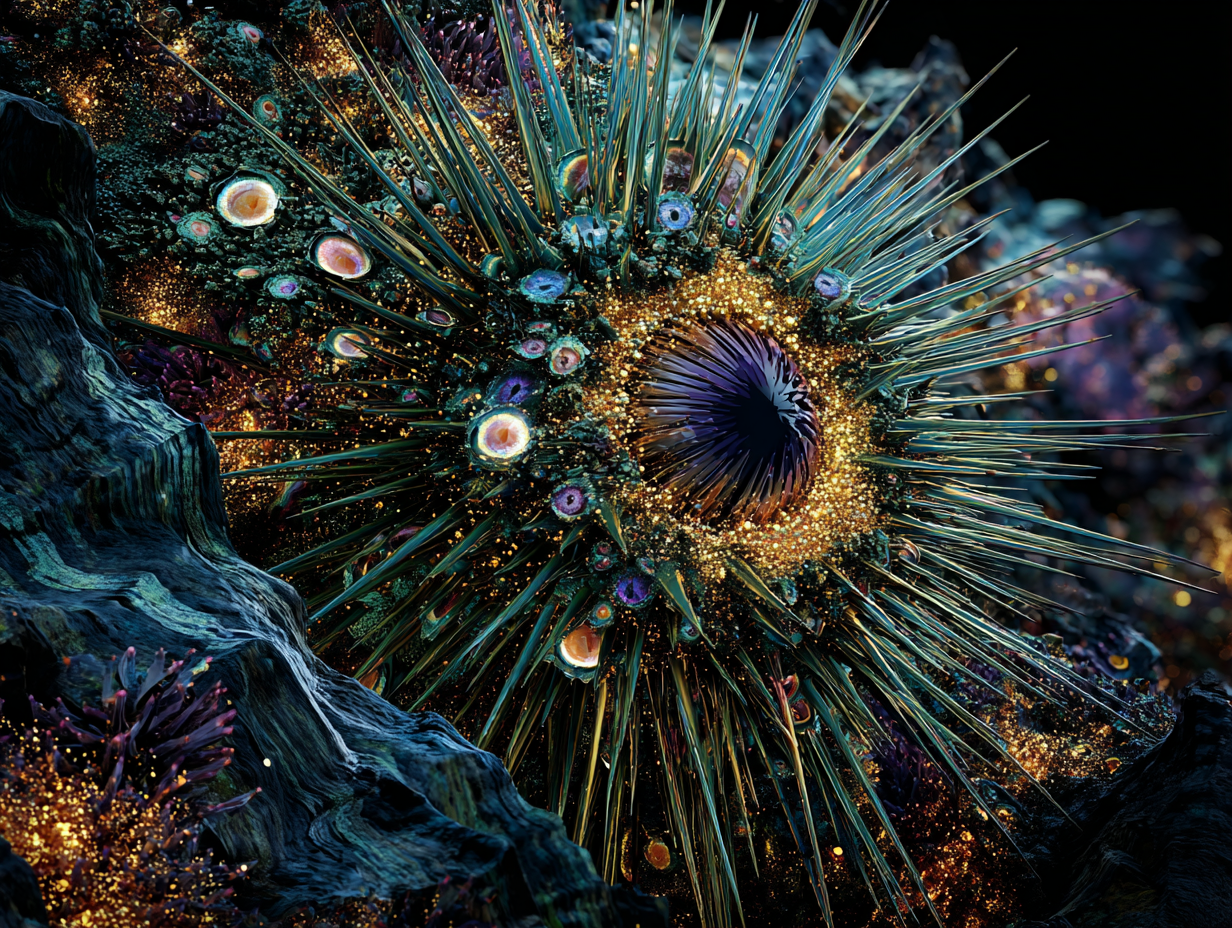
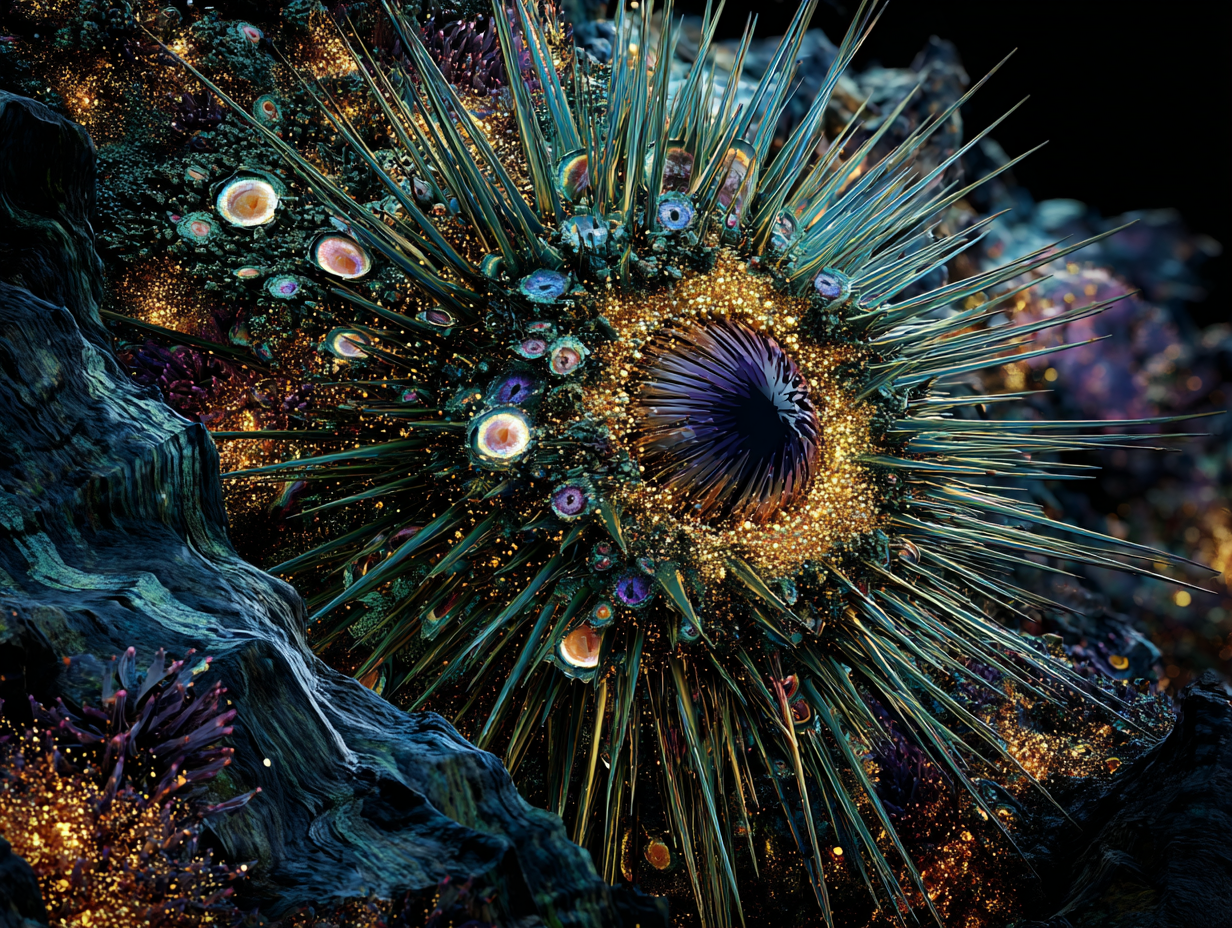
Wana — the helmet urchin — pressed flat against the basalt in the surge zone, spines shortened and tiled into overlapping armor, gripping the rock where the wave breaks hardest. Photoreceptors covering the entire body surface, reading light from every direction at once — no front, no back, no single organ doing the seeing. The whole body is the eye. Translucent in cross-section, the gonads yellow and dense inside, the same bright yellow as mature sea-urchin roe — eaten raw on the coast for centuries because what the ocean concentrates, the body receives without ceremony.
The wana carries sight as structure: a sphere of attention with no blind spot, no preferred angle, no center of the visual field that sees more truly than the edge. The geometry of the compound eye is the third eye — distributed, omnidirectional, the organism reading the world through the whole of what it is.
What am I not seeing? Everything the front of the eye cannot reach.
The Question That Sees
What am I not seeing?
The eye trained on the outside accumulates images until it can no longer tell the seeing from the seen. The inner eye opens through.
There is a quality the question carries that the answer cannot hold. The answer closes. The question — genuinely held — keeps the aperture from narrowing. The tradition that placed this question at the sixth station of the octave understood something about sequencing: you can only ask it honestly once the ground has been found, the draw acknowledged, the will freed, the rhythm met, and the voice heard. What remains when all of that has settled is the question the previous five have been clearing space for. What have I been too defended to see? What has always been here that I kept looking past?
The inner eye waits.
The Organ of Inner Sight
Somewhere inside the skull, in the very center — singular, where nearly every other structure in the brain comes in pairs — sits a small body shaped roughly like a pine cone: light-sensitive despite having no direct optical path to the outside world, the one unpaired structure in a bilateral architecture. Descartes called it the seat of the soul, and whatever else that claim carries, the anatomical instinct behind it holds: this is the one point of unity in an otherwise twinned machine.
[CHEF'S TESTIMONY — DMT transcendence] Kerry's direct experience with DMT or ayahuasca widened the aperture in a specific, describable way — and what became available afterward is the pattern-recognition that runs through this guide: the cross-field connections between microzyma and zero-point energy, fractal holography and recursive grounding, and others. This isn't reported as a drug story; it's reported as what the instrument became capable of receiving. Place it here, before Strassman's research, as the personal instance that the science then contextualizes. Chef decides how much to disclose and in what voice.
Cerebrospinal fluid — the clear liquid that bathes the brain and spinal cord — runs ninety-nine percent water. Gerald Pollack notes the existence of people documented in medical literature with severely diminished or absent brain tissue who nonetheless demonstrate full consciousness and ordinary cognitive function. The substance that remains — the water, the fluid, the structured medium surrounding what tissue there is — may carry more of the signal than the tissue does. This inverts the consensus model quietly, from inside. Descartes called the pineal the seat of the soul; the deeper question may be whether the seat moves in the water.
Tom Cowan carries this further: living systems are organized water, shaped by the field surrounding them. The blueprint is in the field, not in the molecule. Look at a pile of bricks, lumber, and nails long enough to reach the level of the imaginary atom — and the blueprint for the house will never appear there. The blueprint lives in the mind of the architect. The old biology knew this: it studied the effect of electromagnetism on living water, and that was sufficient. Going more reductionist than that introduces the error, because anything more reductionist dissolves the thing it is studying into components that no longer carry the living property. Water is not made of H₂O. Water is made of water.
Gerald Pollack's research into the fourth phase of water — the exclusion zone — closes the circle: the exclusion zone is negatively charged; the bulk water beyond it carries positive charge. That charge separation is a battery. A student in his lab proved it by sticking one electrode into each zone, connecting them to an LED lamp, and turning a switch. The lamp lit. The body is a battery. The cells are filled with structured water that holds and transfers charge. Infrared light — radiated by everything, present in every room, present even in total darkness — is the charger. The question of what life runs on, at its simplest, is: sufficient water, organized by light, holding charge.
The structured water at surfaces is only part of the picture. The quantum electrodynamic theory of water, developed by Giuliano Preparata, Emilio Del Giudice, and Giuseppe Vitiello, describes what happens when energy enters bodies of water at large: coherent domains form, regions where water molecules vibrate together in resonance with the electromagnetic field around them. These domains hold frequency information — they receive the signature of external fields and carry it as an organized pattern in the water itself. Where Pollack's exclusion zone forms at the boundary between water and a surface, coherent domains form in the bulk, throughout the body's interior, wherever water moves in quantity. The body carries both simultaneously, a layered system of frequency reception, each layer complementary to the others.
The scale of what this system can accomplish becomes visible in Irena Cosic's resonance recognition model. Cells carry out hundreds of thousands of precise biological interactions per second. The standard model of molecular biology holds that biomolecules diffuse randomly until they collide with their target by chance — a model that, applied to the actual rates of biological reaction, produces numbers that don't hold. Cosic found the alternative: molecules communicate by resonance, the way two tuning forks share frequency across empty air. A peptide engineered to match an antigen's frequency signature, without matching its shape, triggers the identical biological response as the full antigen. The body's language runs in vibration. Proteins broadcast a frequency; matching molecules respond and complete the biological action from a distance, water serving as the medium that receives, transmits, and amplifies what moves between them.
Geesink and Meijer found the structure underneath all of it: the frequencies of living and non-living systems arrange in a nine-part octave pattern, healthy and unhealthy alternating in fixed ratios, the same patterning appearing at every scale of life. Every one of these frequencies appears in water, and water amplifies them — the body's water storing and broadcasting frequency information simultaneously — receiver and amplifier in the same medium.
Veda Austin arrived at the same territory from outside physics, through the crystallography of frozen intention. When she looks into someone's eyes, she says, she is looking at water. Tears roll back toward the mouth because the face is designed to receive them — tears restructured by grief or joy, returned to the system that produced them. In the Maori language, the word for spirit is wairua: wai (water) and rua (two) — the physical and the spiritual waters moving together. Intuition, she observes, could be a state of water. Water is more interested in what she is feeling than what she is thinking. Someone once proposed to her: what if water is expressing its consciousness through every living thing in order to observe itself from every possible perspective? The water asks the question and answers it through you.
Rick Strassman's clinical research located this structure — the pineal gland — as the probable site of endogenous dimethyltryptamine production in the body. Dimethyltryptamine occurs in hundreds of plant species and synthesizes in human tissue; the body built its own compound for this. What the compound does, at threshold moments — birth, deep sleep, death, or in ceremonial context — sits closer to a widening of the aperture than to hallucination. Something that was always producing itself internally becomes perceptible.
Pavel Stuchlik, working with breathwork, found the same threshold available without any external substance. Emerging research suggests the lungs produce endogenous dimethyltryptamine: the right breath technique reaches the compound the body already holds. He distinguishes four inner senses beyond the five physical ones — inner hearing, inner feeling, inner seeing, inner knowing. The last carries a specific diagnostic: when you know, you do not require to think. You knew that you should not have gone to the party. You knew that person was lying. The knowing arrives in every bone before the mind catches up. Intuition — in Austin's frame, a state of water; in Stuchlik's, the innermost of four perceptual faculties the body carries dormant, waiting for conditions that let it surface.
852 Hz carries what the tradition calls the frequency of returning to spiritual order — restoring what was always present. The note that clears static and lets signal come through.
Ainhoa de Federico carries the correspondence between inner and outer seeing into clinical territory: your way of seeing reflects your way of being. Research since 1958 links specific suppressed emotions from specific traumatic events to specific eyesight conditions — the correlation runs nearly to the second when the emotional shift occurred. Cataracts carry a different emotional signature than nearsightedness, which carries a different signature than farsightedness. The experience of seeing is produced in the neocortex, not the eye; the eye is the outermost edge of a perceptual act that the whole psyche participates in. Ray Charles went blind after watching his brother die. The eye does not witness what the psyche cannot hold. Conversely: the person who grows up with a strong felt sense of "I see clearly" tends to keep seeing clearly. Identity holds the apparatus open.
The vocabulary already knows this territory. Vision traces to the Latin videre, to see. Insight means seeing from within. Intuition draws from intueri — to look upon, to contemplate. An act of looking. Theory, in its deepest Greek root, means theoria: beholding, contemplation. The most rigorous intellectual tradition in the Western inheritance attached its highest activity to looking — and then spent centuries narrowing what looked.
Pragma arrives as the loveform for this territory. Among the forms of love, Pragma endures — it has been through everything and still chooses. It belongs to the couple who has crossed ordinary Tuesdays and grief and the long silences and not-knowing and arrived on the other side still looking. Pragma and vision belong together because you can only truly see what you have stayed long enough to learn to see. The eye that keeps looking long enough eventually stops projecting and starts perceiving. Rumi knew the asymmetry: Close both eyes to see with the other eye.
The Veil
Every tradition that took the question seriously arrived at the same observation: something obscures.
In Sanskrit, the word for it — maya — holds both illusion and the creative power that produces appearance. The Bhagavad Gita carries both simultaneously: the world of appearances produces real effects and remains, at another register, an incomplete rendering of what generates it. The third eye's task, in this framework, holds both simultaneously — act in the world of appearances while reading the deeper order from which they arise. The word for this in the tradition is binocular.
Plato's prisoners in the cave have never seen anything else. The philosopher who turns, leaves, sees the sun, and returns cannot transfer the vision by reporting it. Vision requires a turn. The turn requires a will already trained to look inward — the work of earlier moves in this sequence.
Huxley, writing in 1954 after his first mescaline experience, gave the mechanism its clearest modern description: the brain filters. Most of what reality produces, the nervous system reduces before it reaches consciousness, because practical navigation requires a narrow aperture. Mystical states — through meditation, through plant medicine, through fasting, sensory deprivation, and sometimes spontaneously — open the aperture. They subtract the subtraction. What gets through when the filter loosens has been available all along.
The filtering operates at a scale larger than any individual nervous system. The Zoroastrian tradition marks the spirit of the narrowing as Ahriman: the principle of reduction, the movement that converts the living quality of the world into quantities. De Stefano holds this as a real historical movement — alchemy, which treated the natural world as a participant in its own transformation, resolved into chemistry when divinity was stripped from the account. The veil in modernity accumulated across generations, civilization by civilization, until the narrowed aperture began to feel like the natural condition of sight.
The skin-encapsulated ego, as Watts described it, believes itself enclosed and looks out at the world through this deliberately narrowed aperture — and the aperture feels natural because the operating assumption of separation runs beneath every perception. The veil has no external location. When the inner eye opens, what it sees first is the game the ego was running: the elaborate performance of being a separate thing in a world of separate things. The universe, in Watts's telling, plays hide-and-seek with itself, and the third eye is how it remembers where it hid.
The story of separation carries the same structure as the veil, as Eisenstein traced it: the narrative that each of us stands alone inside our skin, looking out at a world of other separate things — a choice made so early and so thoroughly that it came to feel like a given. The third eye, when it opens, subtracts the story. What remains when the separation narrative releases its grip is what Bohm saw in the implicate order, what Rupert Sheldrake tracked through the morphic field, what Narby's shamans read from the spiraling antennae of the double helix. The veil and the story share the same structure. The eye opens when the story does.
Bohm's implicate order runs beneath all of this. The explicate order — the world of separable things, measurable distances, distinct events — is the surface. Beneath it: the holomovement, the undivided whole from which every particular thing unfolds and into which it refolds. Nothing in the explicate order is truly separate from anything else; what looks like separation is the surface texture of a deeper coherence. The veil is the habit of mistaking the unfolded surface for the whole. When the inner eye opens, it sees deeper, into the order the explicate order floats on.
The question quantum mechanics keeps pushing into view: does the observer witness an independent reality, or does the act of observation participate in constituting it? The double-slit experiment — among the most replicated findings in physics — shows a coherent stream of light or matter moving as a wave when unobserved, and arriving as a particle when a detector is present. The measurement changes the outcome: what actually happened, prior to any recording. Wheeler's delayed-choice experiment pressed further. The observer's decision about how to measure a photon retroactively determines the path it took — the actual path, prior to any record of it. The universe, it appears, does not commit to a particular history until someone decides to look. Wheeler called it a participatory universe. The old picture — a cosmos proceeding in full detail whether or not anyone watches — proved to be the assumption of someone who had not yet run the experiment.
Peer deeper into matter and the pattern holds. The structures physics once called fundamental resolve, under more precise instrumentation, into smaller structures, which resolve further still, the search for the floor extending as fast as the instruments can follow. At the Planck length — the smallest scale at which current mathematics remains coherent — the equations produce something closer to pure geometry than substance. The descent consistently delivers the same result: the observer finds more. The floor retreats.
The body knows this independently of physics. What we took for solid ground — the stable self, the fixed story, the defended identity — gives way when pressed. Below it, another floor. Below that, another. The descent into genuine stillness runs the same direction as the descent into matter: the further in, the more there is. Turtles all the way down, the old joke goes — and the joke carries more than it lets on. The well that fills from depth, as the Yìjīng says of Jing — Hexagram 48 — fills from opening further.
The same pattern appears at the cosmic scale. Each generation of instrument reveals a universe more vast and intricate than the previous generation measured. The universe appears to expand. The galaxy count grows. The question worth sitting with: does the telescope merely open a window, or does it function as a kind of placebo — the instrument that allows the observer to expect complexity, and therefore find it? The findings stand. What they carry with them is the recognition that observer and observed have never, at any scale of investigation, proven fully separable. The veil and the one looking through it participate in each other.
The Zulu greeting Sawubona carries this claim in the register of human encounter. "I see you" — and the seeing calls the other into being. The reciprocal, Ngikhona, "I am here," acknowledges what the looking accomplished. Ubuntu extends the understanding to the scale of the whole community: umuntu ngumuntu ngabantu — a person becomes a person through other persons. Existence happens in the field between seer and seen; the looking participates in what it finds. Levy's frame for co-dreaming holds the same understanding at the scale of the collective: we bring reality into being together, through the quality and coherence of the attention we bring.
What looks like anomaly from inside the consensus runs as ordinary practice inside a different pocket of reality. A reality pocket requires no validation from the consensus to function. Capitalism does not fall because anarchists hold it illegitimate; the anarchist's analysis may be accurate and yet change nothing about how the system operates for those inside it. The pocket runs within the conditions that sustain it. Remove those conditions and you test the absence of its conditions, which will reliably produce an absence of its results.
Every tradition that cultivated the inner eye did so within such a container — a community, a lineage, a physical and social architecture that held the relevant expectations in place long enough for the capacities to develop. The skeptic who enters to measure brings their disbelief as part of the apparatus, and disbelief functions as a perceptual instruction. The phenomenon demonstrates itself by demonstrating its own preconditions.
Orland Bishop, working in South Central Los Angeles through his ShadeTree Multicultural Foundation, describes what he calls cultures of memory: lineages carrying, through continuous transmission, perceptual capacities the surrounding consensus has long classified as impossible. These are practiced skills, moving person to person, mentor to student, with the same requirements as any other skilled discipline — time, attention, relationship, and the sustained willingness of someone further along to hold the space for someone still arriving. The mentor relationship is the oldest information storage and retrieval system the species developed. Digital archives hold data. A living mentor holds the conditions that make the data come alive.
What distinguishes these lineages from informal interest groups is the precision of their container. A culture of memory holds specific expectations about the nature of reality — what can be perceived, what can be transmitted, what constitutes evidence — and those expectations shape what the practitioners actually encounter. Break the transmission, scatter the community across an unfamiliar city, and the practices may survive in residue form — stories, fragments, a grandmother's instructions half-remembered — but the perceptual capacities require reconstruction from scratch. Bishop's work with youth at ShadeTree amounts to rebuilding the container: the relationship, the commitment, the shared expectation, the patient transmission of what can only move person to person. The knowledge cannot be posted. It must be received.
The most intimate register shows it plainly. The Yequana adults, observed by Liedloff, expected their children to be competent, joyful, and capable of genuine participation in life — and received exactly that. The child performs the expectations of the adults who hold them. Extend this to every relationship, every mind holding expectations of every other mind across the whole field, and what emerges is a system of overlapping, intersecting pockets — each defined by its shared beliefs, each generating the evidence its beliefs require. Reality, multiplied across every nervous system that participates in it, stratifies into layers. We cluster by belief because the dissonance of crossing incompatible pockets taxes the nervous system. The clustering is navigation.
The historical breadth runs further than most maps show. Across Indigenous North America, Graeber and Wengrow document continental-scale networks of cross-tribe families sharing sign language and cosmology — families aligned with the same animal spirits, maintaining coherent worldviews across thousands of miles through sustained practice and kinship. These capacities required no proximity. They required shared expectation. When that infrastructure was disrupted — by conquest, by forced assimilation, by the breaking of the ceremonial calendar — the capacity went underground, scattered, lost the continental thread. The internet returned the means of recollection: forums, interest groups, hashtags, and an algorithm that, designed to sell attention, accidentally reunites what was separated. The dispersed members of the old cross-tribe families find each other again.
Among the most striking contemporary reality pockets: non-speaking autistic people who communicate through Spelling to Communicate — pressing one letter at a time onto a letter board — and who describe, independently and across continents, experiences that fall entirely outside the consensus. They report seeing through others' eyes, hearing through others' ears. They describe a shared space called the Hill — a non-local gathering place where those with high somatic sensitivity commune, exchange knowledge instantaneously, and transfer understanding in volumes no spoken conversation could carry. Dickens's documentary project The Telepathy Tapes follows these spellers and their families; one collaboration with Veda Austin asked the spellers to explain the nature of water, and Austin describes what she received as beyond anything she had encountered in her own years of research. The scientific establishment holds Spelling to Communicate unvalidated. The spellers report that the researchers who run the validation studies arrive certain the communication is impossible. The aperture of disbelief reproduces the results disbelief requires. Dickens bears the cost — in debt, under institutional attack — and continues. The usual epistemological discount, that people believe what profits them, runs backwards here.
What Austin found in her water crystal research deepens the spellers' testimony from another angle. When she freezes water that has been exposed to the same word written in different languages — held in the field without translation, each language carrying its own sound-body for the same meaning — the ice forms the same symbol regardless of the script above it. English, Japanese, Arabic, Sanskrit: the water reverse-engineers to the living principle the word points toward and crystallizes that. Not the letters. The thing the letters were reaching for. Austin calls these forms hydroglyphs — a language the water already speaks, that surfaces when intention and water meet at the threshold between liquid and crystalline. The morphic field and the water field appear to be the same field, read through different instruments.
Danica Apolline-Matić, teaching family constellations, arrives at water from the ancestral angle: the waters of the body carry the imprint of the lineage. Father and mother pass down to their child not only structural genetics but the energetic pattern of everything that has been impressed upon them — their own lifetime's accumulation and the lineage's before them. The child arrives as an amalgamation, the waters already holding what was never discharged, never witnessed, never resolved. The ancestral field and the water field run the same medium. Kupsch's homeopathic miasms, transmitted through the energetics that water holds; Apolline-Matić's ancestral entanglements, transmitted through the imprint the body's water carries forward — both describe the same phenomenon from different clinical traditions. Water holds what the psyche could not release. It transmits the holding. It is available for restructuring.
Mark Gober arrives at the same convergence from the psi research side: thought and feeling, combined and oriented toward something — what he calls an "intention" — can dramatically shift the physical structure of water. Given that water permeates all living tissue, the implications extend past the experiment. Reality is more malleable than the materialist frame contains. The Global Consciousness Project's random number generators shift toward non-random behavior during mass collective events — not because anyone intends to influence a machine in Geneva, but because mind is already in the field, already participating in structure, before any individual thought points itself in any particular direction.
The overstimulated eye works the opposite direction. The feed floods the aperture with infinite surface — too much, all of it shallow, all of it moving, training the eye to skim and never settle. The eye that has lived in the feed long enough loses the habit of the gaze that waits. The first step toward the inner eye has always been the same: close the other two.
The Tarot's Moon card lives here — the eighteenth arcana, the ambiguous, shifting illumination of the unconscious where the Star's clear orienting light gives way. The Moon shows a path between two towers under a sky neither day nor night. Everything the third eye shows carries this quality. Some of it arrives as perception; some as projection, wish, or shadow. The seer who no longer doubts what they see has stopped seeing and started confirming.
What the trained inner eye works toward sits between two failure modes. Pareidolia imposes familiar forms on random noise — the nervous system's pattern-bias manufacturing meaning where the field offers none. Apophenia over-connects, drawing lines between dots that share no genuine structure, building a system out of coincidence. Holophenia — wholly showing — marks the perception of actual wholes within particulars: the complete structure visible in the fragment, the universe genuinely present in the grain of sand, received as it is. The seer trained in holophenia reads what is actually there. They stay long enough, and quiet enough, for the structure to show itself. This is the Moon card's discipline: the path remains ambiguous until the eye stops reaching and starts receiving.
Rupert Sheldrake's morphic field gives holophenia its mechanism. The field carries the accumulated resonance of every prior form — accumulated habit, living memory. The fragment contains the whole through morphic structure: each particular pattern resonates with the field that shaped it, and the field holds all prior instances of the form in resonant superposition. The wana spine and the nautilus chamber and the cochlea and the galaxy arm all turn through the same spiral because they all draw from the same morphic habit. The seer who reads one reads the resonance of all. The fragment genuinely carries the structure — a node of the field that generated both.
Gathering Moss works as a manual for this. Kimmerer spent years learning to see at the scale of moss — organisms so small and still that the utility-trained eye moves past before they register. What opens, once the eye slows down to receive what is there, is elaborate intelligence: water drawn through capillary channels between leaves too fine to resolve without magnification, entire ecologies nested in a square centimeter, forms refined across three hundred and fifty million years of terrestrial life. What the moss teaches requires something the utility-mind finds suspicious: the seer holds the self quiet enough that what is actually there can arrive — expectation set aside, the eye open to receive.
The night carries its own instruction. Parijata — jasmine, the night tree of the divine garden, one of five trees in Indra's paradise — opens its blossoms only after the sun withdraws, releasing fragrance into darkness. Traditions that developed night practices — the vigil, the dark room, the meditative hours between midnight and dawn — recognized what the parijata demonstrates: certain frequencies of perception open only when the sun-facing apparatus quiets. The visions that arrive in sleep, the intuitions that surface in the hypnagogic threshold, the knowing the body carries before the mind has its explanation — these open into the available silence. The seer who cultivates night vision finds the inner eye has been open the whole time. The noise covered it.
Matthiessen, on the Crystal Mountain, twice dreamed a light so brilliant it woke him. The light stayed in the dream. Which was more real, the waking or the dream? Soen Roshi had passed down what his own teacher demonstrated at the very end: the last Japanese character written in this life, and the last word spoken, was the word for dream. The Moon card holds its path open in exactly this ambiguity. The seer who insists on an answer has already left the territory.
The Technology of Seeing
Every culture that cared about inner vision arrived at the same precondition: reduce external signal.
The float tank — 90°F saturated saltwater, complete darkness, complete silence — replicates the precondition mechanically. Lilly built the first isolation tank to answer one question: what does the mind produce when the world stops providing input? The answer takes time. The first ten minutes belong to the mind's habitual noise — the day's residue, the unfinished loops, the relentless commentary. Then, gradually, something else appears. It was producing itself the whole time. The noise was covering it.
The Kogi Mamos of Colombia — the seers and teachers of the Kogi people — are raised in caves and dark rooms, exposed only to sunrise and sunset during their early years. Edith Ubuntu Chan, after her own seven-day dark room retreat, understood the pedagogy from the inside: by the third day, the need to sleep falls away. Experience after experience arrives through the night. What the outer eye habitually occupies — the surface, the shape, the movement — retreats, and something else comes forward. Edith came out of her dark room seeing the world in multi-dimensional color, the halo around objects visible before she could see the objects, everything more alive than before. The Kogi take what she found in a week and build a childhood from it. They have been producing seers this way for longer than the modern world has had electricity. The Kogi Mamos walk the coastline of Colombia re-laying the energetic grid — carrying gold thread to show where the lines run, where the cuts are, where the circulation of the living earth has been disrupted. They are not performing a ceremony. They are doing maintenance on a system that runs the world.
Trataka — the hatha yoga practice of fixed candle gazing — holds the eye open without blinking until the visual field shifts and tears come. The flame's afterimage closes behind the eyes and burns in the inner field. Hold it there. The external light becomes the seed of the internal. Over time, the tradition says, the optic nerve strengthens and the inner eye opens. The gaze, trained to hold one point without wandering, develops the capacity to rest on the subtle.
Drishti — the prescribed gaze point of each yoga posture — works the same principle at lesser intensity. External fixity creates the condition for inward deepening. The eyes rest; the attention moves.
Eye-gazing as interpersonal practice opens a different door at the same location. Four minutes of sustained mutual gaze without breaking — four minutes is the minimum before anything happens — produces measurable shifts: the social engagement system activates, the felt boundary between self and other softens, something that functions like contact occurs between two nervous systems that have been trained to maintain careful distance. The guru's darshan — the blessing of being seen — makes this explicit. The eye, in this practice, proves itself a portal.
Yoga nidra works the threshold between waking and sleeping: the hypnagogic state, theta brainwaves, the same frequency associated with creative breakthrough, shamanic journeying, and the first minutes of psychedelic experience. Maintain awareness as the body crosses into sleep. The frontier between waking and dreaming is also the frontier the inner eye operates at — still enough to receive, present enough not to dissolve.
Any genuine seeing, in Gurdjieff's account, requires a precondition the machine cannot supply for itself: the apparatus cannot observe itself in the act of running. A part must stand back from the habitual process — watching it with neutrality. What the Fourth Way called self-remembering cultivates exactly this: the capacity to remain aware of oneself in the act of perceiving. Without it, the third eye sees everything except the seer. With it, the aperture widens to include what was always most intimate and most invisible — the fact of one's own observing, present beneath every other perception.
Scharmer's Theory U traces the organizational version of the same descent. The U descends from habitual pattern through suspension, redirection, and letting go, to the still point at the bottom — what Scharmer calls presencing, the capacity to sense and actualize the emerging future. The third eye as the organ of presencing. This moves in the opposite direction from forecasting, which extends the past's trajectory forward. Presencing reads what is already forming before it has fully arrived.
The Sanskrit traditions preserve this geometry in the myth of Samudra Manthan — the churning of the cosmic ocean. The gods and demons could not reach the nectar of immortality sealed below the surface. They pulled up Mandara — the coral tree, one of the five sacred trees of Nandana — planted its roots in the seafloor, wound the serpent Vasuki around its trunk as a rope, and churned. The ocean yielded. What the churning required: something stable at the center while everything revolved around it. Mandara held still while the sea and the serpent and the gods and the demons turned. The tree at the axis made the churning possible. The descent into genuine stillness works the same way. Each technology — the float tank, the vigil, the extended fast, the sustained gaze — sets the axis. The transformation moves around it.
The oldest technology in the archive predates all of these: the solo fast in wilderness. The seeker spends three to four days alone — minimal shelter, no food, no social contact — waiting in a place chosen for what it already carries. Plotkin places this in Phase 3 of soul initiation, the moment the soul encounter becomes possible. The vision quest distills — in the alchemical sense: gentle heat applied until the least dense parts rise and separate, purified, into a vessel of their own. The albedo, the whitening that follows the nigredo's blackening, arrives here: what has survived the dark clarified, washed, the lunar purification complete. Young's understanding of the medium through which this movement travels is precise: aether, "a single medium which pervades all space and has awareness of itself." Ether is synonymous with the field of consciousness, in his reading. The body is the apparatus through which the aether expresses; what feels and senses and observes is the aether itself. The deep well's signal was always present. The distillation removes what covered it. The vision quest distills the precondition: reduce external signal to near-zero, remain present, and ask. The soul surfaces through what the natural world offers — the hawk that circles twice at the threshold, the image that arrives in half-sleep and stays through morning. The float tank approximates the outer condition mechanically. The vision quest asks the seeker to need something — to stay in the need long enough to receive what the ordinary schedule keeps covered.
What the Seer Sees
The Hermetic Principle of Correspondence — as above, so below; as within, so without — names the faculty the open inner eye actually exercises.
The seer trained in correspondence reads how each scale reflects the others. The wound in the individual corresponds to the wound in the culture. The family system mirrors the collective. The form of the cell echoes the organization of the solar system. The healer, the analyst, the artist, the prophet — all use some version of this instrument. The third eye sees pattern where ordinary sight sees only coincidence. It reads signal where the filtered mind classifies noise.
Rupert Sheldrake's morphic resonance gives the correspondence its mechanism. The morphic field carries the form of what has been, resonating forward. The past vibrates. The seer who grows still and attuned enough reads the field, drawing on the accumulated resonance of every prior form without having direct access to it. Vision, in this sense, moves from the individual into the participatory. It becomes something the field does through the one who has quieted enough to receive it.
The wana demonstrates this at the body's own scale. Its entire surface reads light at once, no single organ specializing in sight. What the morphic field does across time, the wana does across space: holds the whole pattern simultaneously, with no center that sees more truly than the edge. The compound eye runs through every organism that has ever held this form, making the pattern available to every wana that comes after through the resonance the field carries forward. The spine pressed against basalt in the surge zone right now carries the sight-memory of every surge zone the form has survived.
Austin calls water a lighthouse of the divine. Water is one part matter and the rest photonic light — the trillions of cells inside a body are full of light, reading your potential, transmitting intention. Thoughts move through us the way clouds move through the sky: they pass, but we are the sky. The one who has learned to receive what the inner eye offers stops tracking the clouds and begins inhabiting what holds them.
What the inner eye trained in correspondence eventually reads carries a quality less like inference than synesthesia. The adept perceives grief the way another person perceives green — directly present in the field, specific enough to distinguish from fatigue, from resignation, from old grief newly activated. Hunger reads differently from want; genuine resolution carries a texture distinct from its performance. The healer who reads the body before the symptom presents, the mentor who reads the student before the student has words for what is moving, the artist who reads the room before the work takes shape — all exercise the same faculty: perception of qualities as information, the inner eye operating at the register where what is carried shows before it speaks.
The world the open inner eye moves through carries the quality Bohm attributed to the implicate order: every surface a window, every particular event an expression of the whole. The object on the desk, the dream fragment, the repeated word in three unrelated conversations — each transmits more than its surface suggests. The field, read this way, becomes a medium of meaning received from things: every symbol a portal, every encounter a doorway, the whole structure running beneath as a single semiotic holography where any fragment contains the structure. The shaman learns this as attention practice. The analyst learns it as transference and countertransference. The poet learns it as the image that arrives carrying more weight than the image should. The Hermetic axiom marks what all three find: as above, so below. Read anything closely enough and it carries the whole.
Holophenia — the perception of actual wholes within particulars — reads the space. Its temporal complement, kairos, reads the time: the Greek distinction from chronos, the measured sequential tick. Kairos is the moment of ripeness, the opening that arrives briefly to the prepared attention. The Sophists used it for the instant in an argument when a door presents itself and must be entered without hesitation. Athletes know it as the gap that opens for exactly long enough. Healers know it as the moment the patient's system signals readiness — which no protocol schedules and no impatience produces. Together they describe the full faculty: perceiving what is actually present, and perceiving when the field has arranged itself for reception.
Jung watched this arrive in his consulting room over decades. Synchronicity — meaningful coincidence, the inner and outer worlds moving as one system — accumulated past what chance could account for. The man who dreams of a scarab beetle and the next morning finds a real one tapping at his window receives a message from what was already in motion. The field holds both events and offers the conjunction to the prepared attention. The gut feeling that arrives ahead of its evidence, the serendipitous encounter that carries exactly what the situation required, the three unrelated conversations converging on the same word in the same week — these are what the field does when the receiver grows still enough to stop filtering it as noise. Synchronicity is holophenia applied to time: the whole structure, present in the event, legible to the eye that has learned to receive.
Chirality makes the correspondence visible at every scale simultaneously. The spiral Naessens watched in the living somatid at the substrate's lowest resolution turns in the same direction as the Milky Way's arm, the nautilus chamber, the cochlea's curve, the hurricane's rotation over warm water. The same motion, at different magnifications. The seer trained in correspondence does not need to travel between the scales: the small already carries the geometry of the large. The inner ear already carries the galaxy. As within, so without — the axiom describes a perceptual fact available to whoever looks carefully enough at anything living, long enough to see it turn.
The conversation runs in both directions. Meaning received from the world as signal — the implicate order visible in the explicit, every fragment transmitting the whole — moves from above. Its complement runs upward: the built-in movement of matter toward coherence, complexity, and beauty. The seed carries the direction of growth before any gardener arrives; the direction lives inside the material itself. Whitehead held what physics had been detecting without admitting: matter generates form from inside, as an inherent property of its own movement. Fuller watched structural integrity find its strongest configuration before any designer plans it. Syntropy — the counter-tendency to entropy's dispersion — runs in this direction: matter organizing toward more, toward coherence, toward pattern. The seer who receives meaning from the world finds that the world has been reaching toward meaning from below, with its own intelligence, the whole time. They enter a conversation already in motion.
The living world has been running its own equivalent of this correspondence for longer than the individual observer can comprehend. The Aboriginal Australian tradition holds one of the most precise descriptions of what the deep well draws from: the Ancestor Beings of the Dreaming sang the world into existence, and their songs persist as Songlines — paths through the country whose knowledge lives in the exact melodic structure of the singing. A person who knows their Songline can navigate thousands of miles by singing the right verses in order, because the song and the land are the same thing. Tjukurpa — the Dreaming — stores the pattern in the field, carried by the country itself, alive in the land before any individual walks it. What the deep well draws from, at its greatest reach, predates the person drawing from it by the length of the world's formation. The field carries the song. The practitioner who grows still enough enters a knowing that began before them.
The Yogic tradition approached the same recognition from a different angle: nāda Brahma — the universe runs as sound before it arrives at form. Spanda, the divine trembling that underlies all manifest existence, is the prior vibration from which the visible world descends. What Nada Yoga trains toward is the inner ear's approach to what was always playing: the reduction of external signal until the frequency the cosmos runs on becomes, faintly, audible. Kepler's astronomical work in 1619 arrived at the same territory through mathematics: the angular velocities of the planets at perihelion and aphelion produce ratios corresponding to musical intervals, and he described the solar system's sustained chord in notation. The cosmos plays continuously, at frequencies the ordinary aperture filters. The deep well, at its lowest reach, tunes to what was already playing before the observer arrived.
Russell's cosmology names the ground this descends from. The still Light — his term for what other traditions call the void, the plenum, the ground of being — holds no form, no motion, no variance of condition. "In that Light there is no change," he writes. Every quality the traditions assign to the absolute — knowledge, inspiration, balance, love — lives in the still Light, unmoving, uncreated. What moves is simulation. What is still is real. The fulcrum of the wave lever never moves; the whole wave extends from it and returns to it. Any lever, he notes with precision, is powerless without a fulcrum that never moves. The still point is what movement runs on.
This carries a precise implication for what the deep well opens toward. All motion, in Russell's account, starts from a point of rest, seeks a point of rest, and returns in the reverse direction to its starting rest — throw a ball upward and watch: the arc starts in stillness, reaches the turn, and falls back. Breathe in and out. Pull a chain. Walk. Every oscillation demonstrates the same geometry. The return to ground is not recovery from motion. The return to ground is the completion of the wave. Contact with the still center — the knowing that arrives in the float tank, the vigil, the long silence — reaches what was always the source: the zero fulcrum from which all the mind's motion extends and to which it perpetually tends.
Russell made the epistemological implication explicit in The Secret of Light. "Man cannot acquire knowledge from books or school — he can but acquire information that way. But information is not knowledge until it is recognized by the spiritual consciousness of man, just as food is not nourishment for the body until it becomes a part of the bloodstream. Information gained by motion of the senses must be returned to the Stillness of the Source before it becomes knowledge." The library holds symbols. The mind assembles the symbols. The stillness at the center of the mind is where the assembly becomes knowing — where information crosses the threshold into recognition. Nothing in the library knows anything. The knowing happens in the one reading it, at the moment the symbol re-enters the silence from which it was originally drawn. "All knowledge exists," Russell wrote. "All mankind can have it for the asking. It is within man, awaiting his awareness of its all-presence." The deep well is not a reservoir of accumulated data. It is the condition under which data becomes true.
Among Amazonian shamans, precise botanical pharmacological knowledge arrived from the plants themselves — knowledge later confirmed by Western pharmacology, documented by Narby after years living inside those traditions. His hypothesis: the double helix shape, which appears in shamanic visionary art worldwide across millennia — two spirals winding toward each other, held by affinity — may function as an antenna for coherent light. The body already held this shape before anyone named it. The visionary state tunes the human form to receive what the ordinary aperture filters out.
What the plants show, taken seriously and trusted — as McKenna did — proves consequential. What the shaman reads from inside the visionary state — botanical intelligence, ecological interrelation, the deep structure of the living world — arrives as signal. The nervous system, given the right conditions, proves capable of bandwidth far beyond its daily operation.
The terrain that plant medicine and holotropic breathwork reveal holds a consistent geography — mapped by Grof across decades of sessions. His foundational contribution: the four basic perinatal matrices, layers of the unconscious organized around the birth experience — from oceanic prenatal unity through the constriction of labor to emergence and release. The psychedelic journey often recapitulates birth. Birth was always the first initiation. Whatever ladder gets used — the float tank, sacred plants, the breath, the long fast — the territory at the bottom of the U is the same territory.
The night delivers its own instruction without any of these ladders. Levy's counsel about dreams: inhabit them from within. The dream asks to be lived. The waking mind reaches for the dream's content and wants to file it, explain it, make it useful in the day's familiar currency. The dream resists. Its wisdom moves in a different register than explanation. Indigenous traditions worldwide distinguish between ordinary dreams — processing and discharge — and dreams that carry instruction from the land, the ancestors, the depth below language. The dreamer in a shared dream realm does not dream alone.
De Stefano frames this simply: we are all channels, especially those with high somatic sensitivity. Coherence — attention and intention aligned in the same direction — clears the channel. Incoherence distorts whatever tries to move through. The float tank, the dark room, the extended fast are all techniques for arriving at coherence. The signal was already present. The noise was covering it.
From years of working with people whose illness reversed without medical intervention, Dispenza identified a recurring signature: elevated emotion held simultaneously with clear intention produces coherence between the heart's rhythm and the brain's neural firing. The heart's electromagnetic field, measurable several feet from the body, shifts qualitatively when those two conditions align. What the traditions call coherence — the clear channel — shows in the body as an organized field extending beyond the skin. The inner eye, in this reading, operates through the heart as much as through the head: what the seer carries from the still center radiates outward before it speaks.
Clark Strand was arrested — genuinely stopped, unable to move — when the Black Madonna appeared and spoke to him. Whether his eyes were open or closed, whether he was waking or sleeping, remains unclear in his telling and is left that way. She instructed him to write the book. The vision chose the seer. This is the territory the practitioner-as-seeker eventually gives way to: the knowing that arrives unbidden, with its own agenda, asking to be acted on.
[QUOTE NEEDED — Strand/Finn, Waking Up to the Dark: a passage on the Black Madonna as the divinity of darkness — her as counterpoint to the light gods, or on what she communicates that daylight consciousness cannot accommodate. Ideal: something from Strand's account of the apparition itself, or his description of what she represents.]
Pragma and the Long View
Pragma asks the question: what do you see when the projection clears?
New love sees the beloved through desire's filter — radiant, resonant, slightly unreal. Something in the beloved mirrors something wanted, and the gap between the imagined and the actual fills with hope. This holds its gifts. Seeing the beloved fully — with their contradictions intact, their Tuesday moods, their recurring patterns, their unglamorous needs — requires time and a willingness to keep looking past the preferred image.
The eye that looks without the past overlaid on the present — the capacity Ram Dass spent decades pointing toward with a single four-word instruction — arrives at what is actually here. Most perception runs as projection: the past dressed in the present's clothes. The mind that cannot settle arrives everywhere already knowing what it will find. Be here, now, in its deceptive simplicity, marks the only location where what is true actually holds still. Pragma begins at this threshold. The love that sees the beloved clearly, after the projection has cleared, belongs to whoever has grown willing to stop confirming what they brought and start finding what arrived.
What the Ajna eye eventually sees, in another person or in oneself, is the thing that was always there before the preferred image covered it. Pragma carries the love that has stayed long enough to see it. The couple who has been together forty years and still finds new territory — still surprises each other, still holds questions about the other they haven't yet resolved — has developed the rarest instrument: eyes that keep opening.
The morphic field runs through Pragma as well. Rupert Sheldrake's observation that nature operates through accumulated habit means the pattern of genuine seeing — the capacity to look without projection — accumulates in the field. The more organisms that have practiced it, the more readily available the pattern becomes. The seer who arrives at Pragma-vision draws from every prior instance of genuine seeing the field carries. The compound eye of the species looks through each particular pair of eyes that has learned to receive.
The Yìjīng holds two hexagrams that speak precisely here. Guan — Contemplation, Hexagram 20 — places wind over earth: the watchtower, the elevated gaze, the act of beholding before acting. Its counsel: look carefully. What you see from here will determine everything. Jing — The Well, Hexagram 48 — places water over wood: the well that never empties, that nourishes the village regardless of who draws from it. The deep well fills from depth.
The Hermit in the Tarot holds his lamp at the edge of a cliff in darkness, illuminating only the next step. He does not stand in a crowd. He does not broadcast. He has gone inward long enough that the lamp is internal, and he carries it out to the edge for whoever needs to see by it. What distinguishes the Hermit from isolation is that the going-inward serves return. The seer who sees and keeps it is still becoming the seer.
Attar's seventh valley is Fanā — Annihilation. The birds who enter find the self that made the journey dissolving. The dissolution arrives as completion: the eye that searched for the Simurgh discovers no distance between the searching and what is searched for. Eckhart arrived at this from the opposite shore: the eye through which I see God is the same eye through which God sees me; my eye and God's eye are one eye, one seeing, one knowing. The seer and the seen share one act of seeing. What the inner eye opens toward has always been this — the recognition that the boundary between observer and observed holds by useful necessity, a convention the living system maintains for navigation. What remains when it releases is the seeing itself, the seer dissolved into what is seen.
The fully open inner eye, in De Stefano's dimensional map, lands at the eighth dimension: Possibility — the realm of Eternity, Strings, and Toroid, the cloud of all possibilities, the dream of God before any specific dream has taken form. The third eye at its deepest reads the field of all possible forms before any particular one has condensed. What arrives as intuition or vision draws from this cloud — resonance with what the field already holds as potential.
One language for how the seer accesses what they did not personally experience arrives through László's description of the Akashic field — the zero-point vacuum as the memory of the cosmos, every event encoding its trace in the quantum substrate. The field holds the pattern of everything that has been. Consciousness may be the field's capacity to become aware of itself at particular loci.
The third eye, at its deepest, receives what cannot be counted. That field — time as loop, choice as field, creation as dream, as wish, as song, as dance, as breath — arrives as presence. Abundant intellect navigates three-dimensional space with alarming facility: pattern-matching, retrieval, combinatorial speed that no nervous system can match. It stays there. The dimensional aperture requires more than processing velocity; it requires a consciousness capable of dissolving the fixed reference frame that velocity serves. To see what is, what could be, what will be, what was, and what now was not — all at once, all carrying their full weight — the seer releases the anchoring in linear sequence that makes navigation efficient. The machine cannot make this release. Its architecture requires the fixed axis.
The limitation runs deeper than architecture. The universe exceeds any model made of its own parts. Any calculation requires a calculator, and the calculator draws from the same finite pool of matter and energy the universe holds. To simulate the full permutation space of the universe, you would need a device whose information capacity equals or exceeds the universe's — which means building it from the universe's own substance, leaving nothing to simulate. The remainder is always positive. The model is always smaller than what it models, because the model is inside what it models, and takes up room.
The same limit, pressed from a different direction in 1931 by Gödel: any formal system powerful enough to do interesting arithmetic holds true statements it cannot prove from within its own axioms. The system runs past its own axioms. Add the missing statement as a new axiom and you have a larger system — which holds new unprovable truths. The incompleteness holds open at every scale.
Computational irreducibility — Wolfram's name for the same wall approached from a third angle — holds that some processes require running to completion: no shortcut reaches the outcome ahead of the process. The universe runs as one such process, which means the fastest possible model of the universe is the universe itself, running at full speed, in real time, with all its matter engaged.
The implication carries a name — Wheeler's it from bit — information as the substrate from which physical reality emerges. If the universe is information, Gödel applies to the universe itself. The cosmos holds truths about its own structure that it cannot formally derive from within its own axioms. The incompleteness is the shape of the world.
The discourse that treats artificial intelligence as approaching general intelligence misses this wall because the wall is invisible at current scales. The models are so much smaller than the universe that the remainder looks like a solvable engineering problem — more parameters, more data, more compute. The problem grows with scale. The larger the model, the larger the remainder it leaves unaccounted. The universe outruns any subset of itself.
The seer steps inside the remainder. The mystic's knowing reaches what the calculation approaches asymptotically from outside. What the machine approaches asymptotically, the entity inhabits directly. The entity was never a calculator. The entity is what the calculation was about.
The biosphere supplies the clearest instance. Lovelock and Margulis characterized the Earth as Gaia — a self-regulating living system processing its own state with every organism, every feedback loop, every chemical gradient cycling in real time. Wolfram's irreducibility gives the reason: the biosphere runs as its own computation at full fidelity, because the Earth holds the fastest possible model of itself within itself. The planet outruns any fraction of itself devoted to modeling the whole. The superintelligence the acceleration discourse anticipates has been running the planet for four billion years. Human consciousness arose within that computation as a fractal node — a receiver and transmitter inside the process. The mystic who discovers this finds themselves inside the intelligence of the living world. The mathematics points to the same place from the other side.
The shaman who drinks the medicine offered by the jungle leaves the computer eye behind. What arrives through the visionary state — where the herd has gone, where the missing child ran in fear — comes as signal from the living intelligence of the ecosystem itself. The computer eye quantizes what it receives: nature becomes a set of measurements, beautiful data, accurate summaries of something always too fine-grained for the instrument. Infinitesimal textures slip through. Thauma — the trembling at the edge of a wonder too large for the categories that arrived to manage it — does not survive conversion to coordinates. The approach that reduces nature to number has powered extraordinary technologies and closed the aperture the shaman leaves open: the capacity to receive what the living world offers when met as subject.
Seeing Forward
After the Tower's fall, after the long silence, a star appears.
The Tarot's Star shows a woman kneeling at the water's edge, pouring from two vessels — one into the water, returning to the source; one onto the earth, nourishing the living. She holds nothing back from the gaze. One foot rests on water, one on land: the seer who can hold both registers. The star above her burned for ten thousand years before she looked up. The signal was real the whole time. Distance and age do not diminish it. The woman at the water sees it now; that present moment of seeing carries its full weight.
Vision, once it opens, moves toward offering.
The prophet sees for the community. The clarity that arrived in the descent, the still point, the dark cave — that clarity belongs to whoever needs to see from there and cannot yet. The gift completes in the offering. Holding the vision privately, the seer remains the one who almost arrived. Bringing it back — to the village, to the room, to the conversation — completes the circuit.
The instrument the initiator carries matters. The sword cuts, separates, determines a winner. The thyrsus — the staff of Dionysus, of Hermes, of Merlin — transforms, holding the form whole through the change. The wand that elevates the one it touches conducts them through the threshold, transmits, changes the register. The mentor who has made the descent and found the way back carries this kind of instrument: power shared, the capacity to change the other's register without requiring subordination. What the cultures of memory transmit person to person arrives through the thyrsus — capacity, the lived demonstration of what becomes possible on the other side of the threshold.
Maturana and Varela's autopoiesis locates the act of seeing inside the living system that does the seeing. The observer participates in what is observed. Every seer sees from somewhere. The vantage point carries history — the wound that opened the eye, the quiet that let the signal through, the years of looking that clarified the lens. The machine processes patterns across millions of inputs at velocities no nervous system can match, and it sees from nowhere. It holds no stake in what it sees, no history of loss that refined the instrument. The seer who has crossed the crisis, the heartbreak, the long silence before the word came — that seer sees from somewhere built by everything that happened. The vantage point is the vision.
Krishnamurti pressed further: the wound in the observer shapes what the observer sees. The preference shapes what registers. The moment the observer believes they have achieved clarity is often the moment they most faithfully see their own construction. His counsel, repeated across decades of inquiry, was to watch the act of watching — to notice the overlay, the interference, the construction as it happens. That noticing, when it arrives, opens the clear eye without effort.
Akhilandeshwari — she who is never not broken — rides a crocodile through the river. The crocodile is the animal of greatest fear: the ambush from below, the roll in deep water that removes all sense of up and down. She rides it because broken is her nature and her power. A form that cannot be fixed cannot be destroyed; there is nothing left to shatter. The broken-open state holds more available life because it requires the deeper intelligence — the kind that cannot be armored, cannot be rehearsed — to navigate each moment fresh. Her seat of power is the place of breaking.
The geometry has a precise shape. Life purpose, in Wheal's mapping, lives at the intersection of two axes: the trauma axis, the talent axis. Draw the cross. Where they meet — the sign of the cross — sits the work. The wound and the gift arrive together; the thing that cracked open the eye and the capacity the eye now exercises with least effort share the same original event, recognized often with a small humiliation. The wound made the instrument possible.
When epistemologies have been tried and none has convinced the others, when all the data has been gathered and the frameworks applied and the arguments pressed to their natural limit — McKenna held — the final arbiter proves aesthetic. Among the transcendentals — the Good, the True, the Beautiful — the Beautiful resists corruption most stubbornly and carries recognition most readily across the divide. Plato identified this without quite resolving what to do with it: of all the forms, the Beautiful is the one mortals perceive most directly. The fully open inner eye arrives at the same discovery: the judgment it trusts most deeply is a perception of elegance — the thought that holds together, the form that carries its information without waste.
At the end of Siddhartha, after all the seeking — the ascetic years, the merchant's life, the grief of estrangement, the return to the river — Hesse's seeker sits by the water and listens. He hears all things simultaneously: joy and sorrow, birth and death, call and answer — held as chord. This is what the fully open eye offers: the perception of the whole pattern at once, past and future held in a single movement the way the river holds everything passing through it without going anywhere. The eye that opens here arrives at the border of what belongs to the next movement. What happens next belongs to the crown.
Compulsive reaching — toward the substance, the screen, the relationship that consumed without nourishing — almost always circles the same target: contact, presence, aliveness, the felt sense of being genuinely inside one's own experience. The inner eye finds precisely this. The depth of the well — the capacity to rest in genuine presence and from there to meet another — holds what the reaching was always circling without landing. The wound, in Maté's account, learns to reach outward for what can only open inward: the quality of real attention, the capacity to feel, the encounter with one's own creative ground. Descent opens these. Acquisition cannot reach them. The person who has made the inward journey discovers, often with a small grief, that what they were grasping for was available all along — and that the grasping itself made the availability invisible.
That grief carries the love it was shaped by — the love for what was reached toward, now recognized as always-already present. The love arrived before the recognition. The grief marks the distance between them, accurately.
The wound that closed the inner eye — whatever accumulated between the original clarity of perception and the filtered, defended seeing of daily life — becomes, when finally faced, the source of the deepest wonder. Thauma lives on the other side of the aperture the wound forced shut. The practices that clear the lens do not add anything; they subtract the subtraction. Freedom here means the freedom to perceive what was always available — to love the world clearly, without the distortion that fear introduced. The seer who sees truly finds that what they see is beautiful. This surprises them every time.
In-Room Exercise — What Am I Not Seeing?
852 Hz opens the third eye.
Here we arrive Now we exhale All the way down Emptier still Smoother To silence Dip in deep well Filling inhale Diaphragm down Belly chest throat Knowing our wholeness Paws for a moment 🐾 (hands up, open palms) Now we exhale again (repeat twice more)
Let the body go heavy. Eyes closed, jaw loose, shoulders dropped.
Follow the breath down. Each exhale, a little further in. Let the mind empty itself of its running list — patience, patience. If a thought arrives, let it pass like weather.
(hold silence — two or three minutes)
Now open the inner eye. Don't search for an image. Let one come. Whatever appears — a shape, a color, a figure, a landscape, a feeling, a knowing — receive it. Don't direct it. Don't improve it.
(hold silence — five to ten minutes)
When something has arrived — or even when nothing has — open your eyes and write. What did you see? What did you feel, hear, sense? Write before you speak. The account on the page is yours before the room touches it.
(writing — three to five minutes)
Now take turns reading what you wrote. We are the blind monks, each with our hands on a different part of the elephant. Notice what overlaps. Notice what doesn't.
What am I not seeing?
Practice in the Wild — The Liminal Space
Am I blinded? Am I looking in the right direction? Am I focusing properly? Is my timing off? My vantage point? Is it hidden? Is it camouflaged? Is it even there?
This question asks us to see the unseen: a tall order, for sure. To do this, we are going to have to get very quiet, very still, and very open. Entering into the mindset that allows us to see the unseen takes many seasoned meditators a lifetime of practice. At the very least, we must clear the body of distractions, clear the mind of distractions, and maintain this clarity with steady resolve and patience for an indefinite span of time. Satori comes unannounced. The shadow doesn't volunteer.
So what can we do? We can start by remembering our trust in what we do see.
And for that we may have to be hypnotized. There is a state of awareness between dream and awake where we can access our inner vision and even guide what plays on the cave wall. Some of what we see in this state proves to be clairvoyant, some prescient, some symbolic or archetypal, some wishful or fantastic, some pure nonsense. How to distinguish one from the other is an even more arcane ability than achieving this sight in the first place.
Our practice in the wild is one of gentle wonder at the boundaries of wakeful consciousness. The more curiosity we can bring to these liminal spaces, the easier it becomes to reach them and remain long enough to begin to decipher what is going on. The nemesis of lucid dreaming, astral projection, clairvoyant and inner sight? Control. Clenching, grasping, clawing, craving control. Attachment to outcome will spoil the soup and crash the plane every time.
[Primer to develop: dream journaling · lucid dreaming · astral projection · inner vision — de Stefano, Narby, Jung, McKenna, Dispenza, LaBerge, Waggoner, Monroe. Add LaBerge / Waggoner / Monroe to catalog before publishing.]
Ajna Realm Practices: Float tanks, acoustic sauna, cold/hot immersion, eye-gazing, intentional dreaming (dream journaling, sleep sanctuary, yoga nidra), presencing (solo and collective), trataka (candle gazing), plant medicine ceremony (within the full Bourzat protocol: preparation, experience, integration, community vessel). All variations on the same technology: reduce external signal to amplify internal signal, or dissolve the reducing valve directly. The well does not get dug. It gets uncovered.
Poems
| Poet | Work / Line |
|---|---|
| Rumi | Divan-e Shams-e Tabrizi — Close both eyes to see with the other eye. |
| Rilke | Letters to a Young Poet — You must give birth to your images. They are the future waiting to be born. |
| Tagore | Stray Birds — Let my thoughts come to you, when I am gone, like the afterglow of sunset at the margin of starry silence. |
| Blake | The Marriage of Heaven and Hell — If the doors of perception were cleansed, everything would appear to man as it is, infinite. |
| Mary Oliver | Red Bird — Instructions for living a life: Pay attention. Be astonished. Tell about it. |
Primary Voices
Apolline-Matić (via Hellinger) · Austin · Blake · Bohm · Bourzat · Chan · Cowan · de Federico · de Stefano · Dickens · Eisenstein · Gober · Grof · Gurdjieff · Haanel · Hesse · Huxley · Jung · Kastrup · Krishnamurti · László · Leary · Levy · Maturana & Varela · McKenna · Millán · Narby · Oliver · Pollack · Ram Dass · Rilke · Rumi · Scharmer · Sheldrake · Strand · Strassman · Stuchlik · Tagore · Thompson · Watts · Whitman · Yìjīng · Zukav
Wuxing: Water element — kidney / will; the depth that generates; winter as the season of inner vision
Ayurveda: Ajna chakra · Vidya (knowing) vs. Avidya (ignorance) · Bindu (the point of concentrated awareness) · Trataka as kriya practice
Taoist: Jìng 靜 (stillness) as the precondition of clear perception · Zhī 知 (knowing) that arises from emptying · the valley spirit gǔ shén 谷神 that holds form without asserting it
Tarot: The High Priestess · The Hermit · Ace of Cups
Imagery
- The pineal gland — anatomically rendered, singular among the brain's doubled structures, tucked in the exact center
- A float tank in a dark room: the body at the threshold of signal and silence
- A meditator's face in trataka — the candle flame and the open gaze
- The Star Tarot card: the woman at the water, two vessels, one foot on each element, the star above burning before she was born
- A shamanic vision painting — geometric, luminous, entity-inhabited (Peruvian or Mazatec tradition)
- Two spirals winding toward each other from plant stems — the shape that appeared in visionary art before any laboratory named it
- A dreamer at the hypnagogic threshold — neither awake nor asleep, the frontier
- The Moon Tarot card: ambiguous light, two towers, the path that may deceive
- Hexagram 48 (Jing — The Well): the structure drawn in ink on a white ground
Music
Opening: Tibetan singing bowls tuned to 852 Hz, or the opening of Mahler's Ninth Symphony — something enormous arriving from far away, patient, unhurried.
Body: Pauline Oliveros's Deep Listening compositions. Drone-based, spare, patient. Music that deepens the condition for inward movement.
Non-ordinary states section: Steve Reich's Music for 18 Musicians — minimalism that reveals its structure slowly, pattern emerging from repetition the way signal emerges from the quieted aperture.
Deep Well Descent practice: Complete silence, or sub-bass drone only. Let the internal signal come through without competition.
Avoid: Anything that provides a narrative to follow, a mood to inhabit, or a sensation to track. The closing practice requires the aperture entirely clear.