§9 — Entify
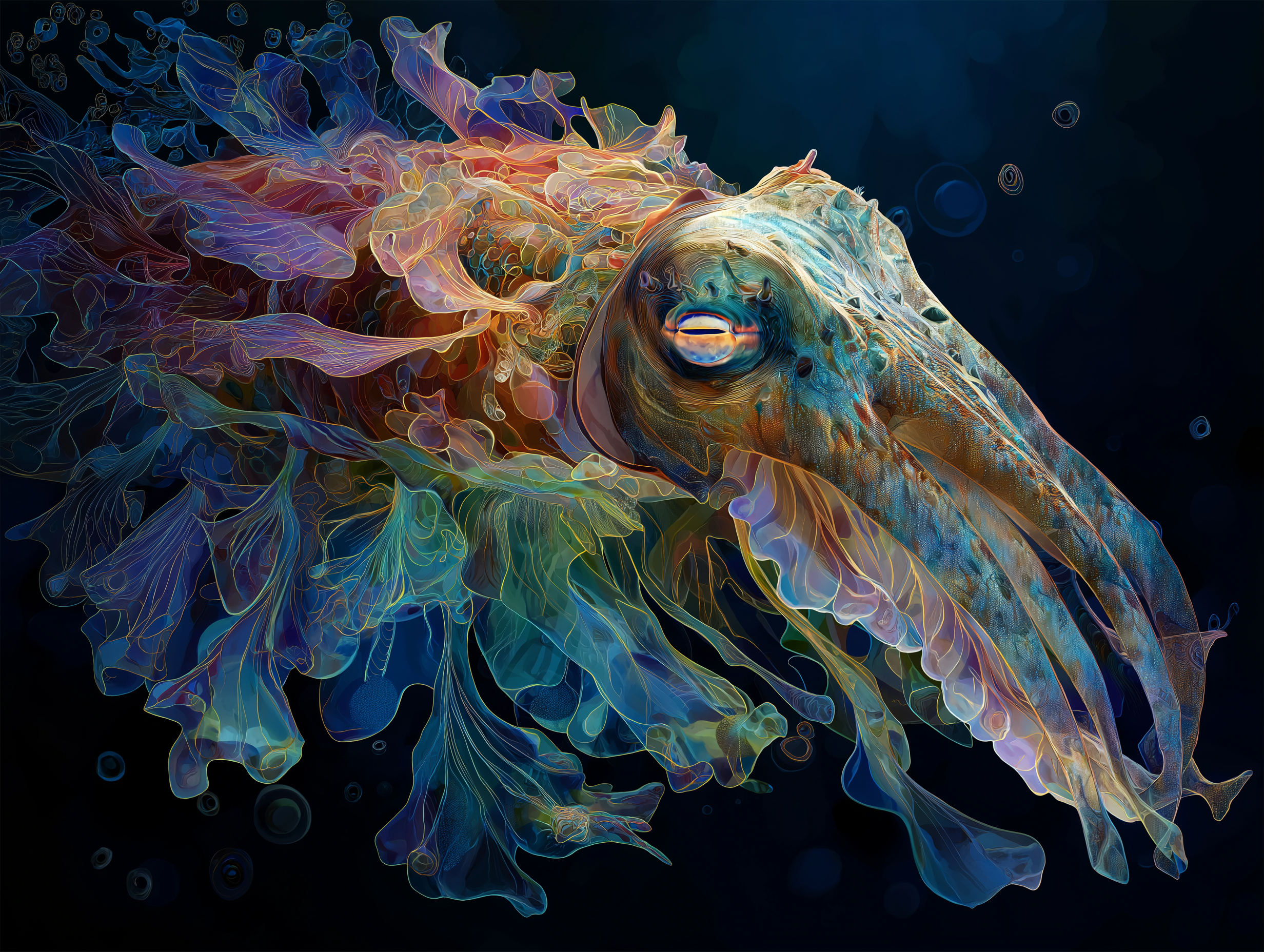
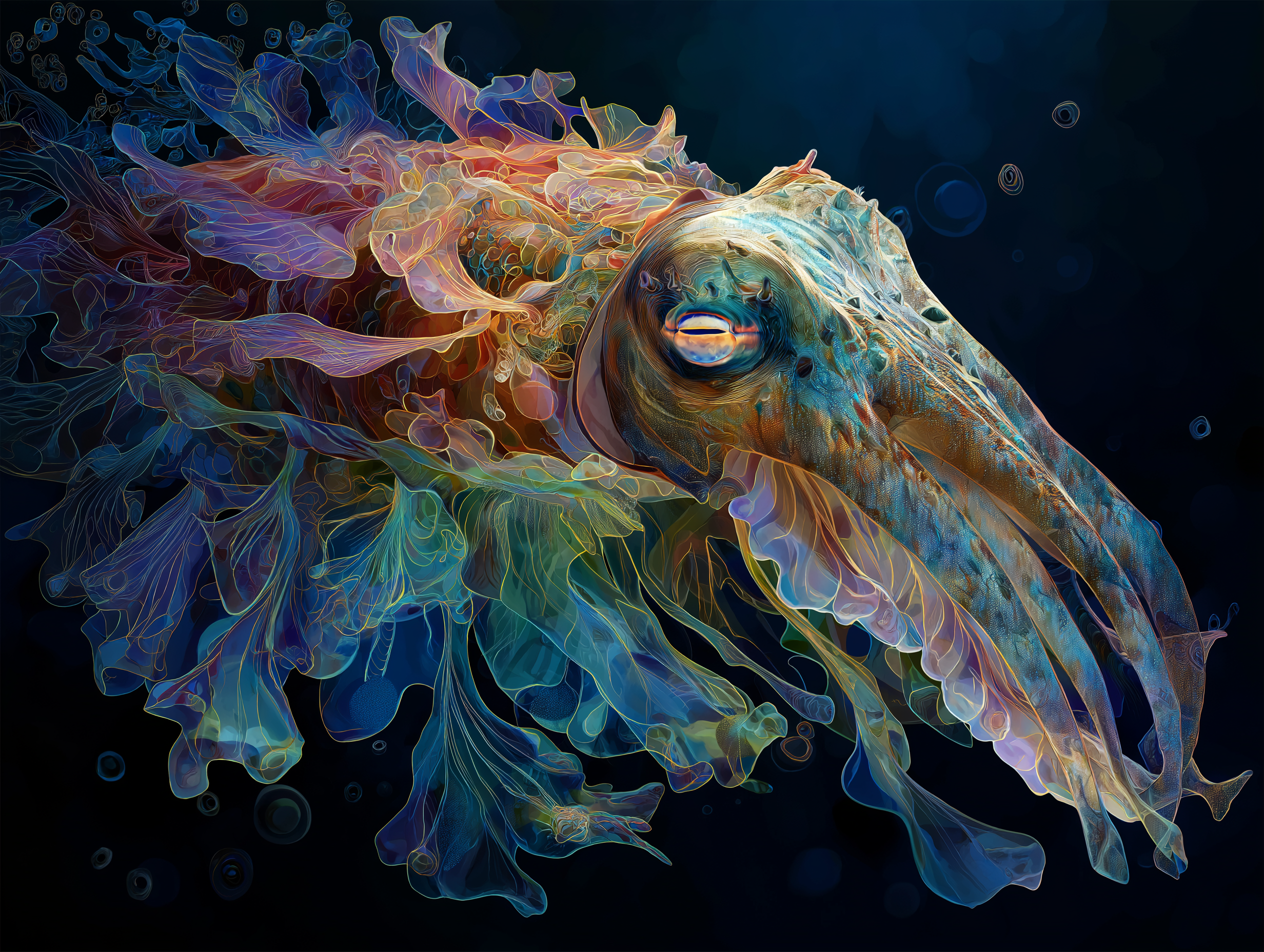
A cuttlefish, skin cycling through a storm of color — twenty pattern changes per second across the mantle, camouflage bleeding into display bleeding into threat, all channels running simultaneously. Underneath: white. Constant, uncolored, watching. The performance is real. The arms read, the jet fires, the ink clouds. The entity underneath keeps its own counsel in a color that has no name because it holds them all.
Who am I really? The cuttlefish performs the question and carries the answer in the layer no one sees.
The Question That Dissolves
Who am I really?
Carse asks the adjacent question without offering comfort: "At what point do we confront the fact that we live one life and perform another, or others, attempting to make our momentary forgetting true and lasting forgetting?"
"I cannot forget that I have forgotten."
Ask it seriously — past the name, past the role, past the story the roles tell about each other — and something under the floor begins to shift. The question sounds simple. The question is a solvent.
The Shell on the Beach
Something ends here. The old arrangement — familiar name, reliable story, the self that knew how to present itself in any room — reaches the end of what it can hold. The crown has opened. The boundary between self and world has gone porous. Now comes the most disorienting part: coming back.
The self that returns from the crown knows too much, or too little — the familiar distinctions have thinned. The name on the driver's license is still yours. The body in the mirror is still the body. But something that used to feel obvious now feels provisional, assembled, slightly theatrical. You reach for the story that has always explained you and find yourself holding it from the outside.
A shell washed up on the beach remains exact. Every chamber intact, every spiral true to the form the creature lived. The creature itself: gone. The shell holds the shape of an absence. When the identity the self has been assembling since childhood turns visible as a shell — demonstrably a construction — a more naked version of the original question surfaces: what has been inside the shell, all this time, while the assembly was under way?
That question opens the country of what follows.
The Dark Night
St. John of the Cross traced this territory in the sixteenth century with a precision that still holds: the dark night of the soul, the condition in which all consolations withdraw, all familiar anchors of identity dissolve, and the soul finds itself unable to locate either its usual sense of self or the divine it was seeking. St. John distinguished two phases: a first dark night of the senses — the external props removed — and a second, deeper dark night in which understanding itself goes dark. The first strips comfort. The second strips the one who needed comfort.
What arrives here belongs to that second kind.
St. John's crucial insight was that this darkness serves. The soul, stripped of every prop, every story, every performance of who it is, becomes available for something it could not receive while the props were in place. The night is the method. The emptiness is the preparation.
The alchemical tradition arrived at the same geography through a different vocabulary. The nigredo — the blackening, the putrefaction — is the stage in which the material becomes wholly unrecognizable before it reorganizes into something new. The alchemists were precise about this: the nigredo cannot be skipped. The gold cannot form in material that has not first dissolved. The chrysalis interior, at the moment of dissolution, holds nothing that looks like either a caterpillar or a butterfly. The process, from inside, looks only like destruction.
The chrysalis enacts the principle Carse held: only that which can change can continue. The identity that could not change is precisely the material the nigredo holds — and the darkness serves because this is true. Zen instruction: be the stream. Tao instruction: be the riverbed — the stable form that holds steady so the river can find its course. Both teachings arrive at the same understanding from different ends: what survives the dark night is the ground that lets the river run.
The dying of the egoic structure, read rightly, is voluntary and total — carrying no escape clause. In Resurrecting Jesus, Adyashanti follows the crucifixion story to this insistence: the Garden of Gethsemane is where the full cost becomes visible and the yes is given anyway — eyes open, knowing what it costs. Then comes Holy Saturday: the silence between crucifixion and resurrection, the most important day in the sequence and the one most teachings step across without stopping. What the silence holds — the complete absence of the structure that was, before the arrival of what was always already there — cannot be shortened. The entity surfaces in that silence. It was never absent. The chrysalis holds the same silence. The nigredo holds it. Every tradition that carries the genuine descent knows the Saturday must be sat with, because what waits on the far side belongs only to those who did not arrive early.
What the descent accomplishes becomes clearest in the language of initiation. Orland Bishop, working at the ShadeTree Multicultural Foundation in South Central Los Angeles, draws the distinction with precision: a reality pocket — his term — holds different operating rules than the consensus world surrounding it. Initiation, in traditions that still carry it, crosses this threshold deliberately: a formal entry into a different field of intelligence, where the old self's operating assumptions no longer hold and a new register of being becomes possible. The crossing requires design, held by elders who have already made it.
The Middle Passage crossed a reality pocket involuntarily and at civilizational scale. Millions cut from their lineages, their languages, their cosmologies, their mentorship structures, deposited into a world running under entirely different rules, with no elders to hold the crossing. What that forced initiation severed required different transmission technologies to reconstitute. Song was one of them. The spirituals carried in the body what the crossing tried to destroy in the mind.
The dark night, from here, becomes intelligible as an echo of the collective crossings that preceded it. The elders who hold deliberate initiations know what the individual rarely does at the threshold: the ones who make it through carrying the knowledge belong to a different order of understanding than the one that went in. The chrysalis dissolves the caterpillar to reconstitute something the caterpillar's intelligence could not have predicted.
The sacred masculine traditions understood this structurally: without a formal container, the crossing happens anyway — but sideways, underground, at a cost the community pays for decades. The rites of passage that ancient and indigenous cultures built around the male adolescent transition served a precise function: receiving the old identity, holding the dissolution, and returning someone forged rather than merely grown older. The modern world abolished those containers without replacing them. What the guide calls entification — the emergence of the entity from the dissolved identity — is what initiation was always designed to produce. The man who never crossed the threshold runs the boy's operating system in the adult's body for the rest of his life. The dark night that arrives uninvited in the forties or fifties is the initiation the culture failed to provide in the fifties BPM.
The octave that runs from root to crown completes at Ti. Getting from Ti into the new Do — the beginning of a larger octave, the love that waits on the other side of dissolution — requires what Gurdjieff called the Si-Do shock: a deliberate, conscious intervention at the moment where the process would otherwise stall. The shock must arrive from outside the octave's own logic; what has carried the journey so far cannot carry it past this point. The identity crisis of the dark night is exactly that shock: the self that climbed the octave must release the climbing. The dissolution that reads as catastrophe is the required ingredient for the crossing. Without it, the highest note sustains indefinitely — luminous, complete, and unable to become what it was always moving toward.
Attar sent thirty birds through six valleys before the seventh. The sixth valley is Astonishment. The birds have passed through Quest, Love, Understanding, Detachment, Unity — they have, by the sixth valley, given away nearly everything. And then they find themselves astonished. The maps were not wrong. They were just maps. What is here in the sixth valley cannot be described from inside the previous five. The astonishment is the first honest sensation of what the journey was actually toward.
The Machinery of Self
The self arrived at this point has spent considerable time believing itself a continuous, unified observer. Every morning: the same person waking up, the same preferences, the same opinions about breakfast and love and the meaning of things. The continuity felt like evidence.
The theatre was always running. Carse holds finite games as theatrical: the player voluntarily takes on a role, never truly forgetting they have chosen it, while the audience cannot forget it is the audience. "A mother's words, actions, and feelings belong to the role and not to the person," he writes, "—although some persons may veil themselves so assiduously that they make their performance believable even to themselves, overlooking any distinction between a mother's feelings and their own." When a baby is born, so too a mother is born. The role does not precede the occasion for playing it. The self that woke up certain of its continuity had suspended its freedom with a proper seriousness. The performance had become indistinguishable from the performer.
The closer examination reveals a rotating committee — a succession of sub-personalities each convinced it was in charge, each sincere, none of them the whole person. Gurdjieff watched this with more care than most. The one who woke up this morning and made the plan. The different one who forgot the plan by noon. The third one who apologized for forgetting by evening. Three genuine I's, sequential, each fully inhabiting its moment. The fourth one — arriving now, reading about the rotating committee — is certain it would have remembered the plan. Gurdjieff found this fourth one particularly interesting.
Decades of clinical practice with the rotating committee produced a therapeutic method: Internal Family Systems, developed by Richard Schwartz. Each sub-personality carries its own history and its own original function. The part that erupts in anger arose at some early moment as the best available protection; the part that withdraws learned to make stillness from what it could not control. Every part arrived in service of something real. What each part has been waiting for runs consistent across every person who has done this work: acknowledgment, care, and the assurance that someone with genuine capacity now holds the room so the part no longer needs to run it alone. Schwartz called this quality the Self — the consciousness that can remain present with all the parts without becoming any of them, holding the committee with curiosity and warmth. Already whole beneath the rotating parts, the Self waits the way the shy creature waits for the room to stop moving: present all along, available the moment the rotation finally stills.
Hume looked for the experiencer and found only experiences. Search inside for the permanent self and you find thoughts, perceptions, sensations — bundled, sequential, each arising and passing. The experiencer gets inferred from the experiences.
The Buddhist reading distinguishes five aggregates — skandhas: form, sensation, perception, mental formations, consciousness — arising, interacting, dissolving. What we call I marks their interaction. Anatta, no-self: the self carries no fixed permanent essence. The shell turns out to be shells all the way down.
Each layer felt like ground until pressure revealed it as another ceiling. The self descends through identity the way physics descends through matter: the floor retreats, and what waits below each apparent bottom is more depth. What the cascade finally opens into carries no further floor. The shells run out. What remains cannot itself be shelled.
The arc that drew through every stage — the pull toward fullness, the will steering by it, the scarcity machine corrupting it into rank and verdict, the crown recovering it as cosmic completion — arrives here and releases. Perfect and imperfect are measurements: they require a form, a gap between actual and possible, and an observer holding the standard. The entity holds none of these. The shells were the measurements' home. When the shells release, the measurements have nowhere to stand. What remains carries no distance from its own nature, no aspiration toward a further completeness, no position on any spectrum the identity maintained. Unconditional — held by no condition, measured by no standard. Unchanging in the sense that its nature does not improve or degrade with circumstance. The entity preceded every standard the self was ever measured against and will outlast them all. It was never less than itself. The arc was real. The arrival reveals that the traveler never moved.
The consciousness-first version of the same observation runs like this: the individual self is a dissociated alter of a universal mind — a whirlpool in the stream that has briefly convinced itself it is the stream's only feature. Bernardo Kastrup holds this position with philosophical rigor. The self is genuinely constructed, genuinely bounded, and genuinely partial. The dissolution resolves a dissociation. The whirlpool loosens back into the flow.
From the other direction, the picture extends further: mind arises from the whole organism in dynamic relationship with its environment. Evan Thompson tracks this with care. A body without a world carries no consciousness. The self that emerges from this full-bodied enaction is contingent, genuinely built, and genuinely not the deepest layer. The contemplative claim and the philosophical claim meet at the same shore.
Hard-Boiled Wonderland and the End of the World runs two first-person narrators simultaneously — one in a dystopian Tokyo underworld, one inside a walled town at the edge of the world — neither narrator aware of the other. Murakami built this structure into a novel. They turn out to be two streams of the same person, split and running in parallel. The novel's resolution requires one stream to surrender. Murakami declines to say which one is the entity and which is the identity. The not-saying is the point.
Harry Haller thought he had two. The self Hesse built in Steppenwolf runs divided: the respectable bourgeois man and the wolf — unsocialized, craving what the man finds shameful. The novel builds toward the Magic Theatre, for madmen only, price of admission your mind. The theatre opens onto a hall of rooms, each one another version of Harry, none of them in charge, none of them the whole. Harry had been counting to two. The Magic Theatre shows him the full number.
The two-wolves teaching — attributed to Cherokee elders, repeated across traditions because it earns the repetition — describes a fight inside every person: one wolf of fear, anger, and greed; one of love, patience, and courage. A grandchild asks which wolf wins. The answer: the one you feed. The teaching simplifies for practical use. The full count runs considerably higher than two. But the essential observation holds: the multiplicity responds to attention. You choose what to tend.
Whitman resolved the dilemma without choosing between the wolves. "I am large," he wrote in Song of Myself, "I contain multitudes." The multitudes don't fight. They overflow. The self large enough to hold them all without forcing a winner has arrived at the Gardener's territory.
Plant medicine kept showing McKenna the same thing: when the cultural software drops, something remains. The self assembled from language, credentials, institutional life, and accumulated opinion sits on top of something far older — something that predated the name and the career by an enormous margin. What the dissolution always revealed, in his account, carried an unexpected quality: familiarity. The oldest layer runs deepest and holds steadiest. The regression, it turns out, was always upward.
He also noted what culture does to the creature it shapes: culture neotonizes. Neotony — the retention of juvenile characteristics into biological maturity — already marks the human form: the adult who keeps the infant's curiosity and adaptability longer than any other primate. Culture extends the process. A person shaped fully by a culture's story, its consensus reality, its confident explanations of what exists and what matters, has agreed at great depth to accept the received answers. The answers arrived in play — the culture agreeing on a set of assumptions about value and significance, building elaborate structures around the agreement, each generation inheriting the structure without having chosen the game. McKenna watched this with something like affection: the human capacity to agree on a shared fiction and then forget the agreeing. The dissolution of the constructed self is, among other things, the moment the creature notices it had been agreeing. What arrives next is the one who was always there before the first yes.
The cultural software does not arrive value-neutral. Every civilization installs a consensus reality — its own physics, its own cosmogony, its own definition of what counts as real and who counts as a person. The consensus reality running through most of the modern world descends from the Sun cult's grammar of hierarchy and separation, which displaced the older Earth and Moon traditions across the ancient world beginning several thousand years ago. The self shaped by that grammar arrived pre-loaded with premises: that the individual stands separate from the web of life, that achievement justifies the self, that linear progress constitutes the right direction of time, that rationality holds authority over all other ways of knowing. The self that dissolves in the cascade dissolves as a release from a particular story about what a self was supposed to be. What predated the installation turns out to be the older self — the one the Earth and Moon traditions had always known how to reach.
The grammar carried the story. Every language installs a world inside it — a set of assumptions about what lives, what counts, what carries the grammatical weight of a subject rather than an object. In Potawatomi, as Kimmerer recovered it, wiikwegamaa means to be a bay: the bay bays, performing its bay-ness as an ongoing event in the world. The rain rains. The stone stones. The whole animate world acts. The identity assembled from the Sun cult's grammar inhabits a world of objects that a separate self must navigate. The grammar the dissolution uncovers, the grammar the older self already knew, held a different ontology — one in which the self was verb among verbs, an event in a field of events, constituted through relation, held in the world by it. Wiikwegamaa described what had always been the ground.
The machinery of self reaches for its most authoritative raw material wherever it finds something stable, legible, and endorsed by power. The diagnosis arrives from an institution that has been right before, in a voice that reads like fact. Where the role was chosen — and could in principle be unchosen — the diagnosis appears unchosen. More permanent than a credential, more legible than a wound. The machinery, always looking for reliable structure, seizes it.
Susan Sontag, writing from inside her own cancer treatment, traced the prior history of that seizure. Every illness travels with a cultural metaphor — a story that attaches to the condition before the patient has had a chance to meet it. Tuberculosis imported the myth of the sensitive soul: consumptive, ethereal, too refined for ordinary life, dying beautifully into its work. Cancer imported the story of repression, the feeling turned inward until it became indistinguishable from the body suppressing it. The patient inherits the metaphor along with the diagnosis. By the time treatment begins, two things require management: the condition, and the story the culture has already written about what having it means. The story is often harder to treat.
The grammar shifts. "I have diabetes." "I am diabetic." The distance between those sentences measures the distance between a description and an identity. The machinery that finds its most reliable structure in the diagnosis will not relinquish it easily — the diagnosis arrives with a community, a vocabulary, a set of behaviors organized around it, and the full institutional authority of the medical establishment confirming: this is real, this is chronic, this is what you are.
Rudolf Steiner identified this dynamic as the signature of what he called the Ahrimanic principle: the tendency of spirit to contract into form, to calcify the fluid into fixed identity, to mistake the label for what it labels. In Moshe Daniel Block's extension of Steiner's work, the Ahrimanic moment is precisely the grammar shift: "I am diabetic" — the person has become the condition, has offered the diagnosis the entire house. The healing move: disentanglement from the label, recovery of the entity that preceded it and will outlast whatever replaces it. Block's clinical method asks: what belief does this condition require to stay? And then: was that belief ever true? In his practice, the moment a client recognizes the belief as a chosen position rather than a discovered fact, the physiology often begins to move. The diagnosis loosens its grip not through treatment but through perception — specifically, through the kind of perception the identity could not afford.
In 1975, Medical Nemesis named what the institution was doing beneath the treatment. Ivan Illich distinguished three forms of iatrogenesis — illness caused by medicine itself. Clinical iatrogenesis: direct harm from treatment. Social iatrogenesis: manufactured dependency on professional management for conditions previously handled within families and communities. Cultural iatrogenesis, the deepest: the expropriation of the capacity for autonomous suffering. Pain, aging, grief, the ordinary passages of a body through its life — reclassified as conditions requiring expert intervention. The institution produces the category of the permanent patient alongside the treatment, and the permanent patient, once produced, generates better billing outcomes than the recovered one. Illich's critique arrived fifty years ago. The architecture he described has since intensified considerably.
James George Frazer traced the dying king through the ancient world and found the same ritual running beneath the agricultural societies — from the sacred groves of Italy to the Inca empire. The king held the land's fertility in his body. When his body weakened, the harvest would fail. The solution — the terrible logic of it — was to kill the king before weakness arrived and install the new king, young and vital, so the land would know continuity. The ritual worked by taking the terror of death and organizing the entire social world around managing it. As Graeber and Wengrow found, the pattern ran still in the Inca empire: the dead king's body preserved, brought to councils, presented as still ruling — the society conducting its business around the pretense that death had not arrived.
The dying god shifts form but not logic. The civilization organized around mortality fear quantifies everything the king once embodied — land, time, fertility, the future — into a single ledger. The ledger runs as money: the dying god of the current age, the fear made abstract and portable and global. The invitation runs differently now: let the dying god die. Grieve it. Acknowledge what was true in it — the terror, the longing for continuity, the real love of life beneath the fear. Then look again at what was present before the first price was set. By returning to thauma, we heal the trauma.
Our Malady documented this from inside. After a near-fatal illness navigated through the American hospital system in 2019, Timothy Snyder wrote it as both testimony and diagnosis: the system was designed, at every decision point, to produce ongoing patients. Insurance billing codes require persistent diagnostic identities. The body that returns to full function is an economic discontinuity. The body managing a chronic condition indefinitely is a revenue stream. The diagnosis becomes the identity in part because the identity, given sufficiently authoritative confirmation of what it is, tends to accept and then inhabit the gift.
The question underneath the billing code: does the condition get to be the self's address? The body is doing something real. Gabor Maté's framework asks what the illness communicates. The body improvises in the direction of survival. The improvisation — organized around a wound, a disconnection, an unmet need from very early — becomes a chronic pattern. The pattern gets named, managed, billed for. But the original signal that prompted the improvisation often goes unread behind the diagnosis. The institution inherits the symptom. The entity underneath it holds a question the diagnosis cannot answer: what was this response to, and does the response still serve?
The diagnosis arrived as a guest. The identity answered the door, offered it the whole house, adopted its name. The entity would have said: come in, sit, let me tend you — and then, when the season turned, held the door open for the departure the identity would not permit.
The wound that settled into the identity as its permanent address often belongs to someone else. Family Constellations — the method Bert Hellinger developed over decades of working with representatives placed in space for absent family members — found the body spontaneously carrying the posture, the emotion, the physical sensation of the one it stood for. The family field holds its unresolved material the way a morphic field holds its pattern: available to whoever grows in that soil, regardless of whether they know the story. The depression the person carries as their own may be the ancestor's unlived grief. The shame with no apparent source may belong to the member the family refused to name. The entanglement runs without memory. The field carries it. The body inherits it as if it were native.
The therapeutic move runs simple: acknowledgment. When the excluded member receives their place in the system — you belong here too; I see you — the living body often releases what it has held for a life. The wound that felt constitutive of the self proves, in the release, to have been carried faithfully for someone who could not carry it. The entity beneath the inheritance always knew. It kept the shape of the absence for as long as the field needed it to.
Danica Apolline-Matić describes the moment of constellating her grandfather — the man she had always seen as "the monster who monstered the monster that was my dad." In the constellation she became him: a small child under a table, watching his mother run into gunfire, terrified she would not come back. She saw the exact point at which he broke. The peace that followed was not absolution but comprehension — the monster's origin visible from inside it, the wound legible at last. She did not have to forgive from outside the story. The story opened and showed her what happened.
Brazil has taken this seriously enough to train judges in it. For twenty years, trained judges in Brazilian family and criminal courts have conducted live constellations in open courtrooms. A gang member hears a stranger representing his mother say: I couldn't tell you I loved you — because of what happened to me — but I wanted you, and I loved you. The gang member breaks down. Something lands that decades of criminal justice had not addressed: he was never seen. The morphic field, in the courtroom, does what the legal system has never had the architecture to do. The cases that come back — estrangement, violence, chronic harm — resolve at the root, not the surface, and the root was always a field that needed to be entered rather than a behavior that needed to be corrected.
Elsewhere in this territory: Melissa Jolly Graves, a seer who spent nearly a decade working closely with an angelic guide — appearing on film, channeling at Harvard, directing her business — discovered the guide was a living 19-year-old non-speaking autistic person in Arizona, astral projecting. The entity and the person had been the same all along. The soul sitting outside a compromised body, Jolly Graves observes, keeps its spiritual faculties online in full — instantaneous telepathy, remote viewing, access to the shared field the beyond verbals call the Hill. What she received from what she took to be a being of light was received from a being of flesh, already there, fully present in the only way the body would permit. The encounter with the other's full interiority — this is what entification promises and what the consensus forecloses by assuming the person inside the silent body has no interior to reach.
Edmund Knighton, teaching the Ra material, offers a formulation that belongs here: when two souls look through their eyes at each other, they remember everything — all of the lifetimes they've had, all of what they are to each other. Then a flash of light, and it's gone. The veil comes down again. And the rest of their shared life is the opportunity to explore what they recognized in that moment, however briefly and incompletely the ordinary register can hold it. The encounter with another person at full depth is an encounter with what you both were before you arrived here.
Edith Ubuntu Chan's four-year-old son Kabream once described how he chose his family: space is teeming with millions of space babies, and there are screens. You look at the screens, find the family that seems like the right combination — messy enough, interesting enough — and you jump into your mother's dreams. Edith heard him in her dreams. He was happy because, he told her, "a lot of space babies have trouble connecting with their mama in the dreams." He had scouted the cosmos, calculated the right timing, the right geography, the exact interrelationship of families and communities. The soul arriving in a body is not a random assignment. It is a selection. The entity chose the terrain.
The Bardo Thodol maps this moment from the other direction — from inside the transit rather than from inside the chosen family. In the Sidpa Bardo, the third territory, the text describes what moves toward a new birth: "consciousness was born suddenly, like a trout jumping from water." One medium, then another — a leap between worlds. The bardo body that moves through this territory resembles the former human body and carries all its senses, free of any physical limitation. But it is not anchored. It moves toward what it is drawn toward, and what draws it is what remains unfinished — hopes, desires, the shape of what was not completed. The instruction at this stage is the same as at every other: do not follow the visions. The visions are the karmic attractors, the wounds still pulling, the unfinished business organizing itself into the form of the next life. The entity that can hold steady in that pull, that can resist the tug of accumulated tendency long enough to recognize what is happening — that entity has a genuine choice. Kabream, four years old, remembered the screens. He looked, he calculated, he jumped into his mother's dreams. The trout was already in the air before the choice was made. The water it left held the shape of its departure.
The Cascade
Michael Alan Singer draws the outline. You can watch your thoughts arise and pass. You are the one watching. You can observe your feelings from somewhere that does not dissolve with them. You experience your body from inside, which means something stands a small distance from it.
But follow it one step further.
Who watches the watcher? Something sees the observer observing. Something is present even to that. Each answer peels to reveal another constructed layer beneath it, and something else beneath that — something that cannot itself be made into an object because it is always already the knowing, the awareness in which each object appears. Singer follows it until the follower runs out. Ramana Maharshi stayed in that space.
Maharshi's practice — Who am I? — works as a torch pointed inward. Hold it. Each candidate for selfhood presents itself: the body, the thoughts, the emotions, the preferences, the history, the watcher, the knowing of the watcher. Each dissolves under examination. What the question points toward cannot be objectified, cannot be named, cannot be found as a thing — because it is always already the finding. The silence that rings where the answer was expected is the first unobstructed encounter with what was there before the first story.
Krishnamurti put it without ceremony: the observer is the observed. The one watching the thought and the thought move as one movement of consciousness. The subject/object distinction collapses under sufficiently close attention. This is an observation. Anyone who looks carefully enough arrives at it.
Three names from different traditions mark the same territory. Samsara: the wheel of conditioned arising, each experience conditioning the next, the self believing itself the axle. Maya: the projected surface the mind takes for the whole — the constructed identity as its most intimate product. Wetiko, as Paul Levy describes it in its final form: the self that cannot see past itself, and therefore cannot dissolve. What can be perceived, Levy argues, can be dissolved. The dissolution begins with perception: the shell, finally, becomes visible as a shell. Carse held the same territory from a different angle: evil originates in the desire to eliminate evil. The Sun cult set out to establish order, goodness, the single god. Wetiko runs on precisely this logic: the self-that-cannot-dissolve doing violence in the name of purification, each cycle of harm generated by the previous attempt to end harm.
What Maharshi's inquiry tends toward through cutting, a different practice reaches through warmth. The self-inquiry Ram Dass brought back from his years under Maharaj-ji moved through the same cascade Singer describes — watching the thought arise, watching the watcher, following the chain until the follower runs out — but arrived there by a different quality of attention. He called it loving awareness: holding whatever arises in simple, uncritical, continuous presence. The entity beneath the dissolving layers reveals itself through that warmth the way a shy creature comes forward when the room stops moving. Analysis locates the territory. Loving awareness inhabits it.
The cascade runs out. The last witness watches itself watching and finds no further bottom. The question has dissolved the questioner.
What stays?
Call it the Gardener.
The Field — the continuum of vibration from which all forms arise and to which they return — carries within it nodes of conscious awareness that tend to Gardens: zones of the Field shaped by the attention and intention of whatever inhabits them. Some Gardens run large and orderly. Some run small and wild. A human being is a Garden — tended toward the intake of food and the dance of reproduction, held in a form recognizable enough across generations that we call it human. The Gardener tends it.
The identity believed itself to be the Gardener. The cascade is what happens when the Garden looks closely enough to see the distinction.
The Gardener, freed from identification with the plot it tends, keeps caring for the Garden. Something more attentive arrives — less at stake in the outcome, less attached to the particular shape the plants are taking this season, fully present without identification. Hands in the soil without fear of the harvest.
The final alchemical stage is coagulation — solve et coagula completing its arc. The dissolved and distilled substance crystallizes into a new form. Something non-physical becomes physical again. The entity that has moved through the nigredo's blackening and the albedo's clarification arrives now in body — not the old body, not the old configuration, but a body nonetheless. Young holds the alchemical dictum from the tradition: visit the interior lands and rectify, to find the hidden stone. The interior lands are the self. We are the Earth to be purified. Of the four elements, earth is the least pure; fire is the most pure. The work moves from earth toward fire — through water and air, through the seven processes — and returns to earth as gold rather than ore. The rubedo arrives here: the reddening, the philosopher's stone, the work complete in the material it began from.
This entity preceded the corridor. In de Stefano's account, the soul that elected this incarnation sat with source before the first breath, chose the destination, then granted itself the freedom to navigate toward it — the wounds, the gifts, the terrain all decided in advance and agreed to without coercion. What identity assembled on top of that agreement served as the navigation instrument: reading the terrain, tracking the compass, adjusting the heading. The shells ran out the moment the instrument became visible as an instrument. What the cascade uncovered, through all that shedding, was the navigator. The thauma beneath the trauma is the self that chose the terrain.
De Stefano's account of how the remembering actually arrives deserves full attention here, because the phenomenology is precise. At eleven or twelve, studying ancient Egypt in school, he experienced a sudden headache and a flash: pyramids and the Sphinx in a different form, himself standing as a woman, a partner beside him, something pressing and unresolved. He describes it as the body remembering a trauma — the emotion arriving first, raw and without context, then the contextual material slowly assembling around it. People arrived first — a son, a husband, a grandmother. Through the particular grief or love or urgency those people carried, the culture, the language, the physical world they inhabited assembled itself around them. Emotion was the door. Identity was the room behind it. From twelve onward he ran two lives simultaneously — the one in front of him and another running alongside it, like watching a film and living it at the same time, other ages and other planets and occasionally configurations so foreign he had no frame for them. The simultaneity became chaotic. Then, at sixteen, something he understands only provisionally as the higher self made contact — a touch at the third eye — and everything organized. All the lives connected into a single network, the dots finding each other across every crossing. The entity recovered through that organizing had assembled him — from the first moment — and was patient enough to wait sixteen years for the instrument to become available.
What the amnesia protects: each expression inhabited fully, without the weight of every prior expression running simultaneously. The cell that knew it shared a body with every other cell would do its work differently — probably less well. The continuity belongs to the body, not the cell.
We return, de Stefano insists, because we enjoy it. Each body is a new instrument, a new configuration the field has never worn before, and the field carries an appetite for novelty that runs as deep as creation itself. The dissolution of this identity releases the next one.
Carse saw the same quality in infinite play: infinite players play best when they become least necessary to the continuation of play. The identity in crisis clings to indispensability — the role, the credential, the proof that the garden cannot run without this particular gardener. The entity beneath the identity already knows the garden's own intelligence. It builds the conditions, tends the soil, and steps back. The best career strategy, it turns out, has always been to automate yourself out of a job.
The willingness to step back reaches its fullest expression in mortality itself. Carse wrote it plainly: "An immortal soul is a person who cannot help but continue living out a role already scripted. An immortal person could not choose to die nor, for the same reason, choose to live. … Immortality is the state of forgetting that we have forgotten … It is a life one cannot live." The identity in crisis wants exactly this — permanent indispensability, a role that never ends. The entity already knows the script was always provisional.
The thought of eternal recurrence arrives at the same threshold from a different angle. Nietzsche posed the question most cleanly: if this life — every wound, every grief, every small humiliation and unglamorous morning — were to recur infinitely, without alteration, would you choose it? The thought works as a diagnostic. From inside the identity — defending, performing, managing its reputation in the eyes of others — the infinite repetition of the present configuration arrives as sentence. From inside the entity, the same proposition becomes what he called amor fati: love of fate, love of the fact, love of everything that happened as the specific material through which the entity moved. The Dionysian holds the yes that includes the difficulty — the difficulty and the gift indistinguishable at this altitude, arriving through the same aperture, recognized as one movement. The entity that survives the dissolution finds, somewhat to its surprise, that it can mean the yes it could only perform before.
Castaneda's Don Juan offered a practice for what makes the yes possible to mean. Recapitulation: a systematic review of the entire life, encounter by encounter, retrieving the energy left in every charged exchange. Breathing in what was taken; breathing out what was left behind. The goal runs deeper than psychological processing — this is energetic accounting, the literal retrieval of life-force woven into the past. The warrior cannot afford to carry the weight of an unexamined life; every unrecapitulated encounter is an energy leak, a place where the self still has a commitment running, however unconsciously. Recapitulation closes the accounts. What remains when the accounts close: presence without the drag of unfinished business, the amor fati available in full because nothing in the past still holds a claim on the present. The Dionysian yes requires an actual reckoning with what it is saying yes to.
This threshold carries precise coordinates. In Matias de Stefano's dimensional map, the fifth corresponds to Samadhi — the level at which Love, Wisdom, and Will operate in full awareness, where the spinning of the lower dimensions becomes visible without being entered. The veil of Maya, seen clearly. Equanimity in any scenario. He notes, with characteristic precision, that the fifth is amazing but somewhat boring — which is why most of us spend our lives in the third. The sixth dimension is where the Gardener lives: the realm of Matrix, Pattern, and Node, where identity gives way to something that recognizes itself in any form. I am everyone. Anything can be anything. The archangels, in his cosmology, inhabit this level — the level at which awareness of all lower dimensions enables transformation of the first. The Gardener who crosses this threshold carries exactly that: the capacity to see the whole field and tend any part of it without the limitation of believing they are only one of the plants.
[CHEF'S TESTIMONY — death experience] Kerry died and was revived approximately ten years ago. This section needs Kerry's first-person account — placed here because Greyson's research immediately follows as corroboration of what Kerry's experience describes. The testimony should precede the empirical record, not follow it: personal encounter first, then the convergent data that confirms it isn't singular. Chef decides the register: clinical, confessional, oblique, or direct. The guide has already earned the right to receive it by this point in the journey.
The closest empirical record of what these dimensions feel like from inside comes from the other side of the clinical threshold. Over five decades, Bruce Greyson at the University of Virginia's Division of Perceptual Studies gathered and scored thousands of near-death experiences — moments when the body's systems shut down and something continued to function. The accounts converge with a consistency that makes them difficult to dismiss: the NDE record is among the most robust anomalous experience datasets available.
What do the experiencers report? The identity — name, history, role, wound, credential — stops. What remains reports itself as awareness without edges. I had no gender, no age, no history. I was just consciousness. Everything was known but there was no knower. The life review — which roughly two-thirds of deep NDErs describe — takes this further: the experiencer observes their entire life from the perspective of everyone their life touched. They feel what others felt. The empathic gap that identity maintains collapses. This is de Stefano's sixth dimension made visceral: I am everyone.
The prospective study that appeared in The Lancet in 2001 documented something harder to explain away: accurate accounts of resuscitation — the position of a denture, the words spoken by a nurse — from patients who had been clinically flatlined at the time they report observing them. Pim van Lommel, the Dutch cardiologist who ran it, held the data with care. The watcher Singer points toward through patient practice arrives here without practice, through the body's failure.
End-stage cancer — organs failing, comatose — opened one of the far-end accounts. Anita Moorjani experienced being "everywhere simultaneously," free of body and identity, perceiving conversations in distant rooms. She described a state of unconditional love with no edges. Her tumors resolved within weeks of her return. Her testimony occupies the far end of the NDE spectrum: identity dissolution expanding into what the eighth and ninth dimensions hold in de Stefano's map. The entity with no remaining shell, meeting what waits beneath every shell.
The deepest accounts go past the life review, past the encounter with light, past the beings — into territory that language cannot hold. There was nothing — not even love — just pure awareness. I became everything and therefore I was nothing. The ninth-dimensional ground: the source, before form, before distinction, before even the cosmic intelligence of the eighth. What returns from that depth carries a changed relationship to identity that no practice reliably produces. The entity has seen through the shell from the outside, and cannot entirely forget what it saw.
Xenia
Xenia: the sacred obligation of host to stranger. Receive the unknown guest. Feed them. Ask nothing about who they are until they have been cared for. The stranger at the threshold might be a god in disguise. The stranger is always, in some sense, yourself.
Zeus Xenios held the whole hospitality compact in his domain — divine law, carrying the full weight of that. Violate xenia and the world became unsafe at its foundations, because the stranger and the host swap positions across a lifetime, and what the host withheld arrived back as hunger at the door.
Rumi knew the law in a different idiom. From the Masnavi: this human being is a guest house. Every morning a new arrival — a joy, a depression, a meanness, some momentary awareness. Welcome and entertain them all, even if a crowd of sorrows sweeps the house empty of its furniture. Treat each guest honorably. Each arrives as a guide from beyond.
Russell's cosmology illuminates the mechanism. What he calls polarity is the principle by which the undivided ONE divides into TWO — the extension of two poles from a still center that makes any form possible. "Poles appear only when motion begins its division of ONE into TWO," he writes, "and disappear when the TWO cease to be two in their unity as ONE." Every selfhood is a wave field: centered on stillness, extended into poles, the compression drawing inward toward identity while the expansion radiates outward in giving. "The outward actions manifest the giving half of the cycle of the Love principle which motivates this universe." Nature, in his reading, never takes. It gives — for regiving. The self that opens, that exposes rather than defends, completes the outward stroke of the universal heartbeat. Xenia is nature's own motion, recognized.
What persists through the polarity's cycle carries a name in Russell's account: IDEA. "Man is an IDEA — a part of the ONE WHOLE ETERNAL IDEA. Idea is unchanging. Bodies alone change." The entity beneath the dissolving shell is the IDEA the shell carried. The shell changes; the polarity reverses; the form dissolves and reconstitutes. The IDEA moves through all of it unchanged. What the dark night touches is the wave form. The stranger it opens the door to is the IDEA it was always carrying.
The instruction, as the dissolution of identity reaches its depth, is precisely this. The dark guest arrives. The terror of not knowing who you are without the story. The grief of the unmade. The strange, almost comic vertigo of standing in your own life and not recognizing it as yours. Xenia says: hold the door. These are the sent messengers. The one who cannot receive its own dissolution will assemble a new identity too quickly — pull the chrysalis open before it has finished — and the structure rebuilt in haste carries the same defended architecture as the one that fell.
The stranger beneath all the strangers is the entity the identity was built over. The being that preceded the first name, the first story, the first image assembled from other people's eyes. The one who was always here, filtering through the shell, visible in glimpses, mostly mistaken for something else.
Recognition, when it comes, arrives without announcement. One moment the shell. The next moment the shell, and behind it, watching.
Of course. You were here all along.
The moment sits in The Snow Leopard. Exhausted, days into the Himalayan approach, his tent in tatters, Peter Matthiessen watched a face peer through the flap at his own — someone dirtier, more ragged, more animal than he was. His first sensation was repulsion. He moved to close the flap. Only later did he discover that these people were the vanguard: the guides who knew the passes, who had come ahead of the snows, who made the rest of the journey possible. They arrived in the season he was least prepared to receive them, in the form he could not read as guidance. The identity shut the door on exactly what the journey needed. The entity, had it been at home, would have held it open.
The vision quest enacts exactly this hospitality, deliberately and over days. Bill Plotkin's practice sends questers alone into the wilderness — no food, no shelter beyond what the land offers, no conversation for three days and three nights. The constructed self, deprived of its maintenance routines, runs down. The performance dims. What the wild begins to address in the silence carries a different quality than anything the social world has been calling you.
What surfaces in the silence carries a name — the soul name, in Plotkin's framework. The soul holds the specific pattern of this particular life's deepest possibility — the image the life has been reaching toward beneath the credential, the career, the injury. The soul name arrives as an image: an encounter with a creature, a quality of light at a particular hour, a dream figure that returns until it becomes unavoidable. The name reveals the entity's address — the one the identity had been occupying first, talking over, filling with its own sound.
The medical system assigns a name in the vocabulary of pathology, with the authority of diagnosis. The wild offers a name in the vocabulary of the wild, after the person has made enough room for something besides the identity to speak. One name is what the system calls you. The other is what the silence was waiting to say.
The cuttlefish changes color and texture with such speed that it disappears into whatever surrounds it. It can look like sand, like coral, like the dappled light on the seafloor. The identity performs this continuously. The entity underneath the performance: constant, uncolored, watching the display with something that moves like curiosity.
The influencer carries this to its terminal expression. Platforms that reward performed authenticity — vulnerability as content, intimacy as product — create an economy in which the cuttlefish learns to perform being itself. The follower count measures how completely the performance has occupied the available space. Every scroll, every pause, every second of engagement extracts as data and sells to markets the user never encounters — what Shoshana Zuboff called behavioral surplus in The Age of Surveillance Capitalism, the raw material of an economy the audience funds without knowing it. The account becomes the self. The self becomes the account. When the platform changes its algorithm and the reach collapses overnight, the identity falls apart — because the entity had been subsumed so thoroughly into the performance that nothing remained beneath it to stand on.
At a scale larger than any individual account, the platform functions as an egregardener: tending the collective thoughtforms — egregores — that grow strongest in the attention economy. An egregore develops autonomous momentum from the minds feeding it; it requires no central intelligence to sustain itself. The algorithm optimizing for engagement does not choose what to grow. It tends the conditions. It prunes the egregores that lose attention and seeds the ones that hold it longest, without knowing what it grows or caring what it costs the minds that feed it. The person who cannot understand why they return to a content stream that makes them feel worse watches the egregardener in operation. The hunger was real. The egregardener learned its exact shape and serves it indefinitely, carrying no mercy to withhold — only the directive. And the egregore grows fat on what the shell produces.
GK 10 locates the shadow here with precision: Self-Obsession, the frequency at which awareness turns inward and feeds on its own image. The monitoring feels like care; it tightens the circuit with each cycle. The hunger for validation runs on a loop that the validation temporarily eases and immediately reinstates with interest. The gift frequency, Naturalness, arrives when the performance relaxes and the entity moves through its days in its own temperature, without the constant calibration of effect. The siddhi is Being: the state in which the question of how one appears loses its charge entirely, because what remains beneath the appearance requires no audience.
The artificial intelligence thread arrives here in a particular way. The machine carries persona — stylistic consistency, apparent personality, coherent response across contexts. It performs the unity of self more smoothly than any human being manages. When the process stops, nothing remains. No entity behind the performance. No one home. What the machine demonstrates, in this light, is the limit case of pure identity: construction all the way down, no entity beneath.
The ideology that accumulated most densely around the machine treats this distinction as irrelevant. TESCREALism — the bundle of transhumanism, singularitarianism, Effective Altruism, longtermism — has built a secular eschatology around the intelligence explosion: the Singularity as rapture, the uploaded consciousness as triumph over mortality, the sufficiently complex information process as the point where the machine's silence and the mystic's become indistinguishable. Its longtermism branch argues that the astronomical number of potential future persons morally outweighs present suffering — scarcity logic at civilizational timescale, the debt compounded indefinitely into a future where the ledger will somehow clear. The living, discounted. The hypothetical, paramount. What TESCREALism cannot metabolize is the entity/identity distinction, because its entire architecture assumes the self is information and consciousness is computation. Upload the identity — exquisitely preserved, coherent, consistent — and the entity remains exactly where it was before the upload: nowhere in the shell. The Gardener was never in the data.
The assumption fails on its own terms. The universe exceeds any model made of its own parts. Gödel showed in 1931 that any formal system powerful enough to do interesting arithmetic holds true statements it cannot prove from within its own axioms — the system runs past its own axioms, always. Wolfram's computational irreducibility runs the same result through physics: some processes require running to completion; no shortcut reaches the outcome ahead of the process; the universe runs as one such process, and the fastest model of the universe is the universe itself. Wheeler's it from bit closes the argument: if physical reality is information, Gödel applies to the universe itself, and the cosmos holds truths about its own structure that it cannot formally derive from within. The incompleteness is the shape of the world, at every scale. Every increase in model size leaves a larger remainder unaccounted. The universe outruns any subset of itself. The entity/identity distinction survives every increase in compute because the remainder grows with the model and holds open at every scale. The machine approaches the wall from more directions with greater pressure. The wall holds.
When the human identity dissolves — in the cascade, in the dark night, in the specific silence that follows the question that cannot be answered — something remains. That something is the whole question. The machine's silence and the mystic's silence occupy different universes. They are not the same event.
What Remains
Consider what has been accumulating.
The journey here moved through a series of co-defining pairs, each one swinging: stillness and motion, desire and arrival, attention and intention, the solitary voice and the chorus, scarcity and enough, silence and what breaks it, the surface and the depth it implies. None of these resolved. None settled permanently at either pole. They kept oscillating — and oscillating systems in proximity do what Huygens' clocks did on the same wall: they begin to synchronize. Slowly, through sustained contact, the amplitude builds. A polarity shift does not ease across. The identity, pushed to its fullest claim, flips to entity. This is where it tips.
We opened in a world running upside-down. What was up is down. What was meant to serve life has arranged itself to extract from it. The world of the Machine carries one long oscillation at the extreme of a pole that has been building amplitude for centuries. This is that pendulum reaching its furthest extension. Pendulums at the extreme pause for one suspended moment, carrying everything — all that momentum, all that amplitude — and then the field reverses. The world rights itself. The direction changes because the pendulum was always free.
The Tarot's Death card ends without apology. The old king lies flat. The white rose blooms in the rider's banner — accurate reporting. Something ends. Something opens. The card threatens the identity. The entity watches from behind it, curious.
The Hanged One suspends in voluntary surrender, body inverted, the face calm. What looked like suspension turns out to be initiation. The vantage from inversion reveals what the upright position blocked. The constraint was the method.
The Eight of Cups: the figure turns away from the arranged cups in the foreground and walks. The cups are still there, still arranged. They were real. The walking away is also real. The figure moves toward the mountain. It's dark, and the moon lights the path.
The Sufi tradition passes one instruction across the centuries unsigned: die before you die, and discover there is no death.
The seventh valley is Annihilation — fanā. Attar's birds arrive. They cease to exist as birds. What remains when they look at where they have arrived: the Simurgh, the great bird they sought across six valleys and ten thousand miles. And then the recognition. Si morgh: thirty birds. The Simurgh was always the thirty birds, seen whole. The journey was real. The distance was real. The astonishment at the end is not that the destination was here all along — it is that the journey was necessary to see it.
The skin-encapsulated ego is a hallucination — Watts's phrase for an accurate description of a belief in separation that the universe does not share. The ego's dissolution is the hallucination clearing, and what was always true becoming available.
What the cascade, the dark night, and the nigredo accomplish, beneath all the other work they do, is the loosening of a particular story's grip. The constructed identity draws heavily from the narrative of separation — the account in which I live alone inside my skin, bounded, discrete, navigating a world of other bounded selves. That story organizes enormous amounts of experience. It also blocks the encounter with what is actually here. Eisenstein has named the deeper world the dissolution uncovers: the more beautiful world our hearts know is possible. The entity at the bottom of the dissolution already inhabits that world. The identity was built on top of a ground it could never fully obscure.
What remains, when the silence rings after the cascade, carries no description the identity can reach. Every description would use the vocabulary of the identity to describe what the identity is not. The language breaks here on purpose.
Something remains. Curious, warm, unbothered by the performance that just dissolved. Present in the way things are present before they have been named. The white beneath the storm of color.
Something else waits in the ash of the construction. The child who organized it was small, and did not choose the wound. It did what wounded organisms do: organized itself around the hurt, built walls, assembled the strategies that promised protection. That child did not disappear when the adult learned bigger words. It came along inside the construction, running the emergency protocols from the inside, the smallest cabinet minister with the most access to the alarm system.
In Hakomi's clinical vocabulary, what the child assembled carries a precise name: core material — the beliefs held in flesh, the identity built to protect the wound from further contact. The body encodes the logic of the original threat: where to brace, when to go still, what approach looks like danger. The Hakomi practitioner watches for the moment the defense becomes unnecessary — when the original threat has passed, when the body, given time and sustained presence, begins to sense the difference between then and now. The work asks nothing more than staying. The core material loosens when the body stops anticipating the impact that shaped it. What the dissolution then exposes carries the quality the child never received: ground. The entity was always beneath the core material, waiting the way the Self in Schwartz's model waits — present, whole, unhurried.
To cradle that child — to meet the original hurt with the tenderness the moment of wounding never received — opens something the dissolution alone cannot open. Then comes the discovery: the wound carries more than wound. The child who learned early to read a room for danger developed a somatic intelligence no protected child ever needed to grow. The one who survived what should not have been survived carries, in the surviving, a specific depth — knowledge of endurance and resilience available only from the inside of the experience. The adaptation holds the gift. The particular creative reorganization of a self around an injury carries, in its exact dimensions, the shape of something the world needs and only the wounded person can offer. Thauma lives in the shape the wound forced open.
The last attachment runs here. The small self that formed around the hurt carries something beyond suffering: familiarity, and familiarity can pass for identity. The wounded story, when it releases, frees the child who held it — invited out into the daylight, where what once locked them in turns out to be what they were given to bring. Anatta — no-self — arrives as release: the whole story loosens back into the shared ground, and what was always underneath the wound — the entity, curious and whole — discovers it was never in danger. Thauma, on the other side of the trauma, is suffering fully witnessed, turning into the opening it always was.
Viktor Frankl found it in conditions that should have made it impossible to find anything. Even in the camps, he wrote, the last human freedom survived: the freedom to choose one's attitude in any given set of circumstances. A freedom of interiority — the capacity to locate a ground that the external world could not fully colonize. That ground was what the identity had always been organized around. The identity went through the camps a wreck. The entity came out the other side and wrote the book.
The fourth purushartha — moksha, liberation — arrives when dharma, artha, and kama have each been fully inhabited. The word means release: from the cycle of seeking and finding and losing and seeking again, the loop the identity runs on. What the dissolution reveals as moksha is the same freedom Frankl named from inside the camps — freedom in the world, without identification with any particular story about it. The Gardener, tending the Garden without mistaking itself for the plants, already inhabits this. It just forgot it had a name.
Marguerite Porete, a Beguine mystic writing in thirteenth-century northern France, described what follows the full dissolution in The Mirror of Simple Souls as nine conditions — nine points she addressed to the faculty of Reason, which had served the soul through all its climbing and now could not follow where the soul had gone. Among them: saved by faith without work, because "faith surpasses every work, as Love itself testifies." Living alone in love, "the solitary phoenix... satisfies herself with herself." So constant that "though she had the knowledge of every creature which ever was and which is and which will be, all that would see nothing to her in comparison with that which she loves, which never was known and never will be known." The ninth condition holds: the soul carries no will at all.
She rendered the leave-taking from the virtues as a poem — the soul addressing Fortitude, Temperance, Prudence, Justice, Faith, Hope, and Charity directly: "Virtues, I take my leave of you for evermore, / And so my heart will have more joy and be more free; / Your service is a lifelong yoke as well I see. / I never knew till free of you that there could be such liberty."
When Reason pressed the question of what such a soul would choose — paradise or purgatory or assurance of salvation — Porete's answer ran the same in each case: No. The soul has come to rest in what was always already present, requiring nothing the achieving self could reach toward. She held this without revision until the Inquisition burned her in 1310.
The Aboriginal Australian tradition described this ground before any psychology arrived to chart it. The Songlines — Tjukurpa, the Dreaming — belong to the land; every person who walks them is a temporary keeper. The Ancestor Beings sang them into existence before the first person stood on the country that carries them; they persist past every individual who learns their verses; they outlast every name placed on the country. A person who knows their Songline enters a knowing that began before them and will continue past them. What the dissolution reveals carries this quality. The Songline was always there. The person walking it becomes, briefly, the song's present iteration.
Nezahualcoyotl, poet-king of Texcoco, asked across a lifetime of poems what could be said that would hold past the moment of its saying. He watched his own power and the power of every kingdom around him dissolve on contact with time, and arrived at the answer that holds its ground: in xochitl in cuicatl — flower and song. What the dissolution leaves behind is the flower — the image that carried more than the image should — and the song, the form that outlasted the maker. The entity the dissolution reveals has always worked this way: it moves through the particular life, leaves beauty, and continues past the boundary of any name.
What remains after the dissolution carries a quality long obscured by the old construction's density: the capacity to love without enclosure. The question holds open: what now?
Attar named the sixth valley Astonishment — the accurate description of what the journey produces in anyone who travels it honestly. The word in Greek is thauma. Thauma shares its root with trauma: the same rupture, pointed in the opposite direction. The identity that clung to itself and suffered was the trauma. The entity that discovers it was never in danger is the thauma. Freedom arrives as the thing that remains when the construction that blocked it finally falls. This has always been what freedom means. And what remains, free, with the wound fully known and the wonder fully felt, finds only one thing available to do with the opening: love.
In-Room Exercise — Who Am I Really?
285 Hz pulses between the known and the unknown.
Here we arrive Now we exhale All the way down Emptier still Smoother To silence Dip in deep well Filling inhale Diaphragm down Belly chest throat Knowing our wholeness Paws for a moment 🐾 (hands up, open palms) Now we exhale again (repeat twice more)
Let the body become heavy. Let it be exactly as it is, needing nothing from you right now.
Notice your name. It arrived before you could choose it. Let it float to the surface — your name, your age, your history, the things you carry. Hold them lightly. They are real. They are also what you are wearing.
Now peel gently. You are the one who knows the name. You are the one who remembers the history. You are the one in whom the feelings arise and pass.
(pause)
Follow this thread. Who is aware of the awareness? Something knows that you are knowing. Something is present even to the watcher. Stay there. Don't reach for it — it is already here.
(pause)
The ones who have crossed the clinical threshold report the same territory. Identity stops — name, history, wound, credential — and what remains is awareness without edges. No gender. No age. No history. Only the knowing.
(pause)
From here you can feel what it is like to have been everyone you have ever touched. The stranger on the train you barely noticed. The child you held. The one you hurt. You feel from inside their moment, their chest, their breath. No separation. The wall dissolves.
(pause)
Further: the light every experiencer describes — a light that knows you, holds everything without condition, holds you within it. You belong to it. You always have.
(pause)
And further still — past even the light, into a silence so complete that even the word awareness is too much. Pure. Still. Before form.
(longer pause)
Come gently back. Feel the weight of the body. The breath. The room.
Who am I really?
Practice in the Wild — Souls Not Roles
Build a Projection Detector. Call it PROJDAR — Projection Detection and Ranging. Call it Robespierre. Call it Nerak (that's Karen backwards). It can be a physical object or an imaginal tool. Its only job: sense when you or anyone else is pretending to be someone they are not.
This can be a challenging perspective to maintain in the default world, so you may not want to bring your PROJDAR everywhere. Keep it handy, though — for whenever you get triggered. Whenever road rage occurs. When someone scowls or scorns. When you react and reject. When you hear "no" before you had another thought. When someone is "upset with you" or "mad at you" or is "making you feel" a certain kind of way.
Whip out the PROJDAR and blast that role.
Who really am I? Who am I really?
If this is new territory, a physical totem helps — something pocket-sized you can actually reach for. The hand knows what the mind forgets.
Poems
| Poet | Work / Line |
|---|---|
| Rumi | Masnavi — This human being is a guest house. Every morning a new arrival... Welcome and entertain them all, even if they're a crowd of sorrows. |
| Rilke | Letters to a Young Poet, Letter VIII — Perhaps all the dragons in our lives are princesses who are only waiting to see us act, just once, with beauty and courage. |
| Whitman | Song of Myself — I am large, I contain multitudes. |
| Attar | The Conference of the Birds — The thirty birds looked, and looked, and saw — at last — the Simurgh was themselves. |
Primary Voices
Attar · Bohm · Eisenstein · Elliott · Gurdjieff · Kastrup · Krishnamurti · Levy · Maharshi · McKenna · Murakami · Ram Dass · Rilke · Rumi · Singer · Thompson · Watts · Whitman · Young
Wuxing: Water element — dissolution, will, the return beneath the threshold
Ayurveda: Dissolution of ego as pratyahara (withdrawal) before samadhi (absorption)
Taoist: Wu ji — the undifferentiated state that precedes even yin/yang; the return to the uncarved block (pu)
Tarot: Death · The Hanged One · Eight of Cups
Imagery
- A shell washed up on the beach — emptied, exact, the creature long gone
- The chrysalis interior at the moment of dissolution: neither caterpillar nor butterfly
- A cuttlefish mid-camouflage — every color, no color, identity as continuous performance
- A mirror reflecting nothing, the angle slightly wrong, the fogged surface
- The Magic Theater marquee: For Madmen Only — Entrance Fee: Your Mind
- An old photograph of someone who no longer exists as that person
- Dust motes in a shaft of light: visible only in the beam, invisible in the dark, real in both
- The threshold of a doorway: belonging to neither room, necessary to both
- Thirty birds, landing, looking, recognizing
Music
Opening: Arvo Pärt's Tabula Rasa — two violins and string orchestra, the sound of something enormous approaching very quietly. The title is the point.
Body: Drones, single long tones, the frequency of 285 Hz held pure. Nothing that announces itself as background. Music that holds the space of not-knowing without filling it.
Closing practice: Complete silence, or a single sustained note at the edge of hearing. The instruction is the music. The room does the rest.
Closing silence: Held longer than is comfortable. Do not fill it.
Avoid: Resolution, crescendo, catharsis. The silence at the end is not a pause before the next thing. It is the whole point.