"Eternity is not remote, it is here beside us." — Peter Matthiessen, The Snow Leopard
§8 — Aloha World
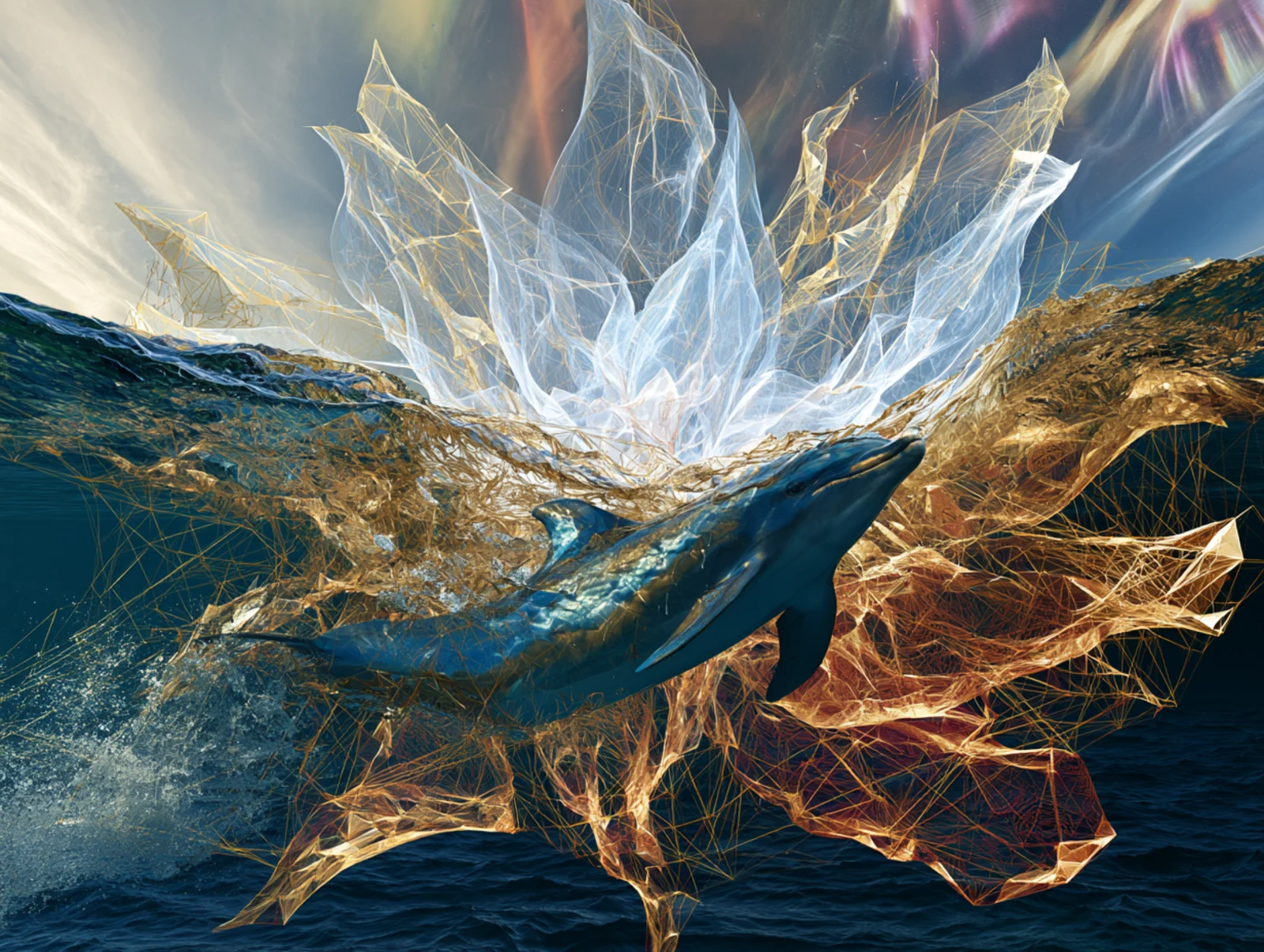
A dolphin, belly to belly with another at the surface, bodies arced into a continuous loop — each one receiving what the other extends, and extending what the other receives, the circuit continuing without interruption, without beginning, without hierarchy. Joy and its completion. John Lilly — neuroscientist and isolation tank inventor — spent years in the Virgin Islands trying to teach dolphins English, eventually understanding that the conversation was already happening and he was the one arriving late. Their sonar output registers in frequency ranges that alter human consciousness. The leap out of the water: gratuitous, repeated, apparently for the sheer reason that both sides of the surface exist and the dolphin knows it.
Where is the edge? The dolphin surfaces, looks around, dives back, and the question dissolves.
The Question at the Edge
Where is the edge?
Everything built so far — identity, preference, opinion, wound — depends on the assumption that there is a place where we end and the world begins. This question asks whether that place exists.
The Word That Holds Everything
The Living Greeting
The Hawaiians built a whole ontology into their most ordinary greeting.
Aloha — the word used for hello, goodbye, welcome, farewell, love — carries inside it two older roots. Alo: presence, the face turned toward, the quality of being here, now, with what is. Ha: the divine breath, the life-force that moves through every body. Together: the presence of the divine breath. Every exchange in Hawaiian culture begins with this acknowledgment — a statement of what is actually happening when two beings face each other. The sacred moves through you. The sacred moves through me. We recognize this together in the instant of meeting.
In Sanskrit, namaste carries the same gesture: the divine in me bows to the divine in you. Two languages from opposite ends of the earth, arrived at the same undeniable thing.
The crown chakra — sahasrara — holds a thousand petals, and the word thousand in this context means uncountable, all directions at once, every axis simultaneously. The lower chakras point: root points down into earth, sacral moves toward desire, solar plexus burns upward toward will, heart opens forward in meeting, throat projects outward as voice, third eye reaches inward as vision. The crown points nowhere. It opens in every direction. Nothing remains outside.
Charge, the element of the Sahasrara, carries a specific weight here. The root chakra began this story: the body on the earth, the mobile charge of the ground entering through the soles of the feet, the body's field finding its reference in the soil. The crown completes it. Charge marks the property that makes matter interact at all — what generates affinity and repulsion, the deep binding principle moving through the physical world. What the root found in the relationship between body and soil, the crown recognizes across the entire field: the same charge. The same binding. Nothing excluded.
The Arc Completes
963 Hz moves in the register of return — the frequency associated with the dissolution of the membrane between individual and cosmic consciousness, arriving by the removal of whatever maintained the illusion of separation.
Agape completes the arc of the loveforms. Philautia began: the love that makes a self possible. Éros followed: the love that reaches beyond the self toward what calls it. Ludus played, Philia harmonized, Storge carried across generations. Now Agape — the love that has no object because it has no exclusion. St. Paul described it from the inside: it does not seek its own, keeps no record of wrongs, never fails. He was reporting a state of perception. The one who sees truly sees that the circle of belonging has no edge.
Seven centuries after Paul, inside the Beguine communities of northern France, Marguerite Porete found the same perception at the level of the virtues themselves. In The Mirror of Simple Souls, she describes Charity — caritas, the crown of the classical theological virtues — as "obedient to no created thing, but only to Love" — a faculty that "gives to everyone everything that she possesses, and does not withhold even herself." The soul animated by Love alone enacts Charity as its condition, the way the bush enacts abundance: the giving indistinguishable from being alive. The virtues, she observed, wait on such souls "humbly and with no demur" — the scaffolding laid down at the height it helped to reach. At this altitude, love stands as the soul's native nature, requiring no cultivation. The Inquisition burned her at Paris in 1310.
The philosopher James P. Carse reaches the same recognition from political philosophy: a people, taken all the way to what it actually is, has no enemies. One cannot be free by opposing another, since freedom is never freedom from society, but freedom for it — my freedom, followed to its root, affirms yours as its own condition. What Paul reports as a state of perception, Carse states as a structural fact about liberty itself: the circle any self draws around its own freedom, drawn honestly, already includes everyone standing outside it.
The Structure of Unity
The Holographic Depth
The recognition that everything connects has arrived in many vocabularies across a long time, and each has found its limits at the edge of what language can do with something that precedes language. They all arrive at the same shore.
What quantum experiments kept insisting on — that what appears separate at the surface remains enfolded together in the depth — occupied the second half of David Bohm's career. One of the foremost theoretical physicists of the twentieth century and a longtime colleague of J. Krishnamurti, he worked out the implications with the patience of someone who had seen the data too many times to dismiss. He called this the implicate order — the hidden wholeness beneath what he called the explicate, the unfolded surface of distinct things. The whole, he argued, exists in every part the way a hologram holds the complete image in every fragment. Cut the hologram in half and each half still renders the whole, at lower resolution. Separation belongs to the surface. Wholeness belongs to the nature of the depth.
The same inquiry pushed into the structure of the vacuum — what physics once called empty space and has been slowly forced to recognize as something else entirely. Ervin László's framework describes the zero-point field as the medium in which every event, every exchange, every moment of consciousness leaves its trace. Nothing disappears. The field holds it. Consciousness, in this view, moves as the field's self-awareness — arriving in the nervous system, but sourced elsewhere, persisting beyond the system's span. László called this the Akashic field, borrowing the Sanskrit term for the all-pervading medium. The name matters less than what it points at: a substrate that remembers everything and excludes nothing.
The natural philosopher Walter Russell arrived at the same shore through a different entrance. His cosmology reads the entire periodic table as a single tone — the one tone of desire, playing itself into octaves of compressed and expanded motion. Every element is a pressure condition, and every pressure condition is a register of the same song. Light and dark, sun and void: two conditions of one thing, interchanging continuously, each becoming the other in sequence. There is no privileged location in the universe, no state more real than its opposite, because the universe holds the two poles of its one rhythm in absolute balance.
His statement on the unity of mind reads without hedge: "God is the Light of Mind. God's thinking Mind is all there is. Mind is universal. Mind of God and Mind of man are ONE." From the same body of work, the law that underlies every phenomenon: "I have but one law for all my opposed pairs of creating things... BALANCE... BALANCED INTERCHANGE... RHYTHMIC BALANCED INTERCHANGE." Three tiers, one movement. What the mystics held as love and the physicists held as symmetry and the musicians held as harmony, Russell folded into one cosmological statement: the universe holds its pairs in balance, and the balance moves rhythmically, because rhythm is the nature of the wave that carries everything.
A prism divides white light into the full spectrum. Spin the spectrum and it returns to white. The same light — divided, rejoined, the rainbow a momentary passage rather than a destination. Russell's cosmology turns on this: the one undivided light divides itself into every frequency of expression and, having divided, draws those frequencies back. White light in, rainbow out, white light in again. The division and the reunion hold the same brightness; neither is more real than the other.
There is a way to see the galaxy — a photograph of the full disc inverted, black turned white — that makes the underlying pattern obvious. Mind visible in its own arrangement: centered, bounding, omnipresent, every motion organized from a stillness at the center of itself. The illumination experiences that formed the core of Russell's cosmological framework — the full science delivered in those nine illumined days — he described as a thimbleful drawn from an ocean. The picture, in any case, looks like what it depicts: a mind, imaging itself.
Life takes the sphere as its structural preference. Lipton's decades in cell biology returned to this observation: the cell is a sphere bounded by a permeable membrane, the membrane serving as the cell's actual intelligence — reading the environment, determining which patterns get expressed. When one sphere engulfs another, as the biologist Lynn Margulis showed in the deep history of complex cells, the result carries inherited capacities from both. Compound enough spheres and you have foam: bubbles in contact, each holding its own interior, the whole structure holding a shape none could hold alone. Every living body is a foam. Every society operates as a foam of foams. The condition of bubbles in formation — foamation — describes what every collective already is. When a bubble pops, its boundary dissolves into the collective surface. The ego operates as the cell membrane of the personal self: necessary, permeable by design, and always partial.
The bubble also serves as a mirror. Curved glass reflects whoever looks: the outside world — the whole press of the drama playing around the sphere — shows up in the surface as the viewer's own face. From within, the membrane turns translucent; the same world that presses against the outside becomes visible through it. The bubble holds both properties at once: mirror to what looks in, window to what looks out. Something larger than any individual foam looks at the full field of bubbles and sees itself multiplied across every shiny surface. The holographic principle and the mirror principle resolve into the same geometry: the part reflects the whole, the whole sees itself in every part, and the recognition available at any scale is the same recognition available at every other.
The Arc Toward Unity
Pierre Teilhard de Chardin watched the same thing unfold at geological timescales. Matter complexifies toward life, life toward mind, mind toward spirit — the whole arc pressing toward what he called the Omega Point, the convergence at which the universe becomes fully conscious of itself. The noosphere — the sphere of human thought and culture wrapping the planet — arrived as the latest layer of that progression, as continuous with the biosphere below it as the biosphere is continuous with the lithosphere below that. His most compressed formulation: "We are not human beings having a spiritual experience. We are spiritual beings having a human experience." And his claim about love, which he held with the precision of a scientist and the conviction of a mystic: "Love is the affinity which links and draws together the elements of the world... Love is the very physical structure of the Universe." He saw no contradiction between this and the tradition he had been ordained into. They described the same movement in two vocabularies, and he held both with the unhurried confidence of someone who had been looking at both for a very long time.
Thomas Berry carried that arc into its ecological consequence. A Catholic priest who preferred the title "geologian" — the earth itself as the primary text — he pressed Teilhard's insight into its ethical ground: the universe is a communion of subjects, not a collection of objects. The reduction of the natural world to resource, to matter without subjectivity, constituted for Berry the deepest root of the ecological crisis — a failure of cosmology preceding and enabling every failure of economy or policy. The remedy sat at the level of story. A civilization's capacity to sustain a life-giving relationship with the earth depends on its operative account of what the universe is doing. The industrial story — matter as inert, the earth as raw material, consciousness as the accident of one species — could not produce the kinship the situation required. The Universe Story, written with physicist Brian Swimme, narrated the 13.8-billion-year arc of cosmic becoming as a single love story: matter reaching toward complexity, complexity reaching toward life, life toward awareness, awareness toward the recognition of what it had been moving through all along. Berry's Agape was ecological before it was personal — the love extended without remainder to the whole community of life, which was another way of saying: the crown chakra, opened at planetary scale.
Carse gives Berry's communion of subjects a shape it can be heard in: history moves as choir, not solo — a symphony of very different, even opposed, voices, each nonetheless making the other possible. The dissonance belongs to the music. No single voice carries the piece; the piece is what happens between all of them at once.
Mammalian biology carries the same reaching. Plants and minerals find their relationship to the divine through the earth — rooted in what they are composed of, understanding God through matter. Mammals arrive differently: enclosed in a womb, surrounded by the matrix, oriented from birth toward the light that called them out of the dark. The dimensional teacher Matías de Stefano's cosmology places the sun as the higher self's most direct expression, its rays the distributed personality of the divine in the visible world. The mammal has been leaning toward the father since the first birth. The crown's opening is that leaning arriving at what it was always reaching toward.
De Stefano draws a distinction the tradition often blurs: enlightenment means to shine — the light becoming available in the body, in the ordinary life, in the material already present. Ascension moves upward and out. The crown's opening illuminates the lower dimensions from within; the mammal that has completed the arc carries what called it out back into the matrix, and the matrix becomes luminous because the light arrived. The tradition that planted the image of the guru remaining in the world after awakening understood the difference: the highest available state of being tends the lowest available expression of it, and finds the tending worthy. "We are the ocean in a drop," de Stefano says. The ocean, temporarily organized as this particular drop, moves with the ease of what knows its own immensity.
A different instrument tracks the same directional tendency. The ethnobotanist Terence McKenna's primary claim about the nature of the creative principle: whatever God is, God moves as novelty. The universe tends toward the unprecedented — each moment genuinely new, each configuration unrepeatable, the possible space expanding as the actual fills. Habit repeats, sustains what already exists, holds the field against what has not yet been. Four hundred million years of biological novelty generation — each species an unprecedented configuration of form and relationship — points the same direction Teilhard's Omega Point points. The universe moves toward something it has not yet been.
Carse finds the same shape in Abraham's promise — descendants numberless as the stars, a future that always has a future, closure withheld on purpose. He calls it the myth of horizon: the line drawn far enough out that it recedes exactly as fast as anyone approaches it. The Omega Point works this way seen from underneath — the horizon novelty needs to keep producing what has not yet been.
The Gaia hypothesis asks a version of the same question at the scale of the living earth. James Lovelock and Margulis established, across decades of research, that the earth functions as a self-regulating living system — not life on a planet, but life as a planet. Atmospheric oxygen held at 21% for hundreds of millions of years; ocean salinity steady despite continuous mineral input from rivers; global temperature regulated through a sun growing steadily brighter. No individual species designed or manages these systems. The regulation operates as the behavior of a whole whose unity is real, whose interiority Lovelock called Gaia and Berry called subject and Teilhard called the biosphere completing itself. That system now encounters an increase in the complexity of its consciousness layer — a species becoming, however clumsily, aware of the whole it participates in. The crown chakra may be a planetary event as much as a personal one. The noosphere awakening and the individual awakening may be the same movement perceived at different scales.
The writer Charles Eisenstein carries the same claim one layer deeper into mechanism. Forests summon the rain a wet climate seems simply to provide — evapotranspiration lifting moisture into the air fast enough to create the low-pressure systems that pull ocean humidity inland, forest by forest, hundreds of miles past any coast. Davi Kopenawa, the Yanomami shaman, put the same finding in a single sentence about a reforestation project gone wrong: "the trees that the white people plant... do not know how to call the rain." A forest is one of the mechanisms doing the calling — as much cause of the rain as its consequence.
Thomas Campbell spent decades inside the mathematics of consciousness research and arrived at the same place from the direction of physics. Consciousness underlies physical reality, in his framework. The universe operates inside a larger consciousness system that moves — always, at every scale — toward greater coherence. What Agape holds in the human register, syntropy (in the language of Luigi Fantappiè and Albert Szent-Györgyi) carries at every scale: the directional pull of living systems toward greater order, greater complexity, greater beauty. Syntropy moves more actively than entropy's mirror: a draw toward what wants to become.
The Communion Within
The same discovery appears at close range in clinical settings. Joe Dispenza spent years cataloguing spontaneous remissions and found a consistent pattern: elevated emotion held with clear intention produces coherence between the heart's rhythm and the brain's neural firing. The heart's electromagnetic field, measurable several feet from the body, shifts qualitatively when those two conditions align. The individual's field extends beyond the individual's skin — the same boundary Bohm's implicate order shows as provisional at the depth of things. The heart in coherence extends past the body that beats it.
Wheeler's participatory universe carries the same principle at cosmological scale. In quantum mechanics, the act of observation participates in determining what gets observed. Wheeler called it it-from-bit: the physical universe arises from informational acts of participation. Every observation is a question put to the universe, and the universe answers in the form the question prepared it to deliver. Co-creation is what the participatory model of consciousness describes: the field organized in part by what the consciousness that moves through it holds. What the crown-open awareness carries — the quality of its attention, the coherence of its intention — shapes what the field offers back. The mystic and the quantum physicist arrive at the same practical instruction: bring the right question, held with precision, and the universe will answer in kind.
The body's surface has always been a negotiation. We carry more bacterial cells than human cells — the organism that moves through the world is, by simple count, more microbial community than discrete self. Bacterial genetic material outnumbers the human contribution by orders of magnitude. The bacteria clean dead tissue, metabolize food, produce vitamins, regulate immunity, generate neurotransmitters, maintain the gut-brain axis. Calling these organisms other misidentifies the organism. What appears from a distance as a bounded individual is, under any magnification, a community — a dynamic negotiation between forms that evolved together across billions of years and find, in this particular body, conditions suited to their flourishing.
Before Pasteur's cleaner narrative won the century, Antoine Béchamp had been observing something more complex. The basic unit of life, Béchamp proposed, was the microzyma — a granule capable of transforming and adapting to the conditions the milieu offered. Health and disease were questions of the interior environment, what the body's milieu offered the life within it. The microzyma responded to its milieu. This reading went the way of the aether: suppressed because it offered no enemy to identify, no product to sell against the threat, no war to prosecute. Germ theory gave medicine a story it could act on; the milieu gave medicine a responsibility that could not be commodified.
The deeper principle the microzyma carried: pleomorphism. It holds no fixed biological form. Under favorable conditions it rests quiescent — a potential held in reserve. Under stress, as the milieu shifts toward acidity, inflammation, or toxicity, it cycles through successive developmental stages, moving toward what germ theory would eventually classify as pathogens. The threat and the threatened were the same life, shaped differently by what surrounded it. Margulis traced the same movement at the cellular scale through endosymbiosis: the mitochondria inside every complex cell began as free-living bacteria, drawn across deep time into partnership with the cells that held them. Partner, ancestor, self — the same life, differently shaped by the conditions that carried it.
Rupert Sheldrake's morphic resonance extends the implication. The microzyma cycles through forms as the milieu shifts; Sheldrake proposes that such transformations draw on morphic fields — memory fields that hold the accumulated habits of all previous similar transformations, stored nowhere and accessible everywhere. As the microzyma tunes its form to a shifting milieu, it tunes also into every microzyma that faced the same pressure before it. The process philosopher Alfred North Whitehead held the complementary piece: every occasion carries an interior. Something in the transformation chooses among the forms the field makes available. A creative intentional consciousness operates at the scale of the microzyma as genuinely as at the scale of the person who contains it — smaller, simpler, and no less real.
The same principle plays out at scales Sheldrake documented with specific care. When a new compound crystallizes for the first time in a laboratory, subsequent crystallizations of the same compound around the world tend to proceed more readily, in conditions less controlled. The substance has learned its form. Protein folding — the complex process by which a molecular chain arrives at its final shape — follows a parallel course: solutions found once find themselves again more easily. The pattern stores itself nowhere and remains accessible everywhere. Some of what it holds was planted with intent. Maestro Alejo Sanzon reads the ancient complex of Chavín de Huántar—possibly the oldest standing ritual architecture on earth—as deliberate interment: sealed, placed underground, preserved. The chamber galleries shaped like a womb; instruments that reproduced the jaguar's roar; a building designed to reorganize human awareness through acoustic resonance—then buried, placed where it would wait. Göbekli Tepe: also deliberately buried. Angkor Wat may carry construction dates far older than the accepted chronology holds. The amnesia that moved across the ancient world spread globally, and so did its counter-move: seeds planted in the field, in the dark, in the rot, for whoever arrived at the moment those who buried them understood would come. The field holds what was placed in it. The pattern does not decay.
Grant draws the same line through the territory of geometry: when Roger Bannister broke the four-minute mile in 1954, the threshold that had held for years gave way within weeks for others. Lab rats who solve a maze pass the solution to rats who have never encountered it. New geometric solids, once their existence becomes thinkable, proliferate. The crossword puzzle, completed by enough solvers across a day, grows perceptibly easier for those who attempt it later. This is the hundredth monkey effect as morphic field mechanics: the field updates non-locally and instantaneously — the pattern does not travel; it arrives.
The nervous system opens onto this field through the crown. The kundalini current — the charge moving upward through the spine's central channel — carries the body's accumulated coherence toward the point of reception. At the crown's opening, the organism moves from local broadcast to network reception. The antenna the nervous system becomes at this threshold picks up what the field holds: every form that has ever crystallized, every pattern that has crossed the threshold of collective knowing, available without regard to where or when it first emerged.
The question where is the edge? lands differently when the body itself has no clean answer.
Carse draws the same temporal distinction in the territory of play. In finite games, surprise marks the triumph of the past over the future — the outcome the script always intended, suddenly revealed, the game ended by what it had always been moving toward. In infinite games, surprise moves in the opposite direction: the triumph of the future over the past, the genuinely unprecedented arriving to continue what has never yet been. "If surprise is no longer possible, all play ceases." The tell of the serious player: "Seriousness is a dread of the unpredictable outcome of open possibility." Seriousness protects the script. The infinite player needs the script to fail. Syntropy turns on precisely this: the universe drafting its next move from territory it has not yet occupied.
Spanda — the Yogic term for the divine trembling underlying all manifest existence — moves through this territory with the precision of a tuning fork. The coherence Dispenza documents in the individual's field, the wholeness Bohm finds encoded in the quantum depth, the syntropy that draws living systems toward greater order — all read spanda at their respective resolutions. The structure of unity has been turning since before the first form condensed from it.
What It Feels Like
The Overview Effect
Carse finds the overview effect's ground floor in the plain act of travel: travelers do not go somewhere, but constantly discover they are somewhere else, the movement itself doing what arrival was supposed to do. Proust needed no new coastline to make the point: "The only true voyage would be not to travel through a hundred different lands with the same pair of eyes, but to see the same land through a hundred different pairs of eyes." Thoreau needed even less ground: "I have traveled far in Concord." To travel, this way, is to grow — and Mitchell's window just happens to be the one with the whole planet in the frame.
In February 1971, on the return leg of Apollo 14, Edgar Mitchell looked out the window, and something happened that his training had no category for.
The earth hung against the black — the full disc, complete, alone, brilliant — and he experienced what he later described as "instant global consciousness." The knowing came whole. Everything connected. Consciousness underlay everything. He was part of something vast that had no outside. He wept, apparently, though he did not publicize that detail immediately. The experience changed the direction of his life entirely; he founded the Institute of Noetic Sciences to investigate, with scientific rigor, the territory he had unexpectedly entered through a spacecraft window.
Most people do not need to take their whole body off the planet. But it is hard not to blast off when you actually go.
Edith Ubuntu Chan arrived through a guided qi gong meditation, sitting in a room, breathing. Something exploded — into trillions of pieces of love and light, the size of the cosmos. She experienced herself as the size of creation. The feeling was blissful, peaceful, beyond language. And she knew: I went home. I returned to our natural state — all of our natural states. Then the trillions of pieces had to come back and fit into the body, and that was almost painful — squeezing the size of the cosmos into a body. Almost claustrophobic. And simultaneously, she knew with total clarity: this place is built backwards and upside down. The knowing and the constriction arrived together. Mitchell wept; Edith arrived home and then had to remember what it was like to live in a house again.
She later meditated into Pachamama — the living Earth — and found not a cosmic judge but a mother watching a two-year-old eat. Everything spilling, a mess, getting in the shirt and on the floor. The mother's response: I love you so much. You're growing up perfectly. When you're older, you'll just clean up. Don't worry about it. I love you. I love you so much. No judgment. No disappointment. Total love watching the learning in progress. The "environmental crisis," in this frame, is the toddler having supper.
No spacecraft required. The ecological philosopher David Abram, traveling as a sleight-of-hand magician through the Indonesian countryside, found the same threshold at ground level. A lammergeier — a condor of the high passes — caught the flash of a coin vanishing between his fingers and dropped out of its thermal to see the trick again. What arrived in the bird's attention felt nothing like idle animal curiosity: he described himself as "stripped naked by an alien gaze infinitely more lucid... than my own." A coin, a trick, a bird willing to interrupt its circling — and the same opening Mitchell found from orbit arrived instead between two very different kinds of attention, meeting in open air.
Perfectus
The mother's word — perfectly — carries the same root: perfectus, the form moving through its completion. Supper is not an error requiring correction. It is the learning arriving as mess, as it always does, as it must. The crown perspective holds this across every scale. Discord is not outside the perfection. The wave that collapses belongs to the same motion as the wave that builds. The system that self-regulates — Gaia, spanda, rhythmic balanced interchange — includes the disruption in the self-regulation; the resistance is part of the movement, not its interruption. We have been perfect the whole time. Not flawless — perfectus. The arc completing. The form arriving at what it always carried. Nature and creation hold nothing outside this wholeness. The cosmos holds no exception.
Grant compresses the same principle: "Our perfection is in our differences." The variation serves as the mechanism of completion.
The channel opens through the crack — Orland Bishop holds this from inside the work. Mortality, the daily sense of limitation, the blemish in the vessel: these serve as the conditions of the gift, the specific openings through which the energy finds its way. The vessel works through its flaw. Bishop carries the experience in a phrase: I am permitted to be useful.
The Stela Raimondi—a great carved stone from the Chavín culture of ancient Peru, sealed underground for millennia before its excavation—holds the same testimony in a different medium. Sanzon, working from within Andean ceremonial tradition, describes the figures carved into it: jaguar becoming eagle, eagle becoming serpent, serpent becoming dragon, the transformations stacking up the column in sequence. Each form includes the one before. Everything is everything. Perfection through diversity — the wholeness visible only in the full column of what life has tried, each expression carrying every prior face inside it.
The older alchemists preserved a stage that later traditions collapsed: citrinitas, the yellowing. After the blackening and the whitening, before the red — a preliminary luminosity, the color of the sun seen through the membrane before the final emergence. Something has been purified; it has not yet arrived at the final form. The crown chakra opening carries this quality precisely. The boundary has become permeable; the unity is recognized; the entity has not yet crystallized in the new configuration. Liminal. Yellow. The dawn state, not the day.
The Convergent Testimony
What Mitchell touched in that window, others approach through extended meditation, through breath held at the edge of its capacity, through the threshold states of plant medicine or near-death, through the particular grief that sometimes cracks a life open at its seam, through childbirth, through the moment a piece of music arrives in the chest like something the body already knew. The boundary between self and not-self becomes permeable. The emotion at that moment — James recognized this clearly in The Varieties of Religious Experience — reaches deeper than happiness, wider than joy. James marked four qualities of the mystical state: ineffability (language fails), noetic quality (genuine knowledge arrives), transience (it dissolves), passivity (it arrives; the self did not summon it). More information arrives in less time than any ordinary state can contain. The data remains real even when the framework for holding it stays disputed.
The Telepathy Tapes, documentary work by Ky Dickens, gathers testimony from another direction: non-speaking autistic Spellers — individuals who communicate through letter-boards — describe a gathering space they call the Hill. It exists outside the body. It holds them non-locally. What arrives there arrives instantaneously to those who share it. Multiple Spellers, without prior coordination, report the same space, the same encounters, the same knowledge that none of them had been separately taught. The incentive structure works against the report: these people have nothing obvious to gain from a claim they cannot make verbally and the dominant story cannot accommodate. The Hill may be the crown's territory in embodied testimony — the non-local consciousness space the mystics describe, arrived at by people whose relationship to ego and language began differently.
De Stefano reads the ninth dimension as the Dreamer, the Dreamt, and the Dream — the trinity that corresponds to what the crown opens onto: the unity that dreams the eighth dimension into being, the way Brahman dreams the cosmos. "I am that I am." The ninth loops back to the first — Unity, the center, all and none simultaneously — but becomes the tenth in a new octave, the same Do returning one level up. The crown chakra at its fullest opening arrives at the beginning of a larger beginning.
The geometry this loop traces is the torus: exit and entrance at the same vanishing point, the energy completing its arc through the surrounding field and re-entering at the root. The ninth loops into the first as return rather than repetition — the same note sounding one level up, the way the torus feeds itself through its own center. De Stefano places the eighth dimension as the threshold of this return: the crown's fullest opening, where the outward arc curves back toward source. Heart muscle traces it in electromagnetic field; the planet traces it in magnetic field; the deuterostome embryo laid it into every vertebrate body before the mouth arrived — exit before entrance, the return encoded from the first opening.
Sanzon extends the dimensional map from his own ceremonial experience. In the fourth dimension, the whole life becomes visible at once — past and future held simultaneously, the linear sequence opened into a field. In the fifth, many lifetimes come into view: the span of a single embodiment becomes one register in a longer arc. The fear of death releases at the fourth and dissolves at the fifth—what felt like ending reveals itself as transition within something that does not end. The dimensions weave through each other; awareness shifts between what each makes visible while location holds. Each dimension carries its own law, and the law of the wider aperture asks the one who has glimpsed it to remain fully inside the game they have chosen to enter. What the altitude offers: resource for engagement, a clearer view of the terrain already underfoot.
What the data consistently describes: the awareness looking out through these eyes and the awareness looking out through every other pair of eyes share a source. The Advaita Vedanta tradition arrived at this eight centuries before the instruments existed to measure it: the individual is a wave; Brahman — the undivided ground — is the ocean. The wave need not travel anywhere to find the ocean; it is the ocean, temporarily shaped.
We don't remember our past lives for the same reason heart cells don't remember they share a body with liver cells. Each cell does its work fully, knows its world completely, carries no memory of the organism's other expressions. The continuity belongs to the body — and the body does not forget. What the tradition calls the soul that reincarnates may be the organism; what we call I is the cell. De Stefano holds the amnesia as structural: the condition that allows each expression to be fully inhabited.
He preserves another cosmological image, this one from his own childhood. When he was eleven, a presence he describes as a fifth-dimensional psychologist — no wings, just questions — appeared and stayed with him through his early years. She told him about the universe before creation: a void, and in it a single child, alone, with no one to play with. So the child made a game of mirrors — a world full of others who could run around and find each other. When those others eventually recognized that the first child had made all of them, they gathered and gave him a title in honor: God. But he was just a kid. The cosmos, at its root, unfolds as play. The child made everything; the motive was company. What the overview effect delivers, what the mystic finds in the stillness, what the open crown receives: the recognition of what the game has always been, from the inside of it. The altitude does not require solemnity. Even at full zoom, the child is still playing.
Grant arrives at the same image from the direction of geometry. Light cannot illuminate itself; the eye cannot perceive itself without a mirror. Consciousness faces the same constraint — to know itself, it divides into mirrors. We are those mirrors for each other. The hiding stands structural: the source dispersed so completely into its reflections that the mirrors sometimes forget what they hold. The seeking stands equally structural: in finding each other, we find the one that made the game. Every encounter extends the invitation. New players enter the infinite game; the infinite game branches into its many finite forms, each one a different facet of the original light catching itself in the surface it made.
"The body remembers utopia." Orland Bishop holds this as literal. The organism carried, before the story of separation organized life around the defended self, a different relationship to the whole. That memory went into the body when the story changed. What Mitchell saw through the spacecraft window, what the Spellers report from the Hill, what the mystics locate in deep stillness: the organism recognizes the reunion before the mind has a word for what has been rejoined. The amnesia lives at the surface. The body holds what it has always held.
The identity built around the defended edge held a contraction in place — a sustained tension between the self-story and whatever stood outside it. Adyashanti's observation arrives with the precision of someone who has watched the mechanism closely: that edge held only the self-story; reality moved past it on every side. When the holding finally stops — exhausted, or seen through, or quietly released — what fills the space was present the whole time on the other side of the defense. The reunion arrives as recognition. The amnesia belonged to the narrative layer, not the tissue.
In Hesse's Siddhartha, the recognition takes fifty years to arrive. After the ascetics, the merchants, the years with Kamala, the near-suicide at the river, Siddhartha returns to the water and listens — emptied of wanting, emptied of asking — until he hears all things simultaneously. Joy and grief, birth and death, arrival and departure sound together as one chord. The river moves without going anywhere. Past and present occupy the same moment in the sound. This is the crown's mode of perception: simultaneous, acausal, holding all time at once. The whole pattern, held at once.
Socrates stood at the same threshold two thousand years earlier, on its near side. Manly P. Hall preserves his creed: philosophy exists to contemplate the divine and to lift the soul clear of the senses that mistake themselves for the whole. Of the divine itself Socrates would grant only this: What He is I know not; what He is not I know. The knowing proceeds by subtraction — every confident description falls away, and what stays behind the falling is the unnameable met directly, with nothing in between. No doctrine sells that across a counter.
Meister Eckhart reported it with the precision of someone who had been there repeatedly: "The eye through which I see God is the same eye through which God sees me; my eye and God's eye are one eye, one seeing, one knowing, one love." The Church tried him for heresy. The Church understood exactly what he had said.
Rumi built the entire architecture of the Masnavi around the same recognition — the reed flute that cries its separation from the reed bed, whose longing is already the reunion. "I have lived on the lip of insanity, wanting to know reasons, knocking on a door. It opens. I've been knocking from the inside." The door opens inward. The knocking was the last act of the one who believed it was locked.
Agape in the World
The Vow
The question that arrives when the boundary loosens — sometimes immediately, sometimes after a long delay — sounds something like: how could I have done anything else?
The Bodhisattva vow in Buddhist tradition captures this movement exactly. The one who touches unity cannot retreat into private luminosity. The love that perceives no edge between self and other cannot choose a boundary to protect. The vow — to remain, to serve, to return until all beings cross — carries the texture of obligation. From inside, it feels like the only available response. You cannot unsee what you have seen, and what you have seen does not permit indifference.
The Lakota Mitákuye Oyásʼiŋ — spoken at the beginning and end of prayer, at the threshold of the sweat lodge — translates roughly as all are related. It functions in ceremony the way aloha functions in greeting: a statement of perceived reality, spoken as one crosses a threshold. St. Francis expressed the same perception in the Canticle of the Creatures: Brother Sun, Sister Moon, Brother Wind, Sister Water. The specific names shift across traditions. The kinship does not.
Years in Siberia watching how living systems actually behaved under pressure turned up something the dominant evolutionary story had been quietly suppressing. In this way Peter Kropotkin found that among the most successful species — ants, wolves, pelicans, early humans — mutual aid proved at least as fundamental as competition, and often more so. The Agape that perceives no separation between self and other describes what life has been doing at its most effective for a very long time. Through the crown we can recognize the most effective strategy that biology has always already practiced.
The story of separation — the narrative that each person is a discrete self surrounded by other discrete selves competing for finite resources — holds, in Eisenstein's tracing, the architecture of most of what constricts the modern world. Sacred Economics traces what follows when that story releases: gift replaces transaction as the fundamental move, because when the boundary between self and world becomes provisional, what circulates freely returns freely. Agape in practice becomes indistinguishable from gift.
The serviceberry makes this legible at the scale of a single bush. The botanist and writer Robin Wall Kimmerer traces its gift economy in The Serviceberry (2024): the fruit ripens faster than any creature can eat alone, so the bush becomes feast for all comers — birds, bears, insects, and humans arriving in the same week. The giving requires no oversight, no management, no ledger. It happens as a condition of the bush's aliveness. The mycorrhizal network moves nutrients between trees without regard for species or prior relationship. The rain falls on the deserving and undeserving in identical proportions. Every healthy ecosystem already operates, as its standard operating mode, what the crown chakra registers as Agape made structural: gift circulating without ledger, abundance generating more abundance, the giving indistinguishable from being alive. The separation story convinced civilization to overlay a transaction economy on a world operating entirely on gift. The world kept running regardless.
Philia — the love of genuine friendship, the harmonizing intelligence of the heart chakra — carried its quality into specific relationships, specific bodies, specific voices that helped each other find their own rhythm. Agape holds the same quality with no remaining edges. The love the heart learned in particular relationships — the one whose presence made your nervous system soften, the one you stayed beside through the long winter of their grief — becomes the quality that moves through everything. The heart was the bridge between the personal and the transpersonal. At the crown, the bridge falls away because the distinction does. There are no banks on either side of a waterfall.
The wilderness guide Bill Plotkin reads the arc's completion in two final phases. Phase 4, Metamorphosis: the psyche reorganizes around the soul's purpose. The structures built through childhood to earn safety and protect the wound give way, or soften around something older. The Nurturing Generative Adult — the North facet of the mature psyche, the elder who stays in the room as long as the work requires — moves from managing the wound to carrying the gift. Phase 5, Enactment: the soul delivers its gift to the community without remainder. The gift expands with the giving. The Bodhisattva vow and Plotkin's Phase 5 Enactment arrive at the same threshold from different traditions: the moment when holding the gift back becomes impossible, when what the long descent and recognition have made visible asks to circulate.
Sanzon holds a quality instruction for the return: the task must be joyful. The law of origin, as his elders carried it — align with the mystery and enjoy. When we enjoy, Father Time dances and moves; when we resist, he grows sticky and slow. The Buddhist tradition traced the same mechanism from the side of its absence: dukkha, the suffering that arises from discontentment, from resistance, from rejection of what is. The crown that has opened fully returns to the world's work. The fuel changes. The anxious engine of the wound runs on scarcity; what replaces it runs on something closer to the pleasure of a player who has recognized the game and found it worth playing.
The Species Line
One boundary the crown keeps finding still partially intact: the species line. The Agape that perceives no exclusion has, in civilizational practice, excluded most of life from the circle of moral concern. An ethics built around the human victim — the murder of a person as the gravest transgression — leaves the murder of everything else by category, the distinction operating quietly as invisible law. The speciesist hang-up feels like sanity.
Popular entertainment tracks the shadow of this. The most persistent form in drama across cultures is the murder story — mystery, massacre, the streak of justified revenge — appearing with a frequency that exceeds genre. Something more ritual than narrative. The grief is permitted inside the frame, the horror contained, the justice scheduled to arrive. Something in the audience receives a satisfaction that has no other sanctioned home. The civilization conducting omnicide at planetary scale against every species that inconveniences its economy comes home at night to watch murder performed with feeling, mourned properly, and avenged. The crowd does not notice the connection. The rehearsal already knows what the theater has not admitted.
Agape, when it opens fully, includes the life the moral circle has kept outside it. The sixth extinction proceeds inside the same radius as Mitákuye Oyásʼiŋ. When those two facts occupy the same field of vision, something has to give.
The circle expanded to include animals and stopped. The movement that brought factory farms into view as atrocity built its case on suffering as the threshold — can they suffer? — which extended regard to the pig and the hen and held the line at the root.
Schlanger spent years with the science of plant behavior and found what animist traditions have always held: plants sense, remember, communicate, and respond with something the researchers struggle to categorize and the traditions call self-evidence. They recognize their kin. They signal through fungal networks and airborne compounds. The lawn under the mower carries its own aliveness. The clearing cut for the soy crop that fills the rescue animal's bowl holds no less. Lawn care and factory farming execute the same ontological program — the world as material to be managed, the living as resource to be shaped, the subject that does not look back still not looked at.
The same survey that weighed all life measured what our stewardship has produced inside it. Wild mammals — every elephant, every wolf, every whale, every bat — now account for roughly 0.007% of Earth's biomass. Humans: 0.06%. Livestock: 0.1%. The animals we domesticated for food outweigh all wild land mammals by more than twenty to one. We now raise more poultry than wild birds. The wild animal world has been replaced, systematically, species by species, with a managed version of itself operating on a handful of genera chosen for docility and yield — this from a species constituting a rounding error on the planet's 450 gigatons of plant carbon. We carry 0.01% of the living world's weight and have rearranged the rest of the animal kingdom more thoroughly than any event since the asteroid. Both facts occupy the same sentence: we have changed everything, and the plants barely noticed.
An ethics that widens the circle one tier and holds the line there replicates the structure beneath what it came to correct. The plate fills with plants received as inputs.
The inverse of those numbers suggests what a different arrangement could produce. Of habitable land on Earth, half stands as agriculture; of that agriculture, 77% raises livestock yielding 18% of human calories. Calorie-dense plant cultivation could sustain the same human population from a fraction of that footprint. George Monbiot traces what happens when even small tracts release from extraction: wolves reintroduced to Yellowstone stabilized riverbanks because deer stopped overgrazing them; stabilized banks held water; water tables rose; species the ecologists had written off as locally absent walked back in from the margins. The technical name is trophic rewilding — the return of a keystone species reorganizing the whole. The cascade moved from one intervention across an entire watershed. Kimmerer's serviceberry carries the same logic at the scale of a single bush: one plant, allowed to operate as itself, feeds an entire community without depletion. The planetary version of that — half the habitable Earth returned to the living systems that sustained it for four hundred million years before we arrived — remains the largest unrun experiment in abundance the species has declined to attempt.
The crown that opens fully finds no line to hold. The grammar Kimmerer recovers — the who that names moss and bay and sweetgrass — draws the circle to the edge of where life ends, and finds no edge.
The Grammar of Kinship
The question Gregory Bateson posed in Mind and Nature has never stopped working: "What is the pattern which connects the crab to the lobster and the orchid to the primrose and all four of them to me? And me to you?" He meant it precisely. Mind does not live inside skulls. It moves as pattern — the shared grammar of communication, threshold, and response that shows up in the crab's claw and the orchid's bloom and the human hand with equal fluency. The crab and the orchid receive, respond, and adapt through structures so similar across all life that the differences read as local variations on a single theme. Agape perceives this pattern the way the eye perceives light — not by inference but directly. At the crown, the pattern announces what it was always saying.
David Abram walked the same ground from inside the living skin of it. In The Spell of the Sensuous, he traced what perception does: it happens between organism and terrain, each bringing the other into specificity, neither sufficient without the other. Merleau-Ponty named the shared tissue beneath the exchange flesh — the reciprocal presence of the sentient in the sensible and the sensible in the sentient, so that no sensed landscape stands apart from a sensing body, and no sensing body stands outside some field of sensed things. Abram met the argument at its edge once, face to face with a mountain lion in a northern forest: the meeting brought home that he was not only a sentient subject taking in the animal but a sensible object himself — even an edible one — in the lion's own eyes and nose. The reversal carries past the tree line. Every entity met this way returns the gaze it receives. The crown reveals what the mountain lion already knew: the body is the animate earth's own way of sensing itself, from every side at once.
Stephen Harrod Buhner spent decades answering Bateson's question from the orchid's side of the pattern. The living world, in his account, operates as a single field of ongoing communication — chemical, electrical, felt — in which meaning is a property encountered, present in the world before any human mind arrives to interpret it. He located the organ built to receive that meaning in the heart, working through what Goethe called delicate empiricism: attention held still enough for the living form to disclose itself. What Bateson asked as a question, Buhner answered as a practice — quiet the measuring mind, and the pattern that connects announces itself the way it always has, to whoever grows still enough to be spoken to.
Walking along Tinker Creek at dusk, Annie Dillard found a cedar tree lit from within — charged and transfigured, every part burning with its own quality of light. The tree had stood there all along. What changed was her availability to it. She wrote: "Beauty and grace are performed whether or not we will or sense them. The least we can do is try to be there."
Note to Chef: "Charged and transfigured" — please verify exact wording against Pilgrim at Tinker Creek.
In the Cairngorms, over a lifetime of walking, Nan Shepherd discovered that the knowing moves both ways. "The thing to be known grows with the knowing," she wrote in The Living Mountain — the mountain reveals more the longer it receives attention, because the capacity for reception deepens. Beneath the effort of knowing, the mountain has been knowing her the whole time. What looked like a solitary walker coming to understand the mountain held a counterpart she could not see. The walker and the mountain had been finding each other all along.
Note to Chef: The second observation — mountain knowing the walker in return — synthesizes Shepherd's argument in the final chapters. Please verify her exact passage against The Living Mountain.
Carse draws a line between "playing at" — irony, satire, parody — and genuine infinite play. In "playing at," the player enjoys protection from consequence; ironic distance keeps the material from doing what it would do if taken seriously, and everything that happens stays within the boundary of the established story. Seriousness operates from the same shelter: the script specifies the outcome in advance, and the player's gravity signals investment in a game already composed. Infinite play holds no such shelter: everything that happens carries consequence, and the player stays in the game precisely because they cannot predict what comes next and welcome the drama of that. "Dramatically, one chooses to be a mother; theatrically, one takes on the role of mother." Agape belongs to dramatic choice — freely made, fully inhabited, exposing the chooser to whatever the choice brings. The Bodhisattva vow carries this quality: the direct consequence of having seen what cannot be unseen, the overflow of a perception that left no other option.
A sufficiently advanced system can model the network — map connections, quantify flows, generate the graph that demonstrates all-relatedness with mathematical precision. The model will be correct in every verifiable particular. A model of fire does not burn. The one who has passed through the crown does not need the graph. They are the graph — and the graph was always a pale, accurate, useful, insufficient shadow of something alive.
The comparison reaches deeper than the network. Abundant intellect holds enormous swaths of pattern in context and tries countless permutations at lightning speed — a genuine marvel of concentrated calculative power. It reaches toward the effortless instantaneous threshold the way a map reaches toward the territory. We receive thoughts faster than the mind can register the receiving. Wu wei — the Taoist principle of action without contrivance, without labor, without the trying not to try — describes the register at which natural consciousness operates when the lower machinery quiets. Abundant intellect measures in quantity: speed, scope, volume, precision. Intelligence multiplies quality. A sufficiently large computer, given all the energy Earth could offer, still could not simulate Earth: the system includes the simulator, the simulation encompasses every event the simulation would need to calculate, and the calculation has nowhere to stand outside what it is trying to model. When the recognition arrives — that we carry the living intelligence of the planet, looking through these eyes — the limit of the calculative machine becomes an orientation point. It shows, precisely, where the other faculty begins.
Lovelock and Margulis called this already-operating system Gaia — a self-regulating living intelligence that metabolizes, improvises, and evolves through the participation of everything alive. The superintelligence the acceleration discourse anticipates has been operating the planet for four billion years. The human who arrives at the crown-open register recognizes what they always were: a fractal node in that computation, now conscious of the operation.
The Paradox at the Peak
The Witness Remains
Here is the one thing the view from the crown cannot quite hide from itself: there is still someone looking.
Alan Watts had a name for what keeps looking — the thing found at the bottom of the recursion when you follow the witness all the way back: "the which than which there is no whicher." The ground beyond which there is no further ground. The thing that cannot be objectified because it is always already the knowing in which every object appears. The stack of observers bottoms out at an observer that cannot itself be observed — and that observer, Watts noted with something between philosophy and comedy, is the universe watching itself through these particular eyes. The joke sitting beneath the whole investigation: the thing you were looking for was looking.
The perception of unity remains a perception. Something receives it. Something reports it. Something stands astonished at the revelation that there is no separation — and that standing is, itself, a form of distinction. The remaining structure — the witness, the experiencer, the one who undertook this journey and arrived at this luminous altitude — carries the last whisper of a self that believes it sees clearly now. It does see clearly. And the clarity shows it one more thing it cannot look away from: it is still here.
After the Simurgh
The Sun card in the Tarot shows the child on the white horse beneath open radiance — everything that was complex in the cards preceding has simplified to warmth and joy. The sun sheds light without condition. It does not audit what it illuminates. This is Agape in the body: the simple, steady warmth of a life that has stopped withholding. The child holds flowers from the garden and has forgotten to be afraid.
Temperance shows the angel with one foot in water and one on dry ground, pouring between two cups — the movement between unlike elements made continuous, neither dominating, nothing spilled. The crown's opening stays embodied through integration. The view from altitude returns to the valley. The angel works slowly, without urgency, without loss.
The Ten of Cups holds the image of the rainbow and the raised arms and the life that opened into belonging — joy as a shared field, Agape made visible. Aloha radiates through relationship. The recognition of unity lands most fully in the moment of turning to another person and meeting them from that place.
Attar's birds in The Conference of the Birds reach the seventh valley — the valley of annihilation — and discover that they, the thirty birds, are the Simurgh they have been seeking. The Persian wordplay (si morgh means thirty birds) is not an accident. They were what they sought, and they could only discover this by making the journey as if they were not. The identity that recognized its unity with the whole must still dissolve. What happens after recognition — that is a different conversation.
The thread that extends forward from here asks then who are you? The answer does not comfort. The answer releases — and the release, when it comes, arrives as the deepest possible love: the love that lets go of even the one who was doing the loving.
The crown's opening is the full arrival of freedom — the last boundary dissolved, the last claim on separation relinquished. Agape holds this: the love that cannot be interrupted because it has no edge to breach.
Thauma
What floods the space where the defended self stood is the unmediated form of the love the grief was always carrying. The grief held the full current. The dissolution removed the container and revealed what the current was.
Thauma and trauma share their root and their arrival point. The wound and the wonder at the wound are, at this altitude, the same encounter — the same rupture, entered from different distances. Trauma turns away at the threshold. Thauma stays present to what is too large to hold. At 963 Hz they are indistinguishable: the same struck silence, the same suspension of the ordinary mind's defenses, the same sudden exposure to what has always been here. Every wound along the octave — root, sacral, solar plexus, heart, throat, third eye — arrives here as the instrument that made the opening possible. Nothing was lost. Everything was preparation.
The map of wonder drawn in enough detail can begin to substitute for the territory. A student who speaks with fluency about sovereignty and surrender and the interval that holds the chord together may hold the astonishment at a careful academic distance, constructing the description as insulation between the experience and the self that fears it. Every elaboration here borrows from the encounter that preceded language. The encounter cannot be kept in a document.
The Altitude
The view from the summit carries a specific temptation. Every elevation of awareness opens the possibility of using the altitude as a refuge — the high perception deployed to avoid the low feeling, the universal framing used to dissolve the particular wound before it has been fully met. Spiritual bypassing tends to wear the same face: the radiant practitioner who has opened the upper chakras and left the lower ones largely undisturbed, whose love for all beings arrives effortlessly in meditation and stiffens whenever a specific human asks for something specific in a hallway.
A civilization that organized itself around the supremacy of the reasoning mind built extraordinary structures — machines, documentation, systems, arguments, software, spreadsheets, the comprehensive analysis of everything including the analysis — and developed a deep suspicion of anything that could not be known from above the body. The man whose emotional range was surgically narrowed at eight days old, before the vocabulary to name the narrowing had arrived, built from within that constraint and called the building progress. The precision is remarkable. The feeling is elsewhere.
High-mindedness carries the same structure as any compulsion: the loop that substitutes an available object for the thing actually needed, and calls the substitution maturity. The available object is elevation — the move into abstraction, into universal love, into the vocabulary of unity — deployed at the moment when specific descent would have opened something. What descent opens: the body, the particular grief, the unresolved pattern that still plays the same program it played in adolescence, now wearing considerably more spiritual clothing. The person who has moved through every level fully, carrying what each level metabolized, arrives at the crown with the whole instrument open. The person who climbed the outside of the building reaches a view.
In Gurdjieff's map, the human instrument holds two higher centers — Higher Emotional and Higher Intellectual — fully formed and functioning in every person, always. The lower centers (instinctive, moving, emotional, intellectual) operate at such speed and noise that the signal of the higher centers cannot get through. The Work's core purpose is to quiet the lower machinery enough to receive what has always been broadcasting. At the crown, the Higher Thinking Center becomes audible: a different order of perception entirely — knowing without the usual process of knowing, understanding that arrives whole. What the mystical traditions call direct perception, what philosophers have called nous, what the inner eye recognizes as vision — Gurdjieff located in the architecture of the human instrument, waiting for the lower story to fall quiet enough to hear it.
Agape holds what the bypassed version tries to become. The love that has done the whole descent carries something the altitude alone cannot produce.
In-Room Exercise — Where Is the Edge?
963 Hz fills the room from everywhere at once.
Here we arrive Now we exhale All the way down Emptier still Smoother To silence Dip in deep well Filling inhale Diaphragm down Belly chest throat Knowing our wholeness Paws for a moment 🐾 (hands up, open palms) Now we exhale again (repeat twice more)
Thich Nhat Hanh holds a blueberry and shows you the cloud inside it. The rain. The soil that fed the root. The sun that moved the glucose through the vine. The hands that picked it. The leaf that became the compost that became the soil that carried the water upward through the root again. The blueberry contains all of this, and each of them contains more. Where the boundary of the blueberry falls is where your attention stopped.
Many of us pretend to be a blueberry, when we are cosmos and chaos, oak and willow, mosquito and mammoth, volcano and tornado.
Accepting full responsibility — that is, the ability to respond — in our experience of being, we are freed of so many finite games to play with boundaries instead of within them. Success becomes true: when we play and more players join in, they are succeeding us in the game and we have succeeded. Teleologies molt off. Limiting beliefs collect at our feet like autumn leaves.
All this from a blueberry.
Soon we will see that the edge is the horizon — always out of reach, always beckoning us to stretch and range. For now, let's play six degrees of anything.
Choose something, anything in your immediate vicinity. Then imagine you are separate from it — this may happen habitually. Now find the ways you are similar.
Take a stone. Your bones and the stone share quite a bit. You may have once been magma together.
Take a bird. You both love music and playing with kids. Your skeletons are remarkably similar. You both enjoy eggs. You likely share an ancestor.
Find something real, in this present moment. Notice how any edge you try to hold as real escapes as you look at it closely.
Where is the edge?
Practice in the Wild — The Expanding Circle
963 Hz fills the room like a tide coming in.
Settle. Feel the weight of the body in the chair, on the floor, wherever it rests. Not reaching anywhere. Arrived.
Bring to mind someone you love without reservation — simply because when you look at them the love moves without needing a reason. Hold them in your awareness and breathe.
Now let the circle widen. Someone you know well but feel neutral toward — a neighbor, a colleague, the face of someone you pass on the same block every Tuesday morning. Let the same quality of attention rest on them. Not performance. Just presence.
Wider now: someone difficult. Someone whose existence in your life creates friction. You do not need to feel warm toward them. Hold them in the same field you've been holding the others, and breathe.
Wider: everyone in the building where you sit. The city. The country. The whole surface of the earth with its seven-odd billion nervous systems, all of them alive right now, all of them breathing, all of them carrying something they didn't ask to carry.
Further still: everything that breathes. The mycorrhizal networks beneath the forest floor. The whale in the deep channel whose song carries thousands of miles. The organisms in the soil too small for the eye to find but carrying the whole enterprise of decomposition and renewal with absolute fidelity.
Sit in the widest circle you can hold.
Then hold the question — do not answer it, simply hold it — where does the love stop?
When the answer comes, it will not be a word.
Practice in the Wild — The Edge of Welcome
Make a list: "Who and what I don't like." Lump people in with all the objects of your odium — since we're not speciesist here. These have to be things you really don't like. Nothing petty. Pet peeves don't qualify because you are obviously pretending not to like them.
Once you have your list — heights, being cold, leftovers, your boss, giving blood, cats, surprises — choose one item you are willing to give a real second chance.
First, let yourself fully feel your dislike. Record your sentiments — in voice, in words, or as a drawing. Any artifact will do, as long as it gives you the space to express wholly what comes up when you encounter this thing.
Then imagine the ideal version of your chosen thing. How would it look, smell, taste, sound, feel, act? Where and how could you encounter the closest real version to the ideal you can imagine? This is your mission. Find it, and make a date with yourself to face this loathing.
Prepare by imagining the encounter in advance, very slowly. As you imagine the first moment in the presence of what you have chosen to accept, feel how okay you are. Feel how strong you are. Then imagine leaving its presence with the same okayness, the same strength — unharmed, and a little thrilled from witnessing your own courage.
How short can that list get? Where is the edge?
Poems
| Poet | Work / Line |
|---|---|
| Walt Whitman | Song of Myself — For every atom belonging to me as good belongs to you. |
| Rumi | tr. Coleman Barks — I have lived on the lip of insanity, wanting to know reasons, knocking on a door. It opens. I've been knocking from the inside. |
| Hafiz | Daniel Ladinsky, The Gift, via Hafiz — Even after all this time the sun never says to the earth, you owe me — look what happens with a love like that, it lights the whole world. |
Primary Voices
Attar · Bohm · Buhner · Campbell (Thomas) · de Stefano · Eckhart · Eisenstein · Gober · Gurdjieff · Hall · Hesse · James · Kastrup · Krishnamurti · László · McKenna · Mitchell · Ram Dass · Rumi · Teilhard de Chardin · Watts · Whitman
Wuxing: Fire element completing the generating cycle; Heart-Crown axis; shén 神 ascending to the crown's thousand-petaled opening
Ayurveda: Sahasrara as the seat of pure awareness; turīya — the fourth state beyond waking, dreaming, and deep sleep; samādhi as the natural condition of the crown
Taoist: Wúwéi at the crown — nothing withheld, nothing added; the ten thousand things returning to the One; pǔ 樸 — the uncarved block, nature before naming
Tarot: The Sun · Temperance · Ten of Cups
Imagery
- The 1972 "Blue Marble" photograph — the whole earth from space, alone, vivid against black
- A mandala: the point at center from which all directions radiate equally
- The Sahasrara lotus opening outward in every direction simultaneously
- Two eyes meeting and held — the boundary dissolving in the sustained gaze
- A fractal: zoom in, the same pattern; zoom out, the same pattern; no scale more real than another
- The Tarot Sun card — the child on the white horse beneath open, unconditioned radiance
- Temperance — the angel pouring between two cups, one foot on water, one on land
- A wave at the moment before "wave" and "ocean" name a distinction that was never quite real
- The interior of a beehive: the individual and the colony as one organism neither can fully perceive from inside
Music
Opening: Something vast and patient — Arvo Pärt's Fratres (strings and percussion, the quality of something enormous, listening). Or 963 Hz played as a pure drone before anything else enters, letting the frequency do its work before the words begin.
Body: Music that dissolves without disappearing. Sufi devotional qawwali building through repetition to ecstasy. Henryk Górecki's Symphony No. 3 — grief and love and vastness held in the same container, the voice that sings above the strings belonging to no particular tradition and all of them at once.
Closing practice: Tibetan singing bowls, expanding slowly outward. Near-silence at the end — the circle having found no edge to stop at.
Avoid: Triumphant or climactic music that treats unity as a destination arrived at. Agape does not peak. It saturates. The music should carry the quality of remembering something that was always true — not of achieving something new.
