§5.5 · Common Senses
Step outside on a moonless Balinese night, into a rice paddy flooded for planting, and the ground stops behaving. Black sky ripples with stars overhead. The paddies underfoot hold the same river of light, water standing still enough to double the whole Milky Way beneath your feet. Fireflies drift between the two skies, indistinguishable from either — some rising to join the stars above, some sinking like slow meteors to join the stars below. A body standing in the middle of that has no fixed position left to stand on. It falls and it floats in the same instant, and it can't tell you which. This is the world before anyone ran a census on it — before the ground agreed to be only ground and the sky agreed to stay up where skies belong.
David Abram found that paddy while apprenticing with shamans across Indonesia and Bali, and what he found there mattered less than what came after — the shaman's actual job runs on a ledger older than healing: the medicine person's "primary allegiance, then, is not to the human community, but to the earthly web of relations in which that community is embedded," living at the edge of the village precisely so the village's account with the living land stays balanced, nothing taken that isn't returned in prayer, propitiation, praise. The larger conversation comes first; the village follows it. Lose that ordering and the machine that follows — the one that counts nature as inventory, tallies scarcity as a permanent condition — is simply what a whole culture looks like once it forgets which relationship was supposed to come first.
Edmund Husserl named the same mechanism from inside philosophy: Galileo's real feat was discovering how convincingly a mathematical model of the world could be swapped in for the world itself, and that model predicted so well that the color, the smell, the felt weight of an actual stone in an actual hand got demoted to "merely subjective," decoration on top of what counted now as the real thing: the equation. Husserl called what got buried under that swap the Lebenswelt — the life-world, the pre-theoretical ground a body already stands on before any theory arrives to explain standing. It never left; there was nowhere else for a body to be. What left was the attention. Four hundred years of trained inattention runs deep, and walking it back takes real effort — but inattention is a habit, reversible, closer to rust than to erasure.
Writing did its own version of the same theft earlier and slower. Long before Galileo, alphabetic script pulled human perception off the land and set it down on the page — oral cultures kept up a running, sensory conversation with weather, animal, stone, plant, each one a party to the exchange; alphabetic culture turned the same attention inward, toward the marks. The landscape didn't go silent. The listening moved indoors and stayed there. Ask most people now and they'll tell you, straight-faced, that they can't sing, can't whistle, don't have an ear for it — the same mouths that will reach for a gas leaf blower before they'll stand still long enough to hear what's actually out there singing. People admire a dog's nose from across the room and never once get down and put their own face to the ground to find out what it's finding. And then some ordinary afternoon a deer holds a gaze a beat too long, or a nightingale answers back, or a hand rests flat on a maple's bark and the trunk breathes warm under the palm — and the whole trained forgetting drops away in a single unremarkable second. Belonging was never lost. It was misplaced the way a word is misplaced, right where it's always been, waiting to be picked back up.
Maurice Merleau-Ponty gave the misplacement its precise shape. Touch your own left hand with your right and something strange happens that language barely has room for: touching and being touched turn out to be one event, felt from two sides at once. He called the crossing point the chiasm — the seer and the seen swap roles mid-perception, and the whole old idea of a body standing outside the world, looking in through some private window, quietly stops making sense. A palm on tree bark doesn't just find the tree — in the same instant, the bark finds the palm right back. The boundary a person spent a lifetime defending was never a wall. It was always a fold, a place where the same fabric doubles back on itself.
Merleau-Ponty called that fabric la chair du monde, the flesh of the world: the same material constituting the sensing body and the sensed earth both, no metaphor required, one weave folding differently in different places to produce a hand here, a stone there, a nose that can be pressed to the ground the way a dog's already is. A body isn't a visitor issued a temporary all-access pass to the world. It's the world, folded up tight enough in one spot to notice itself noticing. Every sense a person has ever used to prove they're separate from what surrounds them was, the whole time, doing the opposite work entirely.
Some senses out there make the five a human carries feel almost coy about it. A mantis shrimp runs sixteen kinds of photoreceptor against a person's three, reading polarized light and deep ultraviolet a human eye will never once register in a lifetime of looking. A bumblebee feels the electric field standing around a flower and can tell, without landing, whether the last bee already took the nectar — the flower's own field measurably shifts after a visit, a kind of silent seat-still-warm signal broadcast to whoever arrives next. An oyster mushroom, entirely brainless, will grow a hunting organ from nothing the moment it chemically detects a nematode worm nearby and dissolves it where it stands — sensing, deciding, acting, no nervous system required for any step of it. And down in the canyon country a rock python still carries the old name Pytho, the earth-serpent said to have spoken the Delphic oracle before anyone thought a temple needed a god with a human face — a creature that tastes the air on a forked tongue and reads the ground through its whole ventral length, no ears at all, hearing the world instead through the skin against the stone.
The machine has already built its own substitutes for every one of these gates, and sells the substitutes back at a markup. A photo library stands in for memory. A Spotify playlist stands in for whatever the heart was actually doing before someone handed it a soundtrack. A processed-food flavor lab stands in for the palate that used to know a ripe peach by smell alone. Botox stands in for the face that used to be allowed to show what it felt. A diagnosis stands in for the direct, wordless interoceptive knowing of a body that already knew something was off, weeks before the test confirmed it. None of these facsimiles are villains, exactly — each one is its own small Black Mirror, showing precisely what it removed by how well it imitates the thing it replaced, which means every substitute, tracked back far enough, points home to the real sense it was standing in for.
Numbness has its own shape when it settles in for good, and it always wants more of itself: more numbness for the loneliness, more for the unfitness, more for the mind gone foggy from disuse, until the whole appetite runs toward painkillers, doomscroll, food, work, whatever keeps the next feeling from arriving on schedule. Wonder doesn't fight numbness back with more effort. It waits for a moment of quiet witness, one unguarded look at what's actually there, and lets that be enough. A person who keeps witnessing long enough stops thinking of themselves as a visitor to the garden and starts noticing they've been the gardener the whole time — the one relationship the machine's substitutes were never built to offer, since witnessing was never a product in the first place.
The true disease this whole turn is circling is a lack of ease — dis-ease, read plainly as description: uneasy because cut off from the ground that grows a body its food, from the microbial commons living in and on it, from the water it's mostly made of and will mostly return to. None of that abundance went anywhere. It's still standing exactly where it always stood, waiting for the attention that used to be paid to it as a matter of course.
Attention, once it's back, wants company. With a little patience toward anyone encountered — animal, vegetable, or the quiet intelligence of a mineral — genius shows itself readily enough, and the honest next move isn't to leave no trace and back away. It's to invite the genius forward and make room for what it wants to do next, the way a jazz player leaves space for the next solo: yes, and — blow on, maestro. Full participation this way runs synaesthetic, every sense firing at once, closer to ecstatic dance than to careful observation. Fear narrows the aperture and mutes the signal. Love opens it and turns the volume back up, and what pours in starts pouring back out in the same measure, because that's what an open channel does once it's actually open.
Pain belongs in the same trustworthy category as every other sense on this list, however unwelcome it is at the door. It's a signal same as smell or sight, pointing at a direction worth not walking in — and it's precisely the senses a person learns to numb, pain included, that come back around later to cause the real trouble. Trust it the way a nose trusts smoke. Something is burning, somewhere, and the nose was never the problem.
A person who has stopped listening to any outside signal at all eventually notices the room's gone quiet except for one voice, and it's always their own, bouncing off walls polished smooth enough to mirror nothing back but self. Comfortable, for a while, the way any echo chamber is comfortable — right up until the bubble it's built from bursts, and the real question surfaces: who exactly was in here, once there was nothing left to reflect? A drop of ocean water, held apart in its own membrane, can convince itself for a long time that it's the only water there is. It only ever finds out otherwise by diving.
Some findings genuinely don't make sense, in the ordinary meaning of that phrase, and the turn's own small joke is that this is exactly backwards: what doesn't make sense to the analyzing mind is often simply sense itself, arriving too directly, too unmediated by argument, for the mind's usual filters to process it as information. Chase clean, tidy sense hard enough and the chasing produces its own kind of confusion. Sense was never lost either. It just doesn't look the way the trained mind expects "making sense" to look.
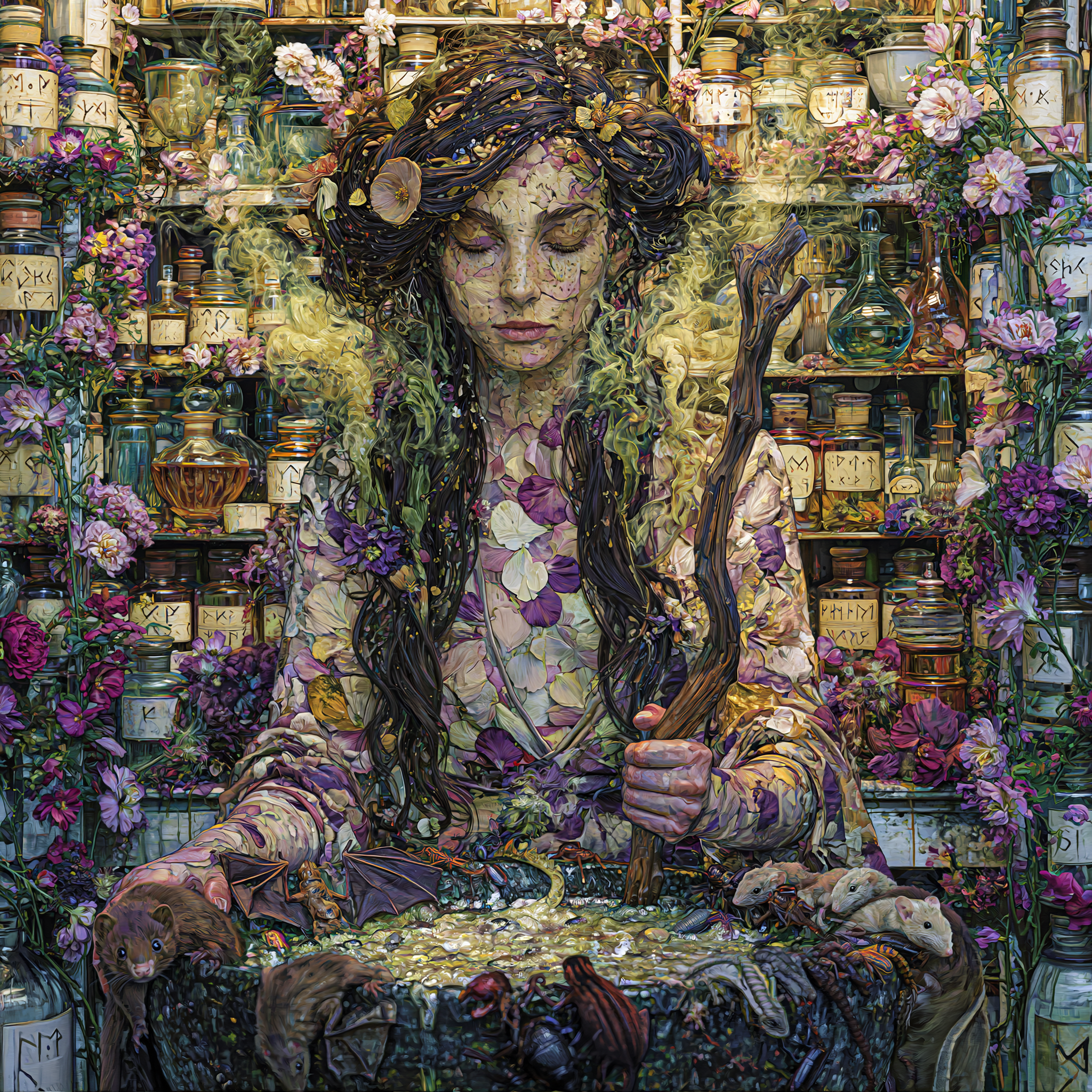
She keeps her post where the sense of smell hasn't been trained out of anyone yet, this one they call, for lack of any better name yet, the Smell Witch — python-quiet, ground-level, reading a visitor by scent before either of them has said a word. Whoever finds her has usually spent the walk down complaining about the birds they can't identify, the plants they can't name, the whole forest holding a conversation they've long since stopped being invited to. She doesn't teach identification. She puts a palm flat on the nearest bark and waits, unbothered, for the visitor's own hand to follow. A body doesn't have to be taught how to belong to a world it's made of. It only has to stop being told, long enough, that it doesn't.
"Humans are tuned for relationship," Abram wrote it plainly, once the argument had done its work: "the eyes, the skin, the tongue, ears, and nostrils — all are gates where our body receives the nourishment of otherness." Not one gate. Five, at minimum, every one of them still standing open even after four hundred years of trained inattention, waiting on nothing but a body willing to walk back through.
What comes back, once the gates are open again and the ground and the sky and the bark and the birdsong are all speaking, is a debt older than any of it — the animate earth gives breath, attention, water, food, and asks nothing in return except the same given back: breath, attention, ceremony, song, what Robin Wall Kimmerer calls reciprocity running at every scale life touches. Abram put the breath itself the plainest way of all: "it is not I, when asleep, who breathes, but 'some great lung outside myself which alternately calls forth and forces back my breath.'" Extraction without return is the one relationship a living system can't sustain indefinitely, and it's the only relationship the machine ever offered. Once the body remembers it lives inside a world that answers back, the throat finally has something worth opening for: one more voice joining a conversation that was carrying on long before it arrived, and will carry on after.